

US midterm elections 2026: What could the results mean for the dollar and Treasury yields?
The 2026 US midterm elections are becoming an increasingly important consideration for financial markets.
The 2026 US midterm elections are becoming an increasingly important consideration for financial markets. While the outcome will not change who occupies the White House, it could significantly influence President Donald Trump's ability to implement his economic agenda during the final two years of his presidency, with implications for the US dollar, Treasury yields and broader investor sentiment.
What's at stake on November 3?
The elections will take place on Tuesday, 3 November, with all 435 seats in the House of Representatives and 35 of the 100 Senate seats being contested. Republicans currently control both chambers, although their majority in the House is narrow. Democrats would need to gain control of the House and secure a net four additional Senate seats to take control of Congress.
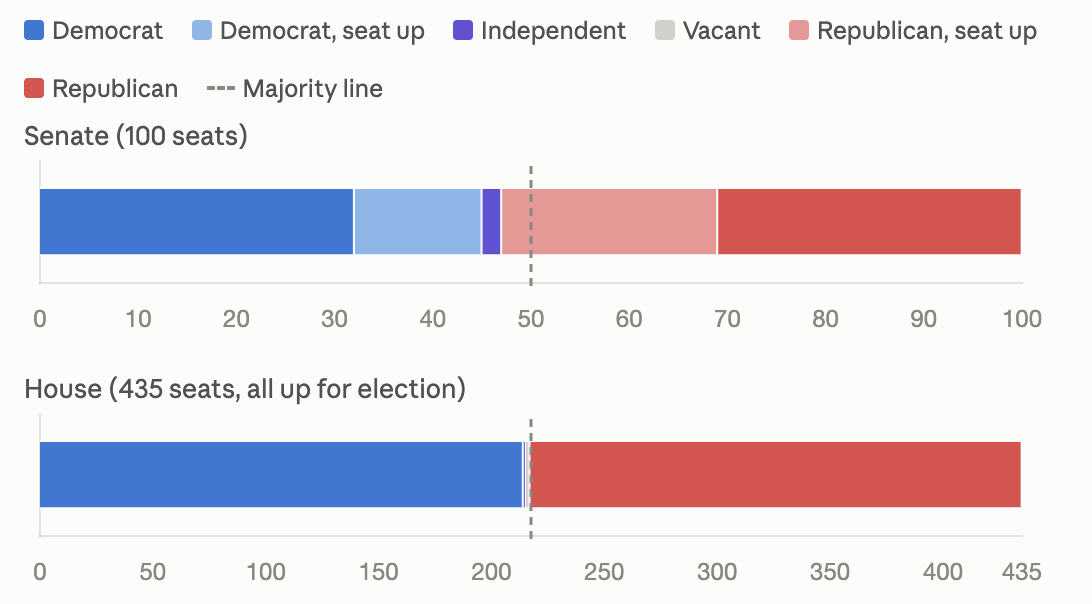
Source: ballotpedia
The elections come at a particularly sensitive moment for the US economy. Elevated energy prices, persistent inflation, concerns about fiscal sustainability and uncertainty surrounding trade policy have complicated the outlook for growth and monetary policy. For financial markets the key will be how the resulting balance of power could influence government spending, taxation, tariffs and the Federal Reserve's interest rate decisions.
Three broad scenarios could emerge, each carrying different implications for the dollar and US government bonds.
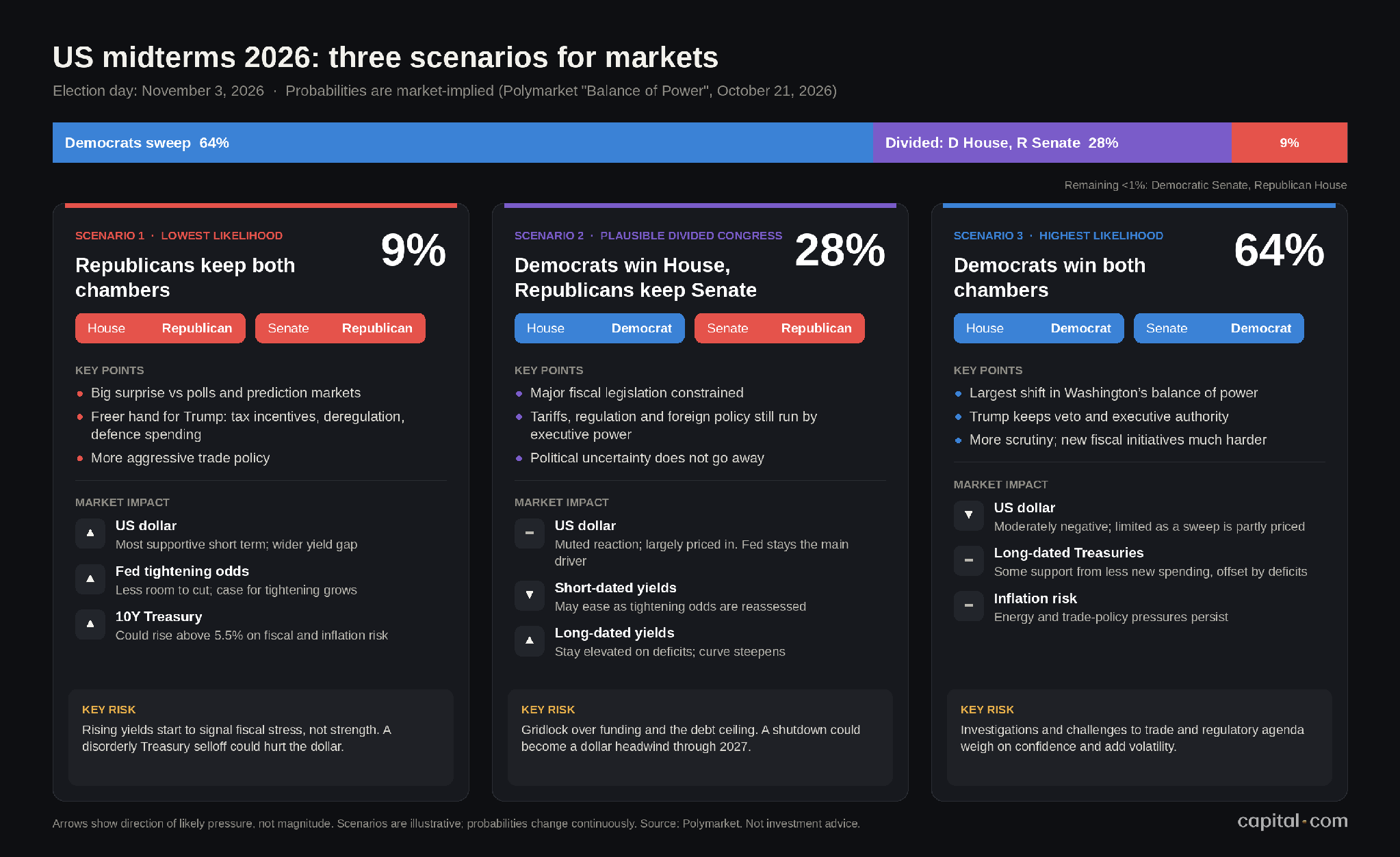
Source: polimarket, data as of October 21st
Scenario 1: Republicans retain control of both chambers
LOWEST MARKET-IMPLIED LIKELIHOOD
A Republican victory in both chambers would represent a significant surprise relative to current polling and prediction-market expectations. It would give President Trump greater freedom to pursue his economic agenda, potentially including further tax incentives, deregulation, increased defence spending and a more aggressive approach to trade policy.
From a market perspective, this scenario could be the most supportive for the US dollar in the short term. Expectations of looser fiscal policy could strengthen growth and inflation expectations, reducing the Federal Reserve's room to lower interest rates and potentially reinforcing the case for further tightening. Higher US yields relative to other major economies would generally favour the dollar, particularly against currencies with less supportive interest rate differentials.
However, the implications for Treasuries would be more complicated. Additional spending commitments could raise concerns about the already substantial US fiscal deficit, pushing longer-dated yields higher as investors demand greater compensation for holding government debt. As a result, the 10-year Treasury yield could rise above 5.5% under this scenario, reflecting a combination of inflation risks, fiscal pressures and expectations of tighter monetary policy.
The main risk for the dollar would be that rising yields eventually become a reflection of deteriorating fiscal confidence rather than economic strength. A disorderly selloff in Treasuries could undermine the currency's appeal, particularly if investors begin questioning the sustainability of US borrowing.
Scenario 2: Democrats win the House, Republicans retain the Senate
PLAUSIBLE DIVIDED-CONGRESS OUTCOME
A divided Congress would significantly constrain President Trump's ability to introduce major fiscal legislation, potentially limiting additional tax cuts or spending initiatives. However, the administration would retain considerable influence over foreign policy, tariffs and regulation through executive powers, meaning political uncertainty would not necessarily disappear.
For the dollar, this scenario could produce a relatively muted initial reaction, particularly given that investors have already been positioning for a Democratic takeover of the House. Reduced expectations of fiscal expansion could ease some inflation concerns, but the Federal Reserve's policy outlook would likely remain the dominant driver of currency movements.
Treasury yields could see a more differentiated response. Shorter-dated yields might ease as investors reassess the likelihood of further monetary tightening, while longer-dated yields could remain elevated because of persistent fiscal deficits and concerns about government borrowing. This could contribute to a steepening of the yield curve, although the direction would depend heavily on incoming inflation and employment data.
The biggest longer-term risk would be political gridlock over government funding and the debt ceiling. While divided government can sometimes reassure investors by limiting fiscal expansion, prolonged budget negotiations or another government shutdown could undermine confidence in US policymaking. The dollar might initially benefit from reduced fiscal stimulus expectations being offset by continued Fed caution, but political confrontation could become a more significant headwind as 2027 progresses.
Scenario 3: Democrats win both the House and Senate
HIGHEST MARKET-IMPLIED LIKELIHOOD
A Democratic takeover of both chambers would represent the most substantial shift in Washington's political balance. Although President Trump would retain veto powers and executive authority, a Democratic-controlled Congress could impose greater scrutiny on the administration and make it considerably harder to advance new fiscal initiatives.
For the dollar, the immediate reaction could be moderately negative as markets price in reduced prospects for additional fiscal stimulus and greater political constraints on the administration. However, any weakness may be limited by the fact that a Democratic sweep is already reflected to some extent in market expectations.
The implications for Treasury yields are less straightforward. Reduced prospects for new deficit-financed spending could provide some support for government bonds, particularly at longer maturities. Nevertheless, the existing fiscal deficit would remain substantial, and political confrontation could complicate efforts to address structural borrowing pressures. Meanwhile, inflation risks stemming from energy prices and trade policy would not necessarily disappear. Overall, persistent inflation and fiscal concerns may outweigh any immediate relief from tighter legislative constraints.
An additional consideration is the potential for increased political uncertainty. A Democratic-controlled Congress could intensify investigations into the administration and challenge aspects of its trade and regulatory agenda. This could weigh on business confidence and introduce another source of volatility for the dollar and Treasuries.
What are markets currently pricing in?
Polling and market expectations currently point to a strong likelihood that Democrats will gain control of the House, while the Senate remains more competitive. The important distinction for investors is between an outcome that has already been largely anticipated and one that forces markets to reassess their assumptions. A Republican sweep could generate the largest immediate repricing of Treasury yields and the dollar, whereas a Democratic victory in both chambers may produce a more measured response.
The bigger picture: Will the elections change the dollar's direction?
Ultimately, the midterms are unlikely to replace inflation, Federal Reserve policy and economic growth as the main drivers of the US dollar and Treasury yields. However, they could alter the fiscal and political backdrop against which those factors operate.
The relationship between the dollar and Treasury yields will be particularly important. Higher yields driven by stronger growth and expectations of tighter monetary policy would generally support the dollar. But if yields rise primarily because of fiscal sustainability concerns, the relationship could become less reliable, with investors demanding greater compensation for holding US assets.
The most significant market reaction may therefore come not from the election result itself, but from how it changes expectations for the next two years of US economic policy. With the Treasury market already sensitive to inflation and borrowing pressures, any outcome that increases uncertainty around government finances or the Fed's policy path could amplify volatility.
For now, investors appear to be positioning for greater constraints on the Trump administration. Whether that translates into a weaker dollar, lower yields or simply a period of political gridlock will depend on how the election result interacts with the underlying economic outlook.