

Michael Kramer: SpaceX's IPO Lock-Up Calendar and Why It Matters
The SpaceX IPO brought with it a calendar of lock-up dates that give insiders an opportunity to sell the shares they privately own.
A lock-up expiration date allows insiders and major shareholders to sell their shares after an IPO. However, other restrictions still apply, including registration requirements and restrictions on affiliates.
This process can increase the float, which is the total number of shares available to trade on a given day. When the float increases, supply rises; if demand doesn’t rise with it, the balance between buyers and sellers shifts.
Given the structure of SpaceX’s IPO, several lock-up dates have already occurred, and others are still due, which may increase the stock's float. In fact, some of its shares have already been released.
The Lock-Up Expiration Dates
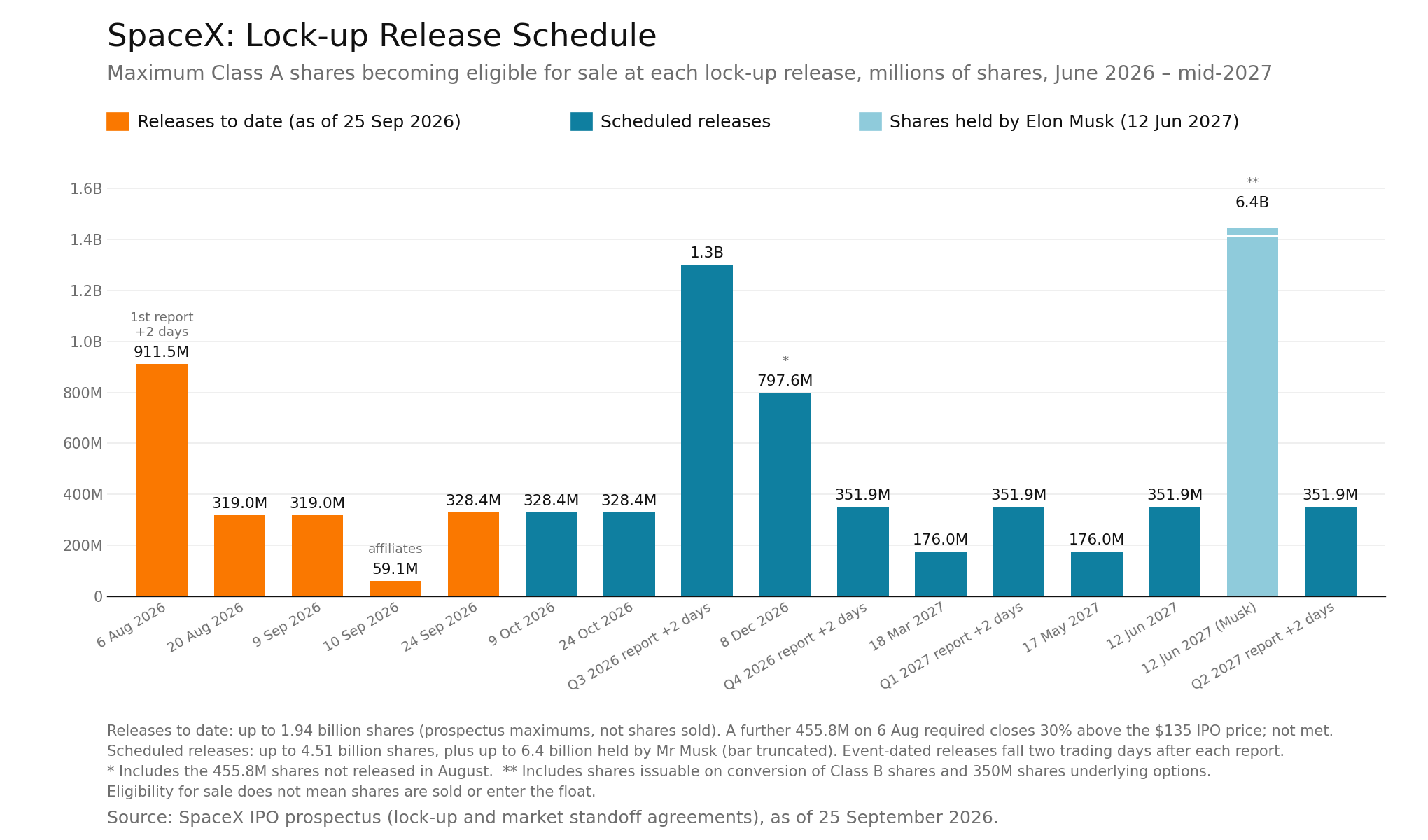
Under the lock-up schedule in the SpaceX prospectus filed with the Securities and Exchange Commission, the largest release so far came on 6 August, the second trading day after the company’s first earnings report on 4 August, when up to 911.5 million shares became eligible for sale. Two tranches of stock also became available to trade on 20 August and 9 September, with each lock-up freeing up to 319 million shares, representing 7% of the shares subject to the 180-day lock-up. Additionally, on 10 September, up to another 59.1 million shares held by affiliates were released.
A further release of up to 328.4 million shares came on 24 September, and the schedule continues with releases of the same size on 9 October and 24 October, but one of the bigger release days comes on the second full trading day following the company’s earnings report for the quarter ending 30 September. Given that the company last reported results on 4 August, the next report is likely to come during the first week of November, when up to an additional 1.3 billion shares would be released. After that earnings-related release in November, the pace slows again until 12 June 2027, when up to 6.4 billion shares held by Elon Musk, plus up to an additional 351.9 million shares held by others, become eligible for sale. A final release of up to 351.9 million shares is scheduled after the second-quarter 2027 results.
What Are the Impacts of Lock-Up Expiration?
None of this means all these shares will be sold, so the market impact is unclear, given the wide range. But over time the pool of shares eligible for sale does increase, and those shares may come to market.
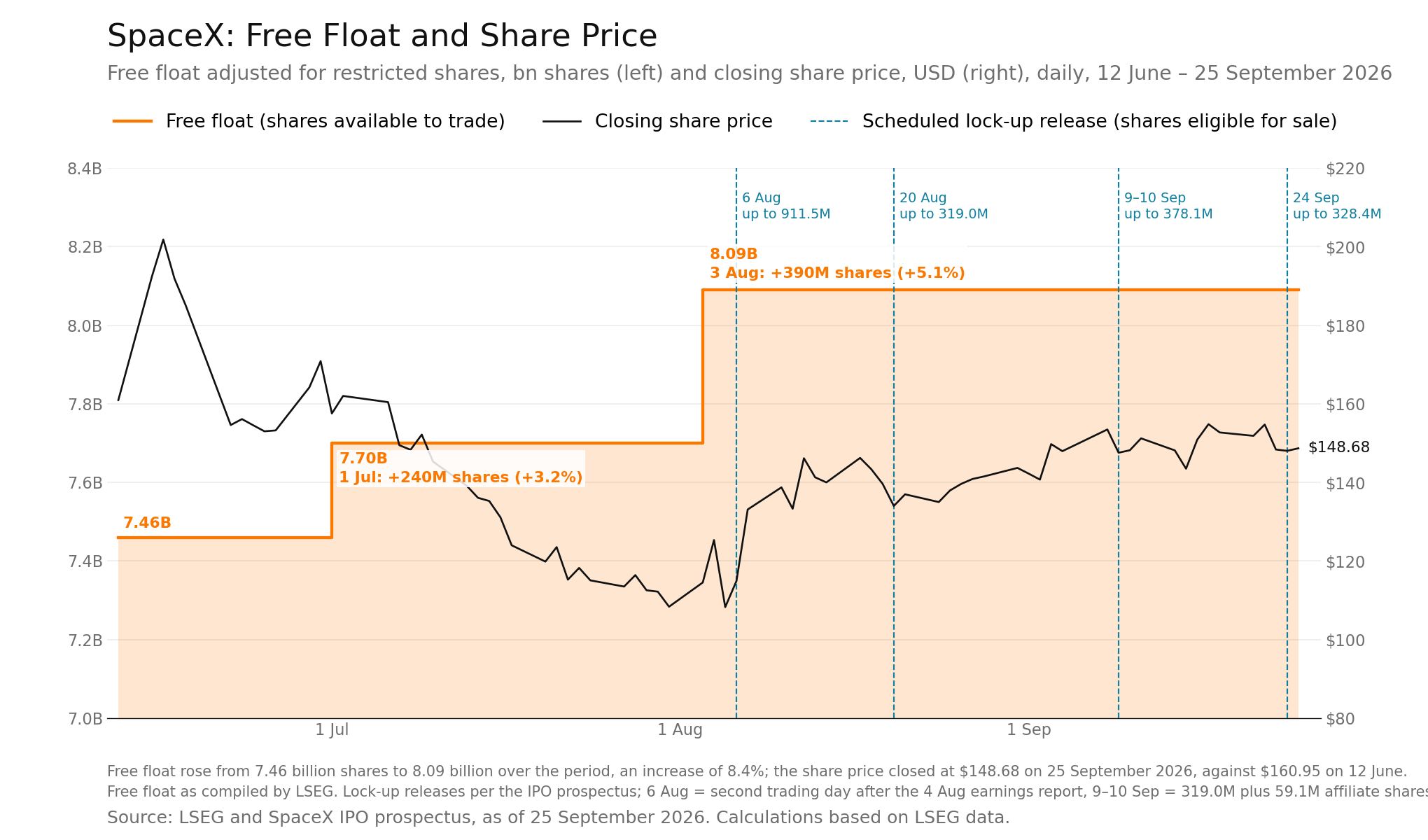
So far, LSEG's float estimate has risen from 7.46 billion shares to around 8.09 billion, with the increases on 1 July and 3 August. However, the lock-up expiries have freed up to about 1.94 billion shares to be sold, based on the prospectus figures, though that is the amount allowed to be sold, not the amount actually sold. More expiries are still to come. Therefore, LSEG's float estimates may not match the lock-up expiry totals.
(Past performance is not a reliable indicator of future results)
The interesting thing is that the stock's market cap, as compiled by LSEG, has increased despite the stock price falling since its first days of trading. That is because the share count LSEG uses has increased along with the free float. This means the value has increased, but not because the stock price has risen.
That means that, going forward, as more shares enter the market, the market capitalisation as compiled by LSEG can continue to rise as the implied share base rises, and not necessarily because the stock price is rising. In fact, the stock could fall, and if the increase in that share base offsets the decline in price, the market capitalisation may not change.
(Past performance is not a reliable indicator of future results)
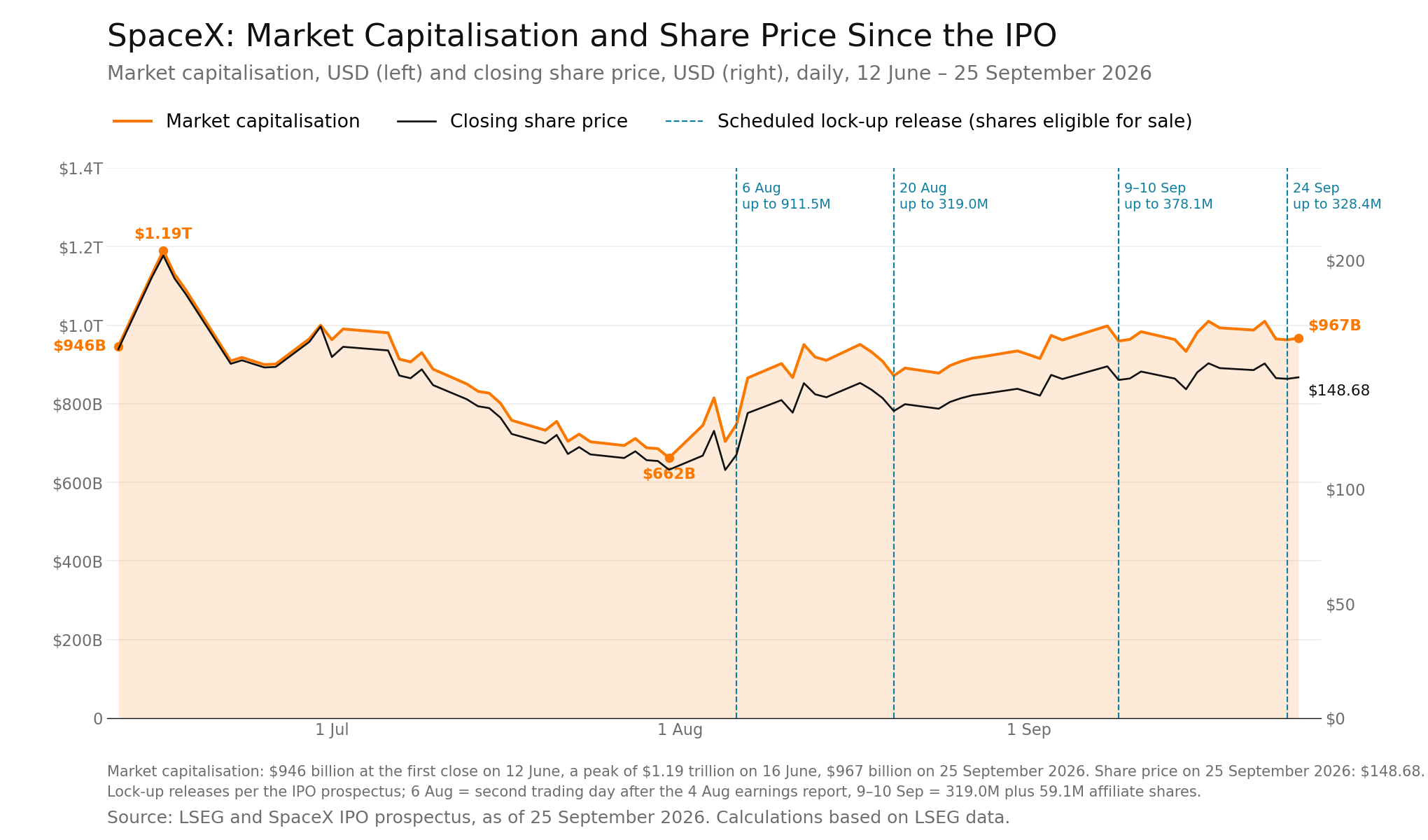
The interesting thing is that the stock's market cap, as compiled by LSEG, has risen faster than the share price alone would explain. Part of that increase reflects the recovery in the price since early August, but part of it comes from the larger share count LSEG now uses as the free float has grown. The releases to date have not been accompanied by a sustained fall in the share price. Between a low of around $110 in early August and 25 September, when the stock closed at $148.68, the shares rose even as several tranches became eligible for sale. Future releases are larger and past price behaviour is not a reliable guide to what happens next.