

Rocket Lab stock forecast: Iridium acquisition equity funding
Rocket Lab is a US space company listed on Nasdaq. On 15 September, it completed a $1.944bn equity offering to fund its pending acquisition of Iridium Communications. Explore third-party RKLB price targets. Past performance is not a reliable indicator of future results.
Rocket Lab Corporation (RKLB) traded at $63.93 at 9:52am UTC on 16 September 2026, within an intraday range of $61.79–$64.75. Past performance is not a reliable indicator of future results.
Trading followed Rocket Lab’s announcement that it had completed a $1.944bn at-the-market equity offering through 29.3 million shares to fund its pending acquisition of Iridium Communications. The company also terminated a $3.6bn bridge-financing commitment. The acquisition remains subject to regulatory approvals and is expected by Rocket Lab to close in mid-2027 (Rocket Lab, 15 September 2026).
Rocket Lab also completed its 16th Electron mission of 2026 on 11 September, taking the total number of Electron launches to 95 (Yahoo Finance, 11 September 2026).
Third-party RKLB outlook: Iridium funding, Neutron execution
As of 16 September 2026, third-party Rocket Lab stock predictions range from $80–$150, reflecting different assumptions around Neutron development, contract growth and the pending Iridium acquisition. These are third-party valuation estimates rather than expected outcomes.
Raymond James (individual price target)
Raymond James initiated coverage with an Outperform rating and an $80 target, around 29% above the roughly $62 share price cited at the time. Analyst Brian Gesuale pointed to Rocket Lab’s revenue growth and expanding launch cadence (Yahoo Finance, 11 September 2026).
Berenberg Bank (individual price target)
Berenberg initiated coverage with a Buy rating and an $83 target. Analyst Michael Filatov cited the potential growth of the global space market and Rocket Lab’s vertically integrated launch and constellation model (Investing.com, 2 September 2026).
Bank of America (individual price target)
Bank of America cut its target to $110 from $115 while maintaining a Buy rating. The revision reflected near-term execution risk alongside a positive longer-term view of the space sector (MarketBeat, 1 September 2026).
Cantor Fitzgerald (individual price target)
Cantor Fitzgerald raised its target to $122 from $96 while maintaining an Overweight rating. The revision followed Rocket Lab’s second-quarter revenue of approximately $234.1m, a company record that exceeded consensus estimates (Investing.com, 2 September 2026).
Stifel (individual price target)
Stifel held the highest target in this selection at $150. Analyst Erik Rasmussen cited Rocket Lab’s growing backlog as a potential counterweight to uncertainty around rocket testing and development (24/7 Wall St., 8 September 2026).
Predictions and third-party forecasts are inherently uncertain, as they cannot fully account for unexpected market developments. Past performance is not a reliable indicator of future results.
Rocket Lab upcoming and latest earnings
Rocket Lab reported second-quarter 2026 results on 10 August. Revenue reached a record $234.1m, up 62% year on year and 16.8% sequentially, including $189.5m from Space Systems.
GAAP gross margin reached 36.1%, above guidance of 33%–35%, while the GAAP net loss narrowed to $49.3m, or $0.08 per share, from $66.4m, or $0.13 per share, a year earlier. Adjusted EBITDA loss was $8.8m, compared with guidance for a $20m–$26m loss, while backlog stood at $2.36bn (Rocket Lab, 10 August 2026).
For the third quarter, Rocket Lab published guidance for revenue of $250m–$265m, GAAP gross margin of 29%–31% and non-GAAP gross margin of 35%–37%. It also expects an adjusted EBITDA loss of $17m–$23m, GAAP operating expenses of $143m–$149m and non-GAAP operating expenses of $121m–$127m.
As of 16 September 2026, Rocket Lab’s investor-relations calendar doesn’t list a date for third-quarter results.
Rocket Lab stock price: technical overview
The RKLB stock price traded at $63.93 at 9:52am UTC on 16 September 2026, above its 10-day simple moving average near $63 but below its 20-, 50-, 100- and 200-day averages near $67, $71, $89 and $80 respectively.
The 14-day relative strength index stood at 39.79, below the 50 midpoint but above the conventional 30 oversold threshold. The average directional index was 21.17, below the 25 level often associated with an established trend. MACD at −3.36 and momentum at −0.37 were also negative, although these indicators don’t predict future direction on their own.
Higher technical references included the central pivot at $70.97 and R1 at $79.78, which sits close to the 200-day simple moving average area. Below the quoted price, the Hull moving average stood near $62.42, close to the intraday low of $61.79, while S1 at $55.12 provided a lower reference (TradingView, 16 September 2026).
These levels are technical reference points rather than indications of where RKLB will move next.
This is technical analysis for informational purposes only and does not constitute financial advice or a recommendation to buy or sell any instrument.
RKLB share price history (2024–2026)
RKLB’s stock price traded near $7.19 on 17 September 2024 before rising through the final quarter. The stock moved from $9.25 at the start of October to $27.30 on 29 November, ending 2024 at $25.48.
In early 2025, RKLB moved mostly between $17–$31, closing at $30.38 on 24 January before falling to $17.14 on 10 March. The shares later recovered from $16.41 on 4 April to $30.08 on 20 June, before reaching $77.57 on 22 December.
RKLB began 2026 at $76.05 and fell to $57.44 on 30 March before rallying to a two-year high of $150.28 on 27 May. It traded above $100 during parts of June before retreating over the following months.
As of 9:52am UTC on 16 September 2026, RKLB traded near $63.93. The quoted level was around 11.0% below the $71.87 close a year earlier, while remaining well above its September 2024 level.

Past performance is not a reliable indicator of future results. Share prices are indicative and may differ from live market prices.
Rocket Lab (RKLB): Capital.com analyst view
Rocket Lab’s shares have moved across a wide range over the past two years, rising from single digits in late 2024 to $150.28 in May 2026 before trading near $63.93 in mid-September.
Several factors could influence the price in either direction. Continued Electron launches, backlog growth, new defence contracts or progress on Neutron could support revenue expectations. Delays to Neutron, weaker contract activity or higher development costs could weigh on them instead.
The pending Iridium acquisition adds another variable – successful integration could broaden Rocket Lab’s business and revenue base, while regulatory delays, integration costs or execution challenges could increase uncertainty. The $1.944bn equity offering provides acquisition funding but also increases the number of shares outstanding, which may affect per-share valuation.
Rocket Lab’s latest results showed record revenue, a narrower net loss and backlog of $2.36bn. Further revenue growth or improving margins could support expectations, while a wider-than-expected loss, higher costs or slower execution could put pressure on valuation.
Capital.com’s client sentiment for Rocket Lab CFDs
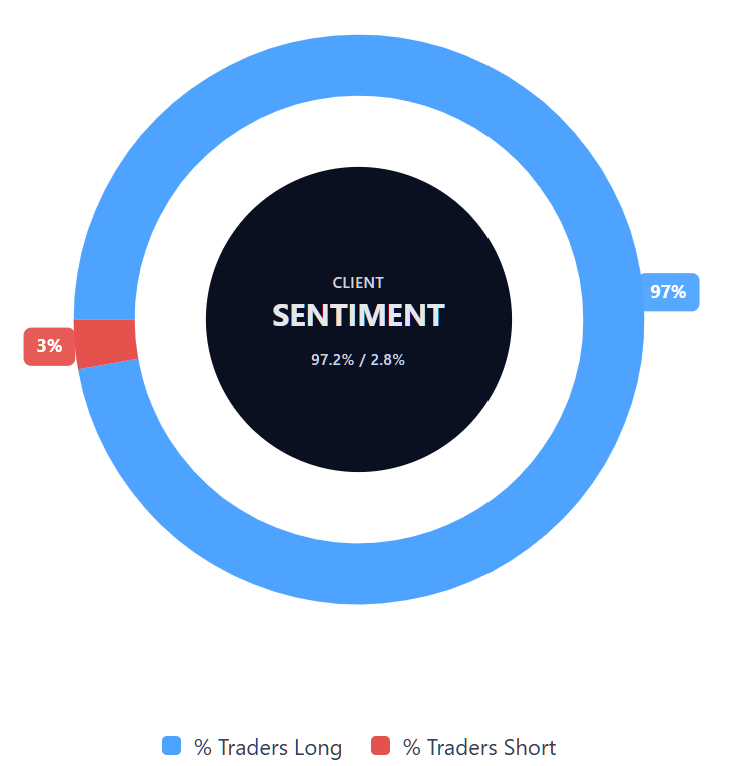
As of 16 September 2026, Capital.com client positioning in Rocket Lab CFDs shows 97.2% buyers and 2.8% sellers, a difference of 94.4 percentage points. This reflects open positions at the time captured, can change and does not indicate future price direction.
Summary – Rocket Lab 2026
- As of 9:52am UTC on 16 September 2026, RKLB traded near $63.93 within an intraday range of $61.79–$64.75.
- On TradingView, technical readings placed the stock below its 20-, 50-, 100- and 200-day moving averages, with RSI at 39.79 and ADX below 25.
- Key influences include the Iridium acquisition and its financing, Neutron development, defence and launch contracts, and earnings performance.
- Successful launches, backlog growth, stronger margins or progress on the acquisition could support expectations, while development delays, integration risks, dilution or higher costs could weigh on them.
- Recent developments include the $1.944bn equity offering, continued Electron launches and analyst targets ranging from $80–$150.
Past performance is not a reliable indicator of future results.
FAQ
Who owns the most Rocket Lab stock?
This article does not identify Rocket Lab’s largest shareholder, as its focus is on share-price performance, earnings, analyst forecasts and recent company developments. Investors looking for current ownership data should check Rocket Lab’s latest regulatory filings and shareholder disclosures, as institutional and insider holdings can change over time. Ownership data may provide context around voting influence or investor concentration, but it does not indicate how RKLB shares will perform.
What is the five-year Rocket Lab share price forecast?
The forecasts covered here do not provide a reliable five-year RKLB stock forecast. The cited analyst targets are mainly shorter-term estimates ranging from $80–$150. Longer-term performance could depend on Neutron development, launch cadence, defence contracts, margins and the integration of Iridium Communications. Forecast uncertainty generally increases over longer periods, so these targets should be viewed as third-party valuation scenarios rather than expected future prices.
Is Rocket Lab a good stock to buy?
Whether Rocket Lab is suitable to buy depends on an individual’s objectives, financial circumstances and tolerance for risk. Recent results showed record revenue, a narrower net loss and a $2.36bn backlog, while analysts cited targets ranging from $80–$150. Potential support could come from successful launches, Neutron progress and contract growth, while development delays, higher costs, dilution or integration challenges related to Iridium could weigh on the shares.
Could Rocket Lab stock go up or down?
Yes. Rocket Lab shares can move in either direction as company and market conditions change. Continued Electron launches, backlog growth, new contracts, improving margins or progress on Neutron and the Iridium acquisition could support expectations. Conversely, launch delays, weaker contract activity, higher development costs, acquisition-integration issues or further dilution could weigh on valuation. Broader sentiment towards space, defence and growth stocks may also influence RKLB independently of company-specific developments.
Should I invest in Rocket Lab stock?
Whether to invest in Rocket Lab depends on your personal circumstances, objectives and attitude to risk. Factors to consider include the company’s revenue growth, losses, backlog, Neutron development, contract pipeline, acquisition strategy and share issuance. Analyst targets vary widely, reflecting uncertainty around execution and long-term demand. Past performance and third-party forecasts are not reliable indicators of future returns and should not be treated as investment recommendations.
Can I trade Rocket Lab CFDs on Capital.com?
Yes, you can trade Rocket Lab CFDs on Capital.com. Trading share CFDs lets you speculate on price movements without owning the underlying asset and to take long or short positions. However, contracts for difference (CFDs) are traded on margin, and leverage amplifies both profits and losses. You should ensure you understand how CFD trading works, assess your risk tolerance, and recognise that losses can occur quickly.