

Cardano price prediction: Dijkstra testnet and Node 11.2.0
Cardano's Node 11.2.0 pre-release became available on 28 October 2026, supporting Dijkstra testnet testing but excluding Leios. The build is not recommended for mainnet use. Explore third-party ADA price targets and technical analysis. Past performance is not a reliable indicator of future results.
Cardano (ADA/USD) traded at $0.190893 at 10:29am UTC on 4 November 2026, near the upper end of an intraday range of $0.184289–$0.191968. Past performance is not a reliable indicator of future results.
Third-party Cardano outlook: Dijkstra testing and Atlas beta launch
As of 4 November 2026, third-party ADA price predictions include algorithmic estimates, scenario ranges and conditional outlooks. These forecasts do not represent a broker consensus or investment recommendations.
Cardano price prediction 2026
- CoinCodex forecasts approximately $0.1597 by 31 December 2026 (Blockchain.News, 31 October 2026).
- GODEX.io models a 2026 base case of $0.42, with a bearish scenario of $0.18 and a bullish scenario of $0.85 (GODEX.io, 30 October 2026).
- CryptoTicker estimates a 2026 average of $0.25539, within a range of $0.17026–$0.3651 (CryptoTicker, 3 November 2026).
- TokenSonar forecasts a November 2026 average of $0.197, within a range of $0.154–$0.252 (TokenSonar, 31 October 2026).
- Changelly projects a November 2026 range of $0.174–$0.198, suggesting relatively limited upside from the quoted price (The Crypto Basic, 2 November 2026).
Cardano price prediction 2027
- CoinCodex projects a December 2027 range of $0.1056–$0.1168, with an average of approximately $0.1111 (CoinCodex, 4 November 2026).
- CryptoTicker estimates a 2027 average of $0.2937, within a range of $0.1277–$0.5659 (CryptoTicker, 3 November 2026).
- TokenSonar projects a 12-month base case of $0.219 by October 2027 (TokenSonar, 31 October 2026).
Cardano price prediction 2030
- CoinCodex forecasts ADA at approximately $0.09531 by the end of 2030, based on its algorithmic model (CoinCodex, 4 November 2026).
- CryptoTicker forecasts a 2030 average of $0.37993, within a wide range of $0.060783–$1.4401 (CryptoTicker, 3 November 2026).
- TokenSonar extends its longer-term forecast to October 2031, with a five-year base case of $0.224 (TokenSonar, 31 October 2026).
Cardano technical analysis
The ADA/USD price traded at $0.190893 at 10:29am UTC on 4 November 2026, below its key daily simple moving averages (SMAs). TradingView placed the 50-day SMA near $0.229 and the 200-day SMA near $0.209 in its 4 November snapshot.
The 14-day relative strength index (RSI) stood at 33.8, within neutral territory but approaching the conventional oversold threshold of 30. The 14-day average directional index (ADX) read 33.2, indicating an established trend without specifying its direction. The 200-day exponential moving average (EMA) also stood above the quoted price, near $0.20.
On the upside, the daily classic R1 level near $0.1932 provides an initial resistance reference. On the downside, the daily pivot at approximately $0.1893 and S1 at $0.1860 mark potential support levels. These levels are based on the previous completed daily candle and may change with subsequent price movements (TradingView, 4 November 2026).
This is technical analysis for informational purposes only and does not constitute financial advice or a recommendation to buy or sell any instrument.
Cardano price history (2024–2026)
ADA/USD began November 2024 near $0.34 before climbing above $1.00 in early 2025. Prices subsequently fell toward $0.60 by mid-year, before recovering to around $1.02 in August. ADA then declined through the final months of 2025, closing the year near $0.33.
In 2026, ADA opened near $0.36 and peaked above $0.42 in mid-January before retreating toward $0.25 by late February. A recovery in March lifted prices toward $0.29, but the gains faded through April and May, when ADA fell back toward $0.24. Prices declined further in June, touching approximately $0.15 before stabilising near $0.18 by July.
ADA recovered toward $0.29 in August before giving back those gains through September and October, ending October near $0.19.

Past performance is not a reliable indicator of future results. Prices are indicative and may differ from live market prices.
Latest ADA news and market updates
Network updates and partnerships
Cardano's Node 11.2.0 pre-release supports testing for the Dijkstra upgrade, with Leios expected in Node 11.3. The 11.2.0 build is not recommended for mainnet use (Intersect, 30 October 2026; GitHub, 28 October 2026). Atlas launched a stablecoin-backed perpetual-futures venue on Cardano on 2 November (TokenPost, 2 November 2026), while the Cardano Foundation partnered with Tokyo-based Pacific Meta to explore enterprise blockchain applications in Japan (CoinMarketCal, 1 October 2026).
Upcoming Cardano milestones
CoinMarketCal lists Amaru Block Production on 5 November as an upcoming network milestone, followed by the Node 11.3 pre-release (CoinMarketCal, accessed 4 November 2026). The Atlas launch comes amid lower trading activity across major decentralised perpetual-futures venues, with notional volume among the 12 largest platforms falling from $2 trillion in Q1 2026 to $1.7 trillion in Q2 (TokenPost, 16 October 2026).
Capital.com analyst view – Cardano analysis
Network upgrades and wider adoption could support demand for ADA, although their effect on the token's price is uncertain. Competition from other smart-contract platforms, regulatory developments and changes in market access could also influence its outlook.
Improving cryptocurrency market sentiment may support prices, while weaker demand or renewed market volatility could put pressure on ADA. Cardano's price history shows substantial movements in both directions, and past performance is not a reliable indicator of future results.
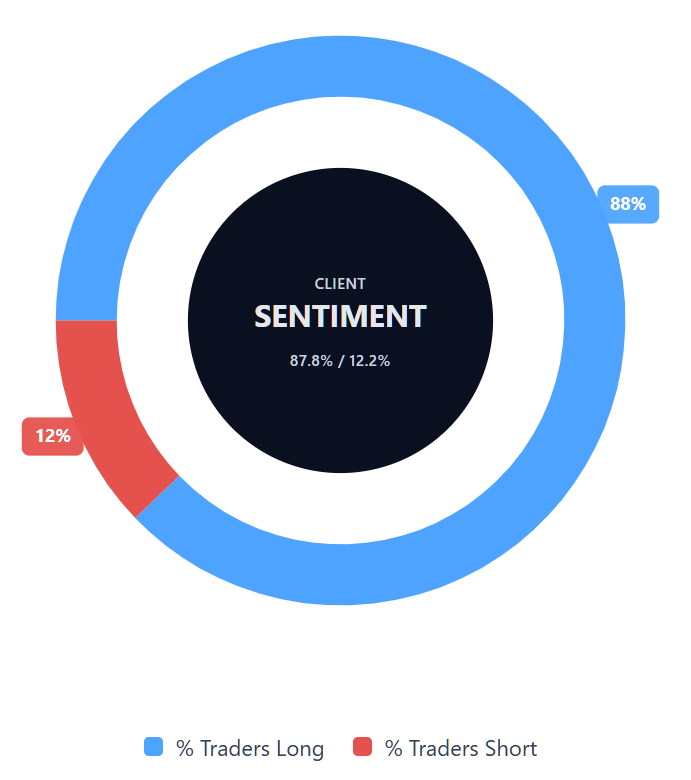
Capital.com’s client sentiment for Cardano CFDs
As of 4 November 2026, Capital.com client positioning in Cardano CFDs shows 87.8% buyers and 12.2% sellers, a difference of 75.6 percentage points. These figures reflect open positions on Capital.com at the time of the snapshot and may change. They do not predict future price direction.
Summary – Cardano (2026)
- Cardano (ADA) traded at $0.190893 at 10:29am UTC on 4 November 2026, within an intraday range of $0.184289–$0.191968.
- According to TradingView data, technical readings placed the 14-day RSI at 33.8, above the conventional oversold threshold, while the 14-day ADX of 33.2 indicated an established trend.
- Potential price drivers include network upgrades, adoption, competition from other smart-contract platforms, regulatory developments and broader cryptocurrency market conditions.
- Recent news includes the Node 11.2.0 pre-release for Dijkstra testing, Atlas's perpetual-futures launch and the Cardano Foundation's partnership with Pacific Meta in Japan.
Past performance is not a reliable indicator of future results.