
Xiaomi stock forecast: Third-party price targets
Xiaomi’s share price remains a focus for traders following the Hong Kong technology sector.
Xiaomi (1810) was quoted around $40.31 HKD in intraday Hong Kong dealing on 3 December 2025 at 1:52pm UTC, between an intraday low of $40.07 HKD and a high of $41.09 HKD. Past performance is not a reliable indicator of future results.
The stock is trading amid broader softness in Hong Kong tech benchmarks, with the Hang Seng TECH Index easing at the open on 3 December 2025, while Xiaomi remains a constituent of the gauge (Hang Seng Index). Sentiment around the company is also shaped by ongoing corporate actions, including recently reported share buybacks and Hong Kong exchange disclosures on Xiaomi’s Class B share capital, alongside ongoing focus on the group’s smartphone, Internet of Things and electric vehicle businesses (MarketScreener, 3 December 2025).
Past performance is not a reliable indicator of future results.
Xiaomi stock forecast 2026–2030: Analyst price target view
As of 3 December 2025, third-party Xiaomi price forecasts reflect differing views on the company’s execution in smartphones, Internet of Things (IoT) and electric vehicles (EVs).
Goldman Sachs (12-month target)
Goldman Sachs trimmed its Xiaomi 12-month target price to about $53.50 HKD, while maintaining a positive rating stance on the stock. The broker cites cost pressures, including rising component and memory expenses, while also noting stronger-than-expected Q3 2025 revenue and adjusted net profit growth supported by higher AIoT margins and investment income (Investing.com, 19 November 2025).
CMBI (funding and growth case)
China Merchants Bank International (CMBI) outlines a Xiaomi target price in the mid-$50s HKD region in an October 2025 report, embedding assumptions about EV expansion, R&D and capex through 2025. The research adds that additional funding and balance-sheet flexibility are expected to support EV capacity, smartphone development and AIoT investment, with valuation cross-checks against global peers and Xiaomi’s historical multiples (CMBI, 27 October 2025).
TradingView aggregated forecast (consensus range)
A TradingView compilation reports an average 12-month price target for Xiaomi near $56–$57 HKD, with individual analyst estimates spanning roughly $41–$80 HKD. The platform notes that this range reflects differing expectations on revenue growth, profitability and EV execution, supported by a broad analyst base contributing to the compiled forecast (TradingView, 26 October 2025).
TipRanks compiled Wall Street view
TipRanks’ Xiaomi summary updated in early December 2025 shows an average 12-month price target of about $55.30 HKD, with a high estimate close to $71.03 HKD and a low near $44.93 HKD based on 27 analysts over the prior three months. The service indicates that most contributing analysts carry buy-leaning recommendations, amid expectations linked to further scale-up in EV, AI and overseas smartphone markets (TipRanks, 3 December 2025).
DBS (fundamental valuation marker)
DBS maintains a Xiaomi target price around $70 HKD in an equity research note, positioning the stock within its broader China technology coverage. The bank points to Xiaomi’s ecosystem strategy and potential EV contribution as medium-term drivers, while also referencing competitive dynamics and macro conditions in its earnings and valuation assumptions (DBS, 20 November 2025).
Predictions and third-party forecasts are inherently uncertain, as they cannot fully account for unexpected market developments. Past performance is not a reliable indicator of future results.
Xiaomi stock price: Technical overview
Xiaomi (1810) is trading near $40.31 HKD as of 1:52pm UTC on 3 December 2025, sitting just below the classic pivot at $40.91 HKD and inside the intraday range defined by the day’s earlier high and low. The simple moving-average cluster on the daily chart is broadly above spot, with the 20/50/100/200-day SMAs around $41.0 HKD / $46.4 HKD / $50.5 HKD / $51.1 HKD respectively, keeping price in a corrective phase below its medium- and longer-term trend band. The 14-day RSI near 39.3 sits in the lower-neutral zone, while an ADX reading around 34 signals an established trend backdrop rather than range-bound conditions.
On the topside, the first area to watch is the classic R1 pivot near $45.19 HKD, with R2 up toward $49.37 HKD, which would come back into focus only if a sustained daily close develops above the initial resistance zone. On pullbacks, initial support is aligned with the $40.91 HKD pivot, followed by the 100-day SMA shelf near $50.5 HKD, while S1 down around $36.73 HKD would be the next notable reference if the market loses the current pivot area on a closing basis (TradingView, 3 December 2025).
This is technical analysis for informational purposes only and does not constitute financial advice or a recommendation to buy or sell any instrument.
Xiaomi share price history
Over the past two years, Xiaomi’s stock price (H-shares) have moved from the mid-teens into a higher trading band. The stock closed at $14.75 HKD on 5 December 2023 and then spent much of the first half of 2024 drifting between roughly $13 HKD and $20 HKD, before moving gradually higher into late summer as prices pushed through $20 HKD for the first time in this period. By December 2024, Xiaomi had almost doubled from its early-2024 levels, ending the year at $34.69 HKD on 31 December.
Momentum accelerated through 2025. Xiaomi climbed from around $34 HKD at the start of January 2025 to above $60 HKD by early July, with a closing high of $60.12 HKD on 2 July 2025, before easing back into the $40–$55 HKD range over the autumn. As of 3 December 2025, the share price stands at $40.31 HKD, meaning it is still well above its 2023–2024 lows but trading noticeably below the mid-year peak.

Past performance is not a reliable indicator of future results. Share prices are indicative and may differ from live market prices.
Capital.com analyst view
Xiaomi’s share price has staged a strong two-year recovery on the Hong Kong market, moving from the mid-$10s HKD in late 2023 to the high-$20s HKD by December 2024 and into the low-$40s HKD by early December 2025, with the stock also trading as high as the high-$50s HKD in October 2025. This trajectory reflects how investors have responded to a period of improving sentiment around Chinese technology names, together with Xiaomi’s own progress in smartphones, Internet of Things products and its push into electric vehicles, while noting that the price has recently eased back from its 2025 highs.
From a broader market perspective, Xiaomi has been trading against a backdrop of mixed global equity conditions, shifting macro expectations and ongoing competition in the smartphone space, which can all contribute to short-term volatility.
Capital.com’s client sentiment for Xiaomi CFDs
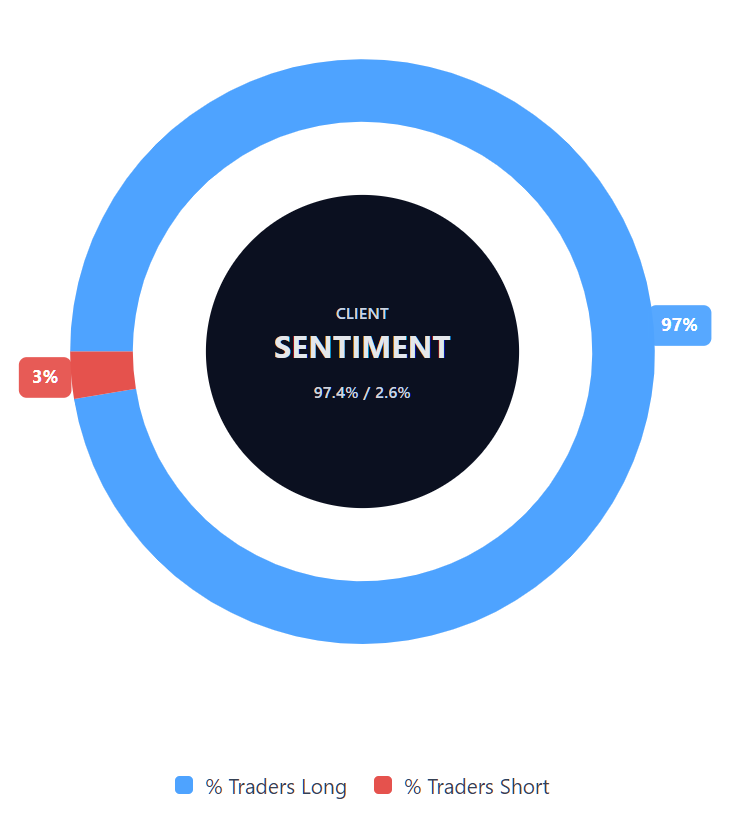
As of 3 December 2025, Capital.com client positioning in Xiaomi is one-sided toward longs, with buyers at 97.4% versus sellers at 2.6%, which puts buyers ahead by about 94.8 percentage points. This heavy-buy skew indicates that positioning is currently dominated by long exposure rather than being evenly balanced. This snapshot reflects open positions on Capital.com and can change over time.
Summary – Xiaomi price 2025
- Xiaomi’s share price has moved from the mid-$30s HKD to $40.31 HKD by early December 2025, after touching the high-$50s HKD earlier in the year and easing back into the low-$40s HKD range.
- Over the past 52 weeks, the stock has more than doubled from about $19 HKD, lifting its market value to around $1.05trn HKD by late 2025.
- Analyst and third-party data point to continued progress in earnings and growing EV and IoT contributions, alongside recent target adjustments and ongoing competitive pressures.
- Client sentiment on Capital.com remains skewed toward the long side, with 97.4% of open CFD positions held by buyers as of 3 December 2025.
- Technical readings show price trading below major moving averages, with intraday action fluctuating around the $40 HKD pivot in early December.
Past performance is not a reliable indicator of future results.
FAQ
Who owns the most Xiaomi stock?
Xiaomi’s largest shareholders are typically the company’s founders, senior executives and early institutional backers, alongside a broad mix of global asset managers that hold positions through index and active equity funds. Public disclosures through the Hong Kong Stock Exchange provide periodic updates on shareholdings, including changes to Class A and Class B share capital. These filings offer transparency around major ownership stakes, which may change over time in line with corporate actions, market conditions and portfolio rebalancing.
What is the 5-year forecast for Xiaomi stock?
Analysts generally publish 12-month forecasts rather than five-year projections, as shorter horizons allow them to anchor assumptions to current revenue trends, margin expectations and developments in the EV and IoT segments. Recent analyst targets for the next year range broadly from the low $50s HKD to around $70 HKD, reflecting differing views on Xiaomi’s execution, costs and competitive environment. Longer-term outcomes are uncertain and depend on a wide range of factors, including global technology conditions and product-cycle performance.
Is Xiaomi a good stock to buy?
Whether Xiaomi is a suitable investment depends entirely on an individual’s objectives, time horizon and risk tolerance. Analysts’ views vary, with some highlighting strengths in smartphones, AIoT and EV expansion, while others point to competitive pressures and fluctuating margins. It’s important to remember that share prices can move in either direction, and analysts’ opinions shouldn’t be interpreted as guarantees or recommendations. Anyone considering exposure to Xiaomi should ensure they understand the risks involved and review factual market information carefully.
Could Xiaomi stock go up or down?
Yes – like all publicly traded shares, Xiaomi’s stock can move in either direction. Its price is influenced by a mix of company-specific factors such as earnings, product performance and strategic developments, as well as broader market drivers including sentiment toward Chinese technology shares, macroeconomic conditions and sector competition. Recent trading shows that Xiaomi’s price has experienced periods of strength and periods of decline, reflecting how these variables interact over time.
Should I invest in Xiaomi stock?
Only you can determine whether Xiaomi fits your personal financial situation and risk appetite. The stock has shown notable price fluctuations over the past two years, influenced by shifts in sentiment toward the Chinese technology sector and Xiaomi’s progress across smartphones, IoT and EVs. Investing always involves the possibility of loss, and past performance is not a reliable indicator of future results. Reviewing clear, up-to-date information can help you understand the potential risks before making any decisions.
How can I trade Xiaomi stock CFDs on Capital.com?
On Capital.com, you can trade Xiaomi via CFDs, which let you speculate on price movements in either direction without owning the underlying shares. Contracts for difference (CFDs) on Capital.com also provide access to tools such as customisable charts, risk-management features like stop-losses* and real-time market data. CFDs are traded on margin, and leverage amplifies profits and losses.
*Standard stop-loss orders are not guaranteed. Guaranteed stop-loss orders (GSLOs) incur a fee if activated.