
Vossloh stock forecast: RTI acquisition expands digital rail
Vossloh is a German rail-infrastructure group that completed its acquisition of Rail Technology International on 15 September, expanding its digital inspection and analytics offering. Explore third-party VOS price targets. Past performance is not a reliable indicator of future results.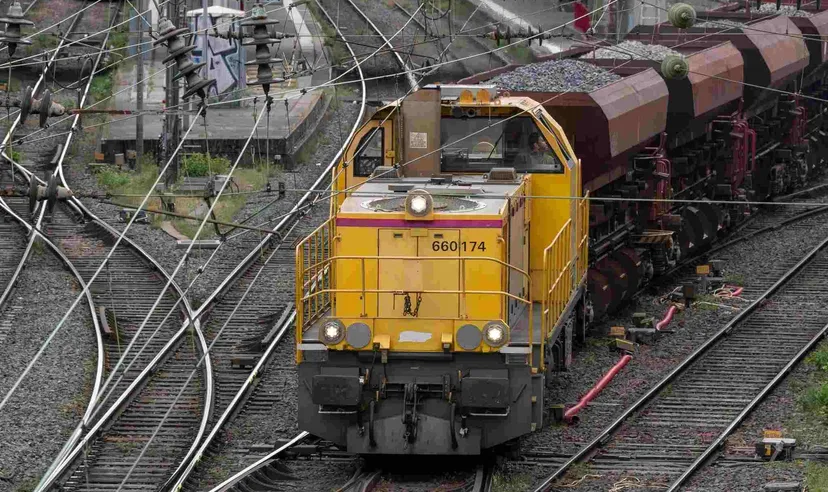
391232865981778 AG (VOS) traded around €57.81 at 8:21am UTC on 16 September 2026, at the top of its €55.99–€57.81 intraday range. Past performance is not a reliable indicator of future results.
The move followed Vossloh’s 15 September announcement that it had completed the acquisition of Australian automated rail-inspection specialist Rail Technology International – or RTI – adding to its condition-monitoring, data and analytics offering (Vossloh, 15 September 2026). It also came after DB InfraGO extended Vossloh’s preventive rail-maintenance framework agreement by one year on 8 September (EQS News, 8 September 2026). Separately, a 9 September voting-rights notice recorded 4.66% of voting rights and instruments attributable to Wellington Management Group as of 2 September.
Third-party VOS outlook: RTI deal and DB InfraGO extension
As of 16 September 2026, third-party Vossloh stock predictions put Vossloh price targets between €65 and €87. These figures are estimates of future share-price levels, not indications of where the price will move.
Finanzen.net (consensus target)
Finanzen.net reported an average analyst price target of €76 on 8 September 2026. Individual estimates may vary depending on assumptions around earnings, rail-infrastructure activity and order conversion (Finanzen.net, 8 September 2026).
IT-Boltwise (consensus target)
IT-Boltwise cited an average Vossloh target of €76 on 4 September 2026, alongside expected 2026 earnings per share of €2.57. Delivery and margin development were among the factors relevant to the outlook (IT-Boltwise, 4 September 2026).
Wallstreet Online (target range)
Wallstreet Online reported an average target of €79.67 across six analysts on 9 September 2026, with estimates ranging from €65–€87. The cited extract showed three Hold ratings but did not specify the remaining ratings (Wallstreet Online, 9 September 2026).
Ad-Hoc News (latest consensus check)
Ad-Hoc News cited an average Vossloh target of €76, with three Buy and three Hold recommendations, as of 14 September 2026. These estimates remain dependent on future financial performance and contract execution (Ad-Hoc News, 14 September 2026).
Predictions and third-party forecasts are inherently uncertain, as they cannot fully account for unexpected market developments. Past performance is not a reliable indicator of future results.
Vossloh earnings: latest results and next update
Vossloh published its first-half 2026 results in July. Revenue for the six months to 30 June rose 21.9% year on year to €710.1m from €582.6m. Orders received increased to €828.5m, while the order backlog reached a record €1,140.7m. The book-to-bill ratio was 1.17 (Vossloh, 23 July 2026).
EBITDA rose to €80.9m from €74.2m, although the EBITDA margin fell to 11.4% from 12.7%. EBIT declined to €32.4m from €44.9m, including €9.1m of purchase-price-allocation effects related to the Sateba acquisition. Net income fell to €13.5m from €34.7m, while earnings per share declined to €0.15 from €1.50.
Vossloh’s current 2026 guidance, revised on 13 July and reiterated with the half-year results, calls for revenue of €1.51bn–€1.61bn, EBITDA of €195m–€210m and EBIT of €100m–€110m.
As of 16 September 2026, the company’s next scheduled periodic update is its statement for the nine months to 30 September, expected in late October. The Cordel and RTI acquisitions have expanded Vossloh’s digital rail-inspection activities but did not change the stated 2026 guidance in the cited releases.
Vossloh stock price: technical overview
The VOS stock price traded at €57.81 at 8:21am UTC on 16 September 2026, near the top of its €55.99–€57.81 intraday range.
According to TradingView data, the price sat below its 20-, 50-, 100- and 200-day simple moving averages, at around €59, €59, €64 and €70 respectively. The 20-day average remained slightly below the 50-day average.
The 14-day relative strength index (RSI) stood at 44.09, below its neutral midpoint. The stochastic %K was 14.17 and Williams %R stood at −79.53, while the average directional index (ADX) was 16.01, indicating limited trend strength.
Above the quoted price, nearby technical reference levels included the €60.08 central pivot, the €63.77 classic R1 level and the Ichimoku base line at €59.53. Below it, the classic S1 and S2 pivots stood at €57.47 and €53.78 respectively, while the nine-day Hull moving average was €56.46 (TradingView, 16 September 2026).
Technical indicators can produce different signals depending on the timeframe and methodology used and can’t determine future price movements on their own.
This technical analysis is for informational purposes only and does not constitute financial advice or a recommendation to buy or sell any instrument.
VOS share price history (2024–2026)
VOS’s stock price traded in a broad range over the past two years, rising from €69.26 on 30 April 2025 to a period high of €95.60 on 24 July 2025. The shares then moved unevenly through the second half of the year, closing at €76.48 on 30 December after trading as high as €91.80 in late September and as low as €67.47 in November.
The share price started 2026 at €78.48 and rose to a 2026 high of €86.79 on 4 February. It then declined through March before recovering to €82.04 on 7 May.
The price weakened again into the summer, closing at €70.63 on 29 May and €63.57 on 30 June, before briefly rising to €70.22 on 3 July. Vossloh closed at €57.56 on 16 September 2026, around 33.7% below its 4 February close and 35.6% below its 16 September 2025 close of €89.39.

Past performance is not a reliable indicator of future results. Share prices are indicative and may differ from live market prices.
Vossloh (VOS): Capital.com analyst view
Vossloh traded at €57.81 at 8:21am UTC on 16 September 2026, after falling from the €86.79 high recorded in early February. During that period, the company also reduced its 2026 revenue and earnings guidance.
Several factors could shape future price moves in either direction. Vossloh’s record €1.14bn order backlog and the Cordel and RTI acquisitions could support expectations if contracts convert into revenue as planned and margins improve. Stronger rail-infrastructure spending or better-than-expected earnings could also influence sentiment positively.
On the other hand, slower order conversion, delayed projects, weaker infrastructure spending or higher costs could weigh on earnings expectations. Acquisition-related integration costs may also affect margins, particularly if expected benefits take longer to materialise.
Broader equity-market conditions, currency movements and changing expectations for profitability may also influence the shares independently of company-specific developments.
Summary – Vossloh 2026
- Vossloh traded at €57.81 at 8:21am UTC on 16 September 2026, near the top of its €55.99–€57.81 intraday range.
- Recent third-party analyst targets cited here range from €65–€87, with reported averages of €76–€79.67.
- TradingView data placed VOS below its 20-, 50-, 100- and 200-day simple moving averages, while the 14-day RSI stood at 44.09.
- Vossloh reported first-half revenue of €710.1m and a record €1,140.7m order backlog, while profitability measures were mixed and full-year guidance was reduced in July.
Past performance is not a reliable indicator of future results.
FAQ
Who owns the most Vossloh stock?
The information covered here doesn’t identify Vossloh’s largest shareholder. A voting-rights notice published on 9 September 2026 recorded 4.66% of voting rights and instruments attributable to Wellington Management Group as of 2 September. Ownership can change as investors adjust their holdings, so this figure shouldn’t be taken as evidence that Wellington is Vossloh’s largest shareholder. Investors can check the company’s latest voting-rights disclosures for updated information.
What is the five-year Vossloh share price forecast?
There is no reliable five-year VOS stock forecast in the third-party data covered here. Recent analyst estimates captured between 20 August and 16 September 2026 ranged from €65–€87, with reported average targets of €76–€79.67. These are shorter-term estimates rather than five-year projections. Longer-term forecasts carry additional uncertainty because earnings, infrastructure spending, costs, acquisitions and wider market conditions can change considerably over time.
Is Vossloh a good stock to buy?
Whether Vossloh is considered a good stock to buy depends on individual objectives, risk tolerance and how future results compare with expectations. The company reported a record €1.14bn order backlog at mid-year, while recent acquisitions have expanded its digital rail-inspection activities. However, Vossloh also reduced its 2026 guidance, and slower order conversion, project delays or higher costs could affect earnings. Analyst targets aren’t guarantees of future performance.
Could Vossloh stock go up or down?
Yes. Vossloh’s share price could move in either direction as expectations around its earnings and outlook change. Faster order conversion, stronger rail-infrastructure spending, improving margins or better-than-expected results could support the price. Conversely, project delays, weaker spending, rising costs or acquisition-related integration challenges could weigh on expectations. Broader equity-market conditions and currency movements may also influence Vossloh independently of developments within the company itself.
Should I invest in Vossloh stock?
Whether to invest in Vossloh depends on your circumstances, objectives and tolerance for risk. Factors to consider include the company’s order backlog, earnings outlook, project pipeline and recent acquisitions, alongside risks from costs, contract timing and changes in rail-infrastructure spending. The analyst targets discussed in this article represent third-party estimates rather than recommendations or guaranteed outcomes. This information is for informational purposes only and doesn’t constitute financial advice.
Can I trade Vossloh CFDs on Capital.com?
Yes, you can trade Vossloh CFDs on Capital.com. Trading share CFDs lets you speculate on price movements without owning the underlying asset and to take long or short positions. However, contracts for difference (CFDs) are traded on margin, and leverage amplifies both profits and losses. You should ensure you understand how CFD trading works, assess your risk tolerance, and recognise that losses can occur quickly.