
Palantir stock forecast: Third-party price targets
Palantir Technologies Inc. is a US-listed data analytics and artificial intelligence company whose share price movements, financial results and analyst forecasts are closely monitored by equity and CFD market participants. Explore third-party PLTR price targets and technical analysis.
Palantir Technologies Inc (PLTR) is trading around $140 as of 3:43pm UTC on 18 February 2026, within an intraday range of $127.69-140.22 based on Capital.com pricing data. Past performance is not a reliable indicator of future results.
The recent move follows continued market reaction to Palantir’s Q4 2025 results. The company reported year-on-year revenue growth of about 70% to roughly $1.4bn and adjusted earnings per share of around $0.25, both ahead of consensus estimates at the time (Yahoo Finance, 18 February 2026). Investors are also assessing recent analyst actions, alongside broader coverage of Palantir’s expanding US commercial and government business linked to artificial intelligence and defence-related demand (MarketBeat, 18 February 2026).
Palantir stock forecast 2026–2030: Third-party price targets
As of 18 February 2026, third-party Palantir stock predictions show a wide spread of views, with recent broker and media reports highlighting differing assumptions on growth, profitability and valuation for the software and AI group.
Mizuho (broker rating and target)
Mizuho upgrades Palantir to Outperform from Neutral with a $195 price target. The firm says this level implied upside relative to the prevailing share price at that time. The analysts cite momentum in Palantir’s US commercial business and raised guidance for 2026 profitability as supporting factors, while noting that valuation remains a consideration amid recent volatility (MarketBeat, 18 February 2026).
Phillip Securities (12-month target revision)
Phillip Securities cuts its 12-month PLTR stock forecast from $208 to $190 per share while maintaining a positive stance. The analyst describes the move as a recalibration after a sharp rally. The revised target continues to assume robust 2026 revenue growth linked to government and private-sector AI adoption, while acknowledging that earlier expectations for multiple expansion had been too optimistic (Finbold, 17 February 2026).
Simply Wall St (consensus and revisions)
Simply Wall St reports that analysts covering Palantir collectively maintain a consensus price target of about $191 per share. The article says the unchanged target followed upward revisions to 2026 revenue forecasts to roughly $7.3bn and higher projected earnings per share, alongside improved sentiment towards the company’s longer-term growth outlook (Simply Wall St, 6 February 2026).
Predictions and third-party forecasts are inherently uncertain, as they cannot fully account for unexpected market developments. Past performance is not a reliable indicator of future results.
PLTR stock price: Technical overview
The PLTR stock price is trading around $140 as of 3:43pm UTC on 18 February 2026, holding above the short-term 10-day simple moving average (SMA) near 136 and below the 20-, 50-, 100- and 200-day SMAs clustered around 148 / 168 / 174 / 161. This positioning places the share price between short-term support and a broader band of longer-term moving averages, which may act as overhead reference levels.
The corresponding 10-day exponential moving average (EMA), near 139, and the 200-day EMA, around 153, sit slightly below their respective SMAs. Meanwhile, the 14-day relative strength index (RSI) at approximately 42 remains in neutral territory, suggesting neither overbought nor oversold conditions at present. The average directional index (ADX), near 31, indicates that a directional trend is in place, rather than a purely range-bound market, although it does not signal direction.
On the upside, the first technical reference level is the classic R1 pivot at 174. R2, near 202, would likely come into focus only after a sustained daily close above the initial resistance zone. On pullbacks, the classic pivot around 160 may serve as an initial support reference, with the 200-day SMA close to 161 and the 100-day SMA near 174 forming a nearby cluster of moving-average levels that traders may monitor. A sustained break below this broader area could expose the S1 band around 132 if selling pressure persists (TradingView, 18 February 2026).
This technical analysis is provided for informational purposes only and does not constitute financial advice or a recommendation to buy or sell any financial instrument.
Palantir share price history (2024–2026)
PLTR’s stock price has seen a marked re-rating over the past two years, climbing from around $23 in February 2024 to $140.12 at the close on 18 February 2026, following a series of rallies interspersed with notable pullbacks. Through late 2024, the stock traded mostly in the mid-$30s before accelerating higher in 2025. It moved from sub-$30 levels in mid-March to around $125-130 by late May, then extended into a volatile $170-220 range in October as price swings increased and intraday ranges widened.
After ending 2025 near $177.60 on 31 December, Palantir initially held above $170 in early January 2026 before momentum moderated, with the price declining from the high-$170s to the low-$130s into February and briefly touching an intraday low near $125.07 on 6 February. By 18 February 2026, the stock had rebounded from that downswing, closing at $140.12 after trading between $132.27 and $141.02 on the day. This left the share price below its late-2025 highs, yet materially above levels observed in early 2024, underscoring the scale of its two-year range.

Past performance is not a reliable indicator of future results. Share prices are indicative and may differ from live market prices.
Palantir (PLTR): Capital.com analyst view
Palantir’s share price has moved significantly higher over the past two years, with periods of strong momentum followed by abrupt pullbacks as sentiment around AI and data-analytics companies shifted. The move from double digits into the $100-200 range has coincided with rising investor interest in the company’s software platform and AI capabilities. At the same time, price swings underline how quickly expectations can adjust when valuations expand or when news flow diverges from market assumptions.
From a fundamental perspective, market participants often link Palantir’s longer-term outlook to expanding government and commercial use cases for data analytics and AI. Some see these trends as supportive of revenue growth and margin expansion. Others point to execution risks, contract concentration and competition within the broader software and AI sector as factors that could affect future performance. In the shorter term, the share price can react to macroeconomic variables such as interest-rate expectations, overall equity risk appetite and sector rotation within technology, which may influence valuation multiples in either direction.
Capital.com’s client sentiment for Palantir CFDs
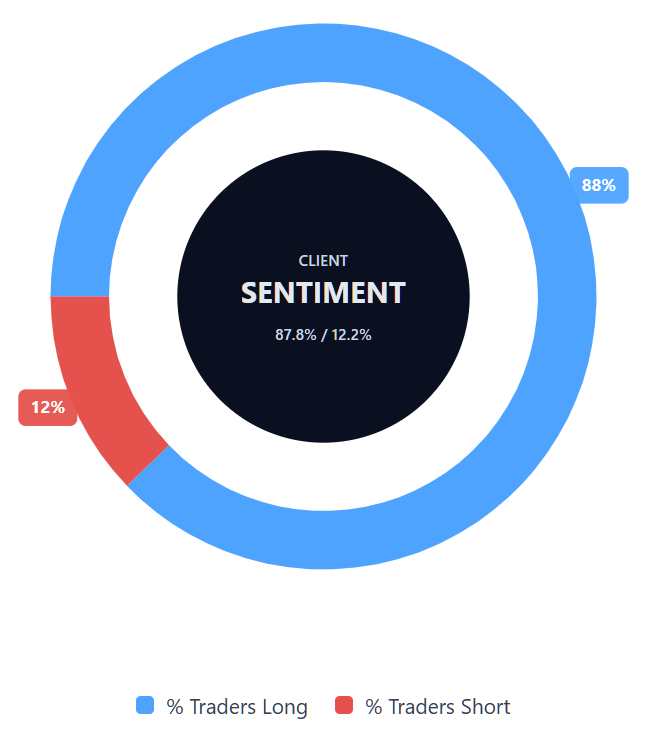
As of 18 February 2026, Capital.com client positioning in Palantir CFDs shows 87.8% buyers versus 12.2% sellers, a net long skew of 75.6 percentage points. This indicates that a majority of clients currently hold long positions in Palantir CFDs, although sentiment data can change quickly and does not predict future price movements. The figures reflect open positions on Capital.com at the time of writing.
Summary – Palantir 2026
- Palantir’s share price climbed from below $30 in early 2024 to above $100 in 2025, with pronounced rallies and corrections along the way.
- Key price drivers have included changing expectations for AI and data-analytics demand, quarterly earnings results, and shifts in broader technology-sector risk appetite and interest-rate expectations.
- In recent months, headlines around new contracts, AI partnerships and analyst rating or target revisions have also contributed to price fluctuations, demonstrating how both company-specific developments and wider market conditions can influence Palantir’s valuation.
Past performance is not a reliable indicator of future results.
FAQ
Who owns the most Palantir stock?
Palantir Technologies Inc. was co-founded by Peter Thiel, Alex Karp and other early backers. Filings with the US Securities and Exchange Commission (SEC) show that founders, executives and institutional investors hold significant stakes in the company. The largest shareholders are typically disclosed in annual proxy statements and quarterly filings. Ownership levels can change over time as insiders sell shares or institutions adjust their positions. Investors can review the latest proxy statements and regulatory filings to access up-to-date information on major shareholders.
What is the 5-year Palantir share price forecast?
There is no single five-year PLTR stock forecast. Long-term projections vary widely and depend on assumptions about revenue growth, profitability, competitive dynamics and broader market conditions. Analyst price targets usually focus on a 12-month timeframe, and even these estimates can change quickly in response to new information. Over a five-year period, macroeconomic trends, contract wins or losses, regulatory developments and shifts in technology adoption could all influence outcomes. As a result, longer-term forecasts tend to involve a high degree of uncertainty.
Is Palantir a good stock to buy?
Whether Palantir is considered a ‘good’ stock depends on an individual’s objectives, risk tolerance and time horizon. The company operates in data analytics and artificial intelligence, sectors that attract investor interest but can also involve valuation and execution risks. Palantir’s share price has shown significant volatility in recent years. Investors often assess financial performance, competitive positioning, balance sheet strength and broader market conditions before making decisions. This article does not provide investment advice or a recommendation to buy or sell any security.
Could Palantir stock go up or down?
Like all publicly traded shares, Palantir’s stock price can move in either direction. Company-specific factors such as earnings results, forward guidance, contract announcements or leadership changes may influence performance. Broader drivers, including interest-rate expectations, overall equity market sentiment and sector rotation within technology, can also affect price movements. Past performance does not indicate future results, and volatility may persist.
Should I invest in Palantir stock?
Deciding whether to invest in Palantir shares requires careful consideration of your financial situation, investment objectives and risk appetite. Equities can offer potential for capital growth, but they also expose investors to market risk and potential losses. It may be helpful to review official company disclosures, analyst commentary and independent research before making a decision. If appropriate, consider seeking guidance from a qualified financial adviser.
Can I trade Palantir CFDs on Capital.com?
Yes, you can trade Palantir CFDs on Capital.com. Trading share CFDs lets you speculate on price movements without owning the underlying asset and to take long or short positions. However, contracts for difference (CFDs) are traded on margin, and leverage amplifies both profits and losses. You should ensure you understand how CFD trading works, assess your risk tolerance, and recognise that losses can occur quickly.