Germany 40 forecast: US-Iran strikes, oil supply concerns
Germany 40 (DE40) reflects the performance of Germany’s leading blue-chip companies and is trading amid broader European equity weakness following reports of US and Israeli strikes on Iran and rising energy supply concerns. Past performance is not a reliable indicator of future results.
The DAX 40 index – referred to as the Germany 40 (DE40) on CFD trading platforms such as Capital.com – is trading around €24,670.5 in Monday’s European afternoon session, having moved between an intraday low of €24,612.5 and a high of €25,379.3 on 2 March 2026. Past performance is not a reliable indicator of future results.
Price action in DE40 is unfolding against a broader risk-off backdrop in European equities. Regional benchmarks, including Germany’s DAX and the pan-European Euro Stoxx 50, are down around 2% as investors respond to an escalation in Middle East tensions and renewed concerns about energy supply (Trading Economics, 2 March 2026). Newswires report coordinated US and Israeli strikes on Iran and subsequent retaliation, alongside weakness across major European indices (Reuters, 1 March 2026). Germany’s market opened sharply lower, with defence-related and energy-sensitive sectors drawing particular attention (Nasdaq, 2 March 2026).
Germany 40 forecast 2026–2030: Third-party targets
As of 2 March 2026, third-party Germany 40 predictions span a broad range of index levels, with quantitative models generally pointing to gradual upside from current prices while allowing for periods of consolidation and drawdowns. Targets are usually expressed as month‑by‑month paths or year‑end levels for the underlying DAX benchmark, based on historical patterns and macro‑policy assumptions rather than broker-style fundamental valuation.
Long Forecast (range‑based path)
Long Forecast projects the DAX starting March 2026 at 25,284 points, trading in a 23,509–28,137 band that month and closing 2026 near 30,418 points, before rising further to around 35,938 points by November 2027 and 39,713 points in January 2028. It notes that these month‑by‑month projections derive from extrapolated historical price behaviour amid sensitivity to interest‑rate expectations and geopolitical developments (Long Forecast, 2 March 2026).
CoinPriceForecast (long‑term level targets)
CoinPriceForecast states that the DAX stands at about 25,284–25,261 points in early 2026 and expects the index to reach approximately 27,101 points by mid‑2026 and 28,192 points by end‑2026, with subsequent year‑end projections of 29,336 points for 2027 and 31,604 points for 2028. The service adds that its longer‑horizon baseline sees the index 'hitting 30,000 by the end of 2028' and '40,000 by the end of 2030,' using a rules‑based model that extrapolates past performance and volatility patterns under assumptions of continued global growth and risk appetite (CoinPriceForecast, 2 March 2026).
Predictions and third-party forecasts are inherently uncertain, as they cannot fully account for unexpected market developments. Past performance is not a reliable indicator of future results.
DE40 index price: Technical overview
The DE40 index trades around €24,670.5 as of 14:39 UTC on 2 March 2026, just below a short-term moving-average cluster. Price remains between the intraday low at €24,612.5 and the high at €25,379.3. The simple moving-average band shows the 20-, 50-, 100- and 200-day moving averages grouped near approximately 24,946, 24,835, 24,406 and 24,176 respectively. Shorter-term averages sit above the current price, while longer-term measures remain below spot levels.
The 14-day relative strength index (RSI) at around 42.9 places momentum in lower-neutral territory. The average directional index (ADX) near 14.5 suggests a weak, non-directional trend rather than a strong impulse move.
On the topside, the nearest classic resistance level is R1 around 25,702.6, with R2 near 26,121 coming into focus only if the index records a sustained daily close above the first barrier. On the downside, the classic pivot at 24,987.6 serves as an initial reference level. The 100-day moving average near 24,406 marks a further area of technical interest, with S1 at 24,569 as an additional level if selling pressure extends. A daily close back above the pivot could stabilise the near-term profile, while a sustained move below the 100-day average would shift attention towards the lower end of the recent range (TradingView, 2 March 2026).
This technical analysis is provided for informational purposes only and does not constitute financial advice or a recommendation to trade.
Germany 40 index history (2024–2026)
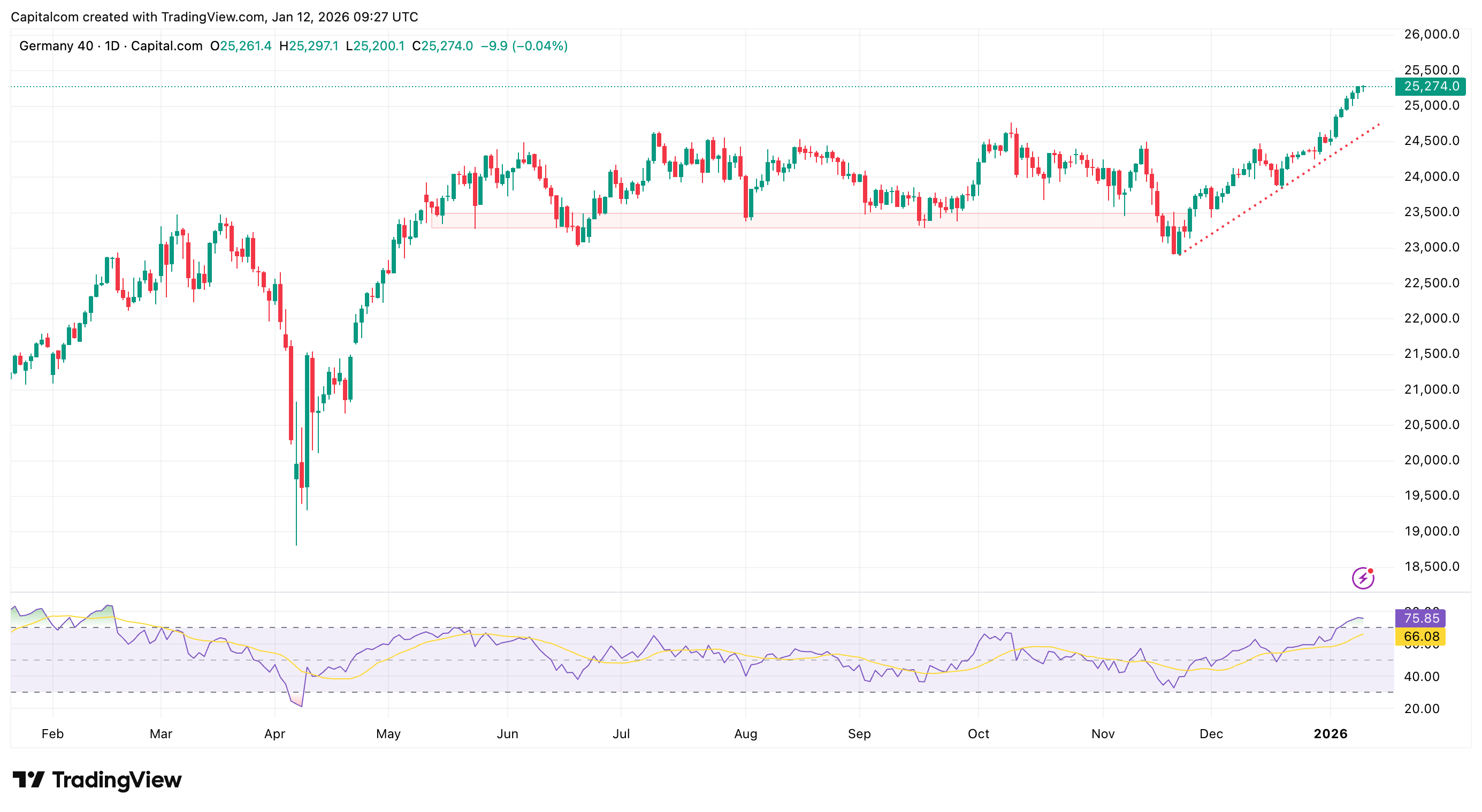
The Germany 40 index has risen from just under 20,000 at the end of 2024 to the mid-24,000s by early March 2026, representing a two-year recovery phase accompanied by periods of volatility. The index closed 2024 near 19,832.1 on 31 December before trending higher through 2025. It ended that year around 24,501.8 on 31 December 2025, following several pullbacks and rebounds around the 20,000, 22,000 and 24,000 levels.
During the first two months of 2026, DE40 has largely held above 24,000 and briefly traded above 25,000. It closed at 24,667.2 on 2 March 2026, consolidating near recent highs.
The advance wasn’t linear. In early 2025, the index dipped below 21,000 before recovering into the spring. Sharp swings in April and again in late 2025 illustrate how sentiment can shift within a broader upward trend. By mid-2025, DE40 was trading consistently above 23,000, with subsequent rallies through the summer and autumn lifting the index into the 24,000–25,000 range, where it has largely remained into early 2026. Past performance is not a reliable indicator of future results.
Past performance is not a reliable indicator of future results.
Germany 40 (DE40): Capital.com analyst view
Germany 40 (DE40) has spent much of the past year moving higher into the mid-20,000s, broadly tracking developments in Germany’s large-cap equity space despite uneven domestic economic data. Supportive factors have included corporate earnings resilience among major exporters, increased defence and infrastructure spending, and expectations of easier eurozone monetary policy. However, these same drivers could act as constraints if fiscal implementation slows, trade measures intensify or interest rates remain restrictive for longer than anticipated.
At current levels, the index may also be more sensitive to shifts in global risk appetite. Periods of heightened geopolitical tension, changes in US or Chinese demand, or renewed volatility in energy markets could influence price dynamics in either direction.
At the same time, elevated valuations do not preclude further two-way price action. Stronger global growth, continued disinflation or effective delivery of fiscal and industrial programmes in Germany could support corporate earnings, while setbacks in these areas may weigh on sentiment.
Capital.com’s client sentiment for Germany 40 CFDs
As of 2 March 2026, Capital.com client positioning in Germany 40 CFDs stands at 67.3% buyers versus 32.8% sellers, leaving a net long majority of approximately 34.5 percentage points. This snapshot reflects open positions on the Capital.com platform and can change over time as market conditions evolve.

Summary – Germany 40 2026
- As of 14:39 UTC on 2 March 2026, Germany 40 (DE40) trades near €24,670.5, compared with sub-€20,000 prices in late 2024. The index is consolidating in the mid-€20,000 range after reaching record and near-record levels earlier in 2026.
- Technical indicators show price just below a cluster of key moving averages, with lower-neutral RSI readings and weak trend strength signals, leaving the near-term bias undefined.
- Key variables to monitor include large-cap earnings trends, eurozone interest rate expectations, energy and defence spending, and shifts in global risk sentiment linked to geopolitics and trade. Recent volatility has coincided with developments in the Middle East and broader swings across European equity markets.
Past performance is not a reliable indicator of future results.
FAQ
Who owns the most Germany 40?
The Germany 40 (DE40) tracks the performance of 40 of the largest publicly listed companies in Germany by market capitalisation and liquidity. As an index, it is not ‘owned’ by a single individual or institution. Instead, its constituent shares are held by a mix of institutional investors, asset managers, pension funds, exchange-traded funds (ETFs) and retail investors. Ownership levels can shift over time as capital flows change and companies adjust their shareholder bases.
What is the 5 year Germany 40 forecast?
Five-year Germany 40 index forecasts can vary widely and depend on assumptions about economic growth, corporate earnings, interest rates and global trade conditions. Most publicly available projections focus on shorter 12-month horizons rather than multi-year targets. Over a longer period, outcomes will likely reflect Germany’s industrial performance, eurozone monetary policy and geopolitical developments. Long-term forecasts are inherently uncertain and should be treated as scenario-based estimates rather than precise predictions.
Is Germany 40 a good CFD to trade?
Whether Germany 40 is suitable as a CFD depends on your objectives, risk tolerance and trading approach. The index offers exposure to large German companies and tends to react to macroeconomic data, earnings results and geopolitical events. This can create trading opportunities, but also periods of heightened volatility. CFDs are leveraged products and carry a high level of risk if not managed carefully.
Could Germany 40 go up or down?
Germany 40 can move in either direction depending on changes in corporate earnings, economic data, central bank policy and global risk sentiment. Positive developments in growth, inflation or fiscal policy may support prices, while weaker data or geopolitical tensions could weigh on the index. Market expectations can shift quickly, particularly around major news events. As with all equity indices, price movements are uncertain and can be influenced by multiple interconnected factors.
Should I invest in Germany 40?
Deciding whether to invest in Germany 40 requires consideration of your financial situation, investment horizon and tolerance for risk. The index reflects exposure to Germany’s leading listed companies, but it also carries risks linked to economic cycles, sector concentration and external shocks. If you are unsure, you may wish to seek independent financial advice. This content is for informational purposes only and does not constitute investment advice.
Can I trade Germany 40 CFDs on Capital.com?
Yes, you can trade Germany 40 CFDs on Capital.com. Trading index CFDs lets you speculate on price movements without owning the underlying asset and to take long or short positions. However, contracts for difference (CFDs) are traded on margin, and leverage amplifies both profits and losses. You should ensure you understand how CFD trading works, assess your risk tolerance, and recognise that losses can occur quickly.