
CAC 40 index forecast: US-Iran ceasefire hopes
France 40 tracks major French-listed companies, with recent price moves shaped by US–Iran ceasefire talks, US–EU trade uncertainty and weak French GDP. Explore third-party FR40 targets and technical analysis. Past performance is not a reliable indicator of future results.
The CAC 40 index – referred to as the France 40 (FR40) on CFD trading platforms such as Capital.com – traded at 8,235.70 as of 4:07pm UTC on 7 May 2026, within an intraday range of 8,104.10–8,352.50. Past performance is not a reliable indicator of future results.
The recent advance coincided with improved risk sentiment across European equity markets, driven primarily by reports that Washington and Tehran were moving closer to a framework agreement aimed at ending hostilities. France's CAC 40 gained 3.2% on 6 May 2026, as oil prices retreated on reduced supply-disruption concerns (The Euro Magazine, 7 May 2026). The move came against a still-uncertain backdrop for US–EU trade relations, with the EU's chief negotiator stating on 6 May 2026 that there was 'still some way to go' on a bilateral deal, after President Trump threatened to raise automobile tariffs to 25% from the previously agreed 15% (Reuters, 6 May 2026). France's first-quarter GDP also unexpectedly stagnated amid energy-cost pressures linked to the Iran conflict (Bloomberg, 30 April 2026). The ECB's deposit rate remained at 2%, unchanged at its 30 April 2026 meeting, providing a steady monetary policy backdrop (European Central Bank, 30 April 2026).
Third-party France 40 outlook: Ceasefire hopes, trade and GDP risks
As of 7 May 2026, third-party France 40 predictions show a wide range of outcomes, shaped by European macro conditions, US–EU trade dynamics, ECB policy, and global risk sentiment. The following targets summarise projections from independent forecast providers, each using distinct methodologies and base dates.
Long Forecast (monthly trend-extrapolation model)
Long Forecast projects a May 2026 close of 7,568, within a monthly range of 7,038–8,098, followed by a gradual recovery through the second half of the year to a December 2026 close estimate of 8,212, within a range of 7,637–8,787. The model uses historical trend extrapolation on a rolling monthly basis, with the May 2026 opening level set at 7,168 as its base (Long Forecast, 10 March 2026).
Trading Economics (macro model and analyst consensus)
Trading Economics projects the FR40 to trade at approximately 7,695.2 by the end of the current quarter, with a 12-month estimate of 6,917.1, derived from global macro models and analyst expectations. The model flags eurozone growth headwinds, noting France's GDP stagnation in Q1 2026 as a key drag on the near-term outlook (Trading Economics, 7 May 2026).
Coin Price Forecast (trend-continuation model)
Coin Price Forecast places the FR40 at 8,733 at mid-2026 and 8,764 at year-end 2026, around 5% above the 8,341 base level recorded at the time of the model's last update. The projection extends to 9,288 by year-end 2027, applying a trend-continuation methodology to the previous price series (Coin Price Forecast, 7 May 2026).
Traders Union (analytical composite)
Traders Union projects the FR40 to reach 8,580.2 at mid-2026 and 8,598.2 by year-end 2026, extending to 8,436.2 at mid-2027 and 9,029.8 by end-2027. The composite draws on multiple analytical models and notes the index's sensitivity to eurozone trade and monetary conditions as a primary driver of its medium-term trajectory (Traders Union, 7 May 2026).
Wallet Investor (algorithmic futures model)
Wallet Investor projected the FR40 futures contract to reach approximately 8,160.8 within one year from a 22 March 2026 base level of 7,672.2, implying a modelled gain of around 6.4%. The December 2026 close estimate stood at approximately 9,059.9, with month-on-month values ranging between 8,631.8 and 9,059.9 across the second half of 2026, derived from algorithmic pattern analysis of historical futures price data (Wallet Investor, 22 March 2026).
Predictions and third-party forecasts are inherently uncertain, as they cannot fully account for unexpected market developments. Past performance is not a reliable indicator of future results.
FR40 index price: Technical overview
The FR40 index traded at 8,235.70 as of 4:07pm UTC on 7 May 2026, holding above its broad moving-average cluster. The 20-, 50-, 100- and 200-day SMAs sat at approximately 8,207, 8,098, 8,159 and 8,051, respectively. With the 20-day SMA above the 50-day SMA, the near-term trend remained constructive from a technical perspective, according to TradingView data.
The 14-day RSI registered 54.46, sitting in upper-neutral territory and consistent with a market lacking strong directional conviction in either direction. The ADX(14) read 17.39, indicating that the trend remained relatively subdued rather than firmly established, according to TradingView data.
To the topside, the classic R1 pivot at 8,428 represented the nearest reference above the last price. A daily close through that level could put the R2 level near 8,741.20 in view. The Hull moving average (9) at 8,180.80 and the 20-day SMA at 8,207.30 marked the immediate band the index was navigating.
On pullbacks, the classic pivot point at 8,142.50 provided initial support, followed by the 100-day SMA shelf at 8,158.70. A move beneath the 200-day SMA near 8,051.10 would represent a more substantive deterioration in the short-term structure, with the S1 classic pivot at 7,829.30 as the next reference below (TradingView, 7 May 2026).
This technical analysis is for informational purposes only and does not constitute financial advice or a recommendation to buy or sell any instrument.
France 40 index history (2024–2026)
The France 40 index opened 2024 in the mid-7,300s before climbing steadily to 8,259.50 on 15 May 2024, a record high at the time, alongside broader European equity strength. The index then slipped back through the summer, retreating toward 7,140 in early August 2024 amid global growth concerns and a brief period of market volatility, before recovering to close the year at 7,378.40 on 31 December 2024.
2025 brought a choppier ride. France 40 opened near 7,350, edged up to the 8,200–8,250 range by late February 2025, then suffered a sharp drawdown as US tariff announcements unsettled European markets. The index briefly touched 6,748 on 7 April 2025, its lowest point in the two-year dataset. A recovery followed through the spring and summer, with the index consolidating in the 7,600–7,900 range for much of the second half.
France 40 traded at 8,235.70 on 7 May 2026, approximately 11.6% above its 7 May 2025 close of 7,647.60, and roughly 11.6% up year to date from the 31 December 2025 close of 8,140.40.

Past performance is not a reliable indicator of future results. Prices are indicative and may differ from live market prices.
France 40 (FR40): Capital.com analyst view
France 40’s price performance over the past year reflects a market navigating competing forces rather than trending cleanly in one direction. The index recovered from a sharp April 2025 drawdown, which saw prices briefly fall to around 6,748 amid US tariff-related volatility, to reclaim the 8,200s by early 2026. France’s stagnant Q1 2026 GDP and ongoing US–EU trade negotiations, with no finalised deal reached as of May 2026, remain key headwinds. However, any de-escalation in trade tensions or a resolution to the Iran conflict, cited as one factor behind the 6 May 2026 rally, could provide further support. Conversely, a deterioration on either front could weigh on recent gains.
The index currently sits above its key long-term moving-average cluster, which some technical participants may view as a constructive backdrop. However, subdued trend strength, as indicated by a relatively low ADX reading, could suggest that the current positioning does not necessarily reflect a strongly directional market. The ECB’s steady deposit rate at 2% provides policy continuity, which may support valuations, but it also limits the scope for additional monetary stimulus if eurozone growth disappoints further.
Capital.com’s client sentiment for France 40 CFDs
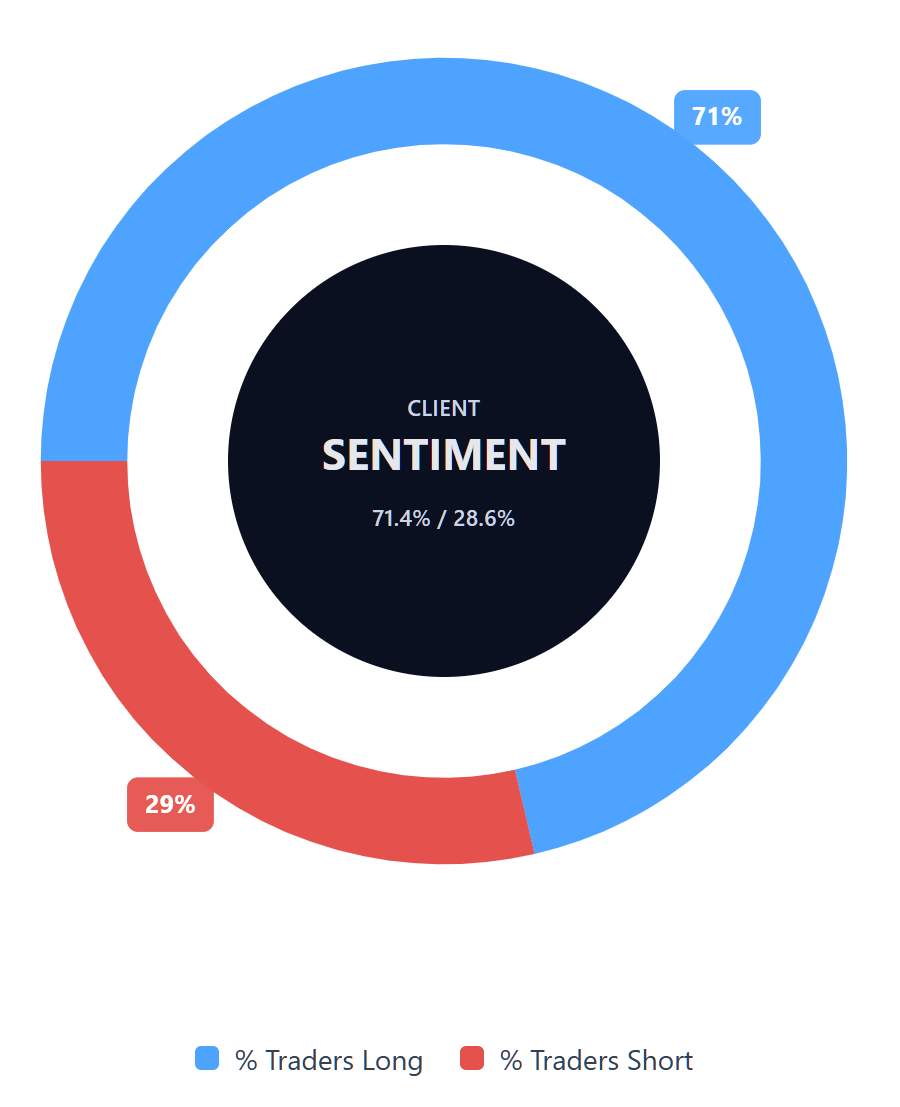
As of 7 May 2026, Capital.com client positioning in France 40 CFDs stands at 71.4% long versus 28.6% short. This puts long positions ahead by 42.8 percentage points and indicates a long-biased client sentiment snapshot. The data reflects open positions on Capital.com and can change rapidly as market conditions evolve.
Summary – France 40 2026
- France 40 (FR40) traded at 8,235.70 as of 4:07pm UTC on 7 May 2026, up roughly 11.6% year on year from 7,647.60 on 7 May 2025.
- Key macro drivers include stalled US–EU trade negotiations, France’s unexpected Q1 2026 GDP stagnation, and the ECB’s steady deposit rate at 2%.
- Recent gains followed reports of progress toward a US–Iran ceasefire framework, which eased energy-cost concerns and coincided with a sharp rise in European equities on 6 May 2026.
Past performance is not a reliable indicator of future results.
FAQ
What is the five-year France 40 forecast?
Is France 40 a good CFD to trade?
Whether France 40 is suitable to trade as a CFD depends on your experience, risk tolerance, strategy and understanding of leverage. The index can offer exposure to major French-listed companies and broad European equity themes, but CFDs are complex instruments and prices can move quickly in either direction. Trading France 40 CFDs may suit some short-term strategies, but it also carries a high risk of losses, especially when markets react to macro data, policy decisions or geopolitical news.
Could France 40 go up or down?
Yes. France 40 could rise or fall depending on factors such as US–EU trade negotiations, ECB policy, French and eurozone growth, energy prices, earnings expectations and wider risk sentiment. Recent gains followed reports of progress toward a US–Iran ceasefire framework, but the article also notes headwinds from stagnant French GDP and unresolved trade talks. Technical indicators showed the index above key moving averages, while subdued ADX suggested the trend was not strongly established.
Should I invest in France 40?
Can I trade France 40 CFDs on Capital.com?
Yes, you can trade France 40 CFDs on Capital.com. Trading index CFDs lets you speculate on price movements without owning the underlying asset and to take long or short positions. However, contracts for difference (CFDs) are traded on margin, and leverage amplifies both profits and losses. You should ensure you understand how CFD trading works, assess your risk tolerance, and recognise that losses can occur quickly.