HomeGermany 40 (DAX) forecast: US-Iran tensions ease

Germany 40 (DAX) forecast: US-Iran tensions ease

Germany 40 is a German equity index covering major listed companies, with recent price moves shaped by Middle East tensions, US–EU tariffs and ECB policy. Explore third-party DE40 targets and technical analysis. Past performance is not a reliable indicator of future results.
By Dan Mitchell
Frankfurt skyline with modern financial district skyscrapers and German flag, representing the Germany 40 (DAX) index
Photo: Shutterstock

The DAX index – referred to as the Germany 40 (DE40) on CFD trading platforms such as Capital.com – is trading at €24,886.90 as of 1:13pm UTC on 7 May 2026, within an intraday range of €24,465.20–€25,116.20. Past performance is not a reliable indicator of future results.

Market sentiment appeared to improve after reports on 6 May that the US and Iran were close to an agreement to end ongoing hostilities (Reuters, 6 May 2026). The broader Stoxx 600 rose 2.3% and the DAX gained approximately 2% on the day, as investors assessed whether easing Middle East tensions could reduce energy supply risks for German industrials. The move also came amid broader relief across European equities, with the euro strengthening 0.5% against the dollar to 1.1751 on 6 May (CNBC, 6 May 2026). However, the US–EU trade backdrop remains a structural overhang; the EU faces a 15% baseline tariff on most goods entering the United States, with higher sector-specific levies on steel, aluminium, and automobiles (European Parliament, 20 February 2026). The ECB's deposit facility rate stands at 2%, unchanged since March 2026, with the next policy decision scheduled for 11 June 2026 (Morningstar, 19 December 2025).

Germany 40 forecast 2026–2030: Third-party targets

As of 7 May 2026, third-party Germany 40 predictions reflect a range of near-term and year-end 2026 projections, shaped by German macroeconomic conditions, ECB policy, and evolving US tariff dynamics.

Long Forecast (May 2026 monthly model)

Long Forecast projects a May 2026 close of 25,287 for the DE40, within an intraday band of 21,603 – 27,057, representing a 5.6% gain from the month's opening level of 23,955. The model extends its year-end 2026 estimate to 25,193, within a December band of 23,429 – 26,957, as regression assumptions embed ongoing headwinds from unresolved US trade exposure for German exporters (Long Forecast, 30 April 2026).

Coin Price Forecast (mid and year-end level targets)

Coin Price Forecast sets its mid-2026 DE40 target at 25,894 and its year-end 2026 target at 26,469, implying an approximate 6% rise from the current level of €24,886.9. A short-term projection of 25,596 is indicated for mid-May 2026, with the model updated daily using a regression framework applied to historical price series (Coin Price Forecast, 7 May 2026).

Traze (technical and valuation analysis)

Traze identifies near-term resistance for the DE40 at 24,569, noting that a decisive close above that level would open a technical path toward 25,000 and then the 26,318 Fibonacci extension target derived from the 2020 – 2021 bull market advance. The analysis notes that the index trades at a price-to-earnings ratio of approximately 14x on a forward basis, below its five-year average, amid macro headwinds including an IMF-revised 2026 German GDP growth forecast of 0.8% (Traze, 28 April 2026).

Daily Forex (technical outlook)

Daily Forex notes that the DE40 was trading near 22,100 in early May before rebounding, with German ten-year Bund yields cited as a structural overhang on equity valuations. The analysis identifies the 22,890 – 23,100 zone as near-term support and 23,800 as the first meaningful resistance, with a breach required before any extension toward the 24,000 – 24,500 range could be considered (Daily Forex, 5 May 2026).

Predictions and third-party forecasts are inherently uncertain, as they cannot fully account for unexpected market developments. Past performance is not a reliable indicator of future results.

DE40 index price: Technical overview

The DE40 index is trading at €24,886.90 as of 1:13pm UTC on 7 May 2026, holding above the full daily moving-average cluster. The 20/50/100/200-day simple moving averages sit at approximately 24,202/23,815/24,282/24,118. Price trades above all four levels, and the 20-over-50 alignment remains intact, keeping the near-term trend positive from a technical perspective, according to data sourced from TradingView. The Hull moving average (9) at 24,779 runs closest to current price, with price now extended above it, while the Ichimoku base line at 23,681 sits well below.

Momentum indicators sourced from TradingView are positive but not extreme. The 14-day relative strength index reads 63.36, in the upper-neutral zone, suggesting the move off the April lows retains scope without yet signalling a technically stretched condition. The average directional index at 20.99 falls within the 15–25 range, indicating a developing rather than established trend.

On the topside, the classic R1 pivot at 25,164 is the nearest reference above current levels. A daily close above that would put the R2 level at 26,036 in view. To the downside, the classic pivot point at 23,921 provides initial reference, with the 100-day simple moving average at 24,282 acting as the first significant moving-average shelf. A sustained move below the 200-day simple moving average at 24,118 would weaken the short-term structure (TradingView, 7 May 2026).

This is technical analysis for informational purposes only and does not constitute financial advice or a recommendation to buy or sell any instrument.

Germany 40 index history (2024–2026)

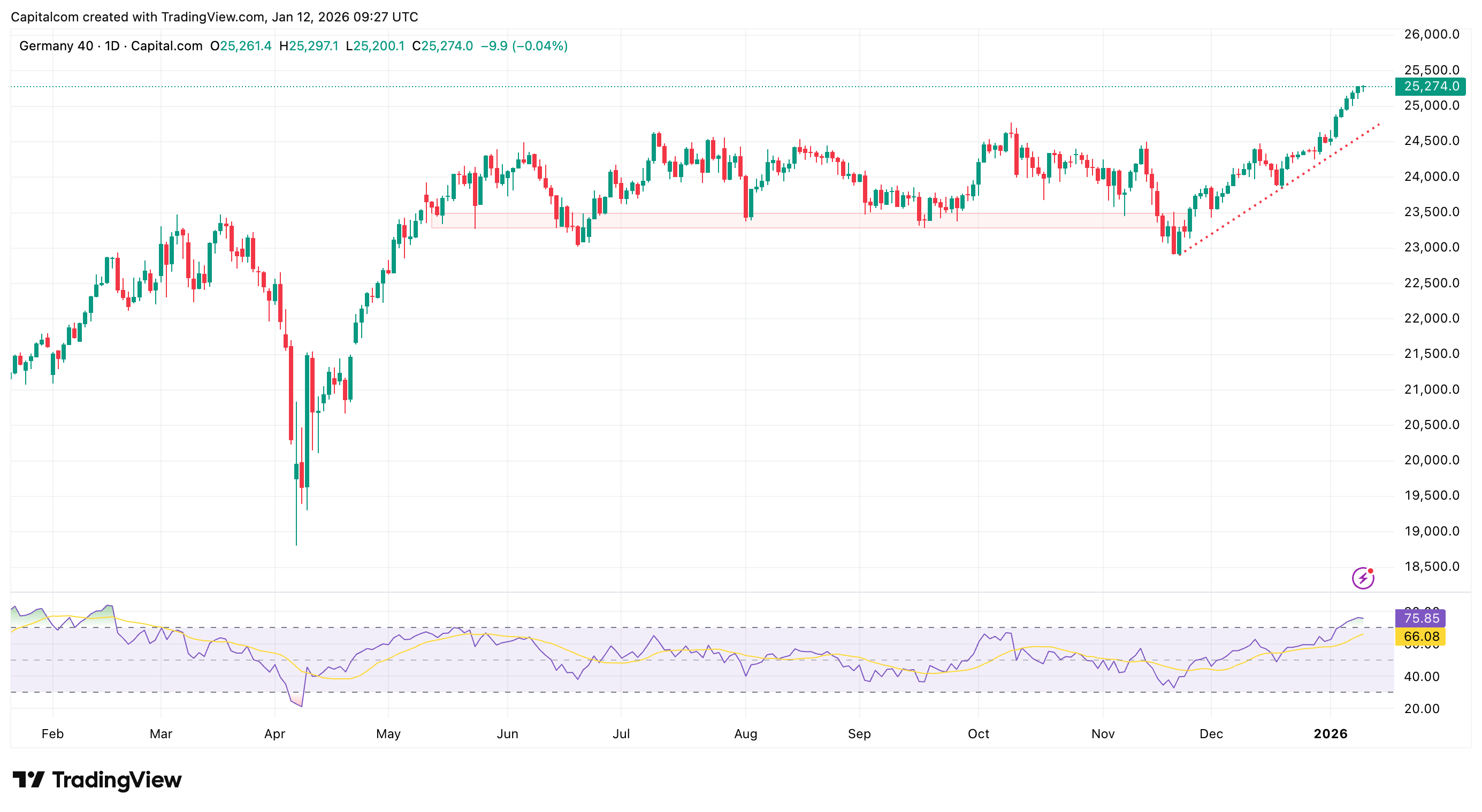
The Germany 40 index opened 2025 near €19,848 before climbing steadily through the year, supported by ECB rate cuts and improving European earnings expectations. It closed 2025 at €24,502, a gain of roughly 23% on the year.

The index pushed further into 2026, touching a two-year high of €25,384 on 13 January, before trade policy uncertainty began to weigh on sentiment. As US President Trump escalated tariff announcements in late March and early April 2026, targeting European goods including automobiles and steel, the DE40 shed around 15.3% from that January peak, sliding to €21,504 on 9 April, its lowest level since late 2024.

A partial recovery followed as markets reassessed the tariff impact and geopolitical tensions showed signs of easing. The index climbed roughly 15.7% off the April low, returning to the €24,888 area by 7 May 2026. The DE40 is approximately 1.5% higher year to date as of 7 May 2026 and around 7.4% higher year on year.

Past performance is not a reliable indicator of future results. Prices are indicative and may differ from live market prices.

Germany 40 (DE40): Capital.com analyst view

Germany 40 (DE40) has recovered from an April low near €21,504 to trade around €24,889 as of 7 May 2026. Germany’s €500bn fiscal expansion programme, which loosened the country’s constitutional debt brake to fund infrastructure and defence spending, has provided medium-term structural support for industrial and capital goods constituents. The ECB’s current deposit rate of 2%, set at its March 2026 meeting, adds a further layer of support for rate-sensitive sectors. However, the same fiscal shift has pushed German ten-year Bund yields higher, raising borrowing costs for corporates, which could weigh on earnings multiples, particularly for indebted industrials.

The index’s export-driven composition is a double-edged characteristic in the current environment. Progress in US–EU trade negotiations could remove a significant headwind for automotive and chemicals names, which account for a large share of aggregate index earnings. Equally, the IMF’s downward revision of Germany’s 2026 GDP growth forecast to 0.8% serves as a reminder that the domestic macro backdrop remains fragile, and that a deterioration in global trade conditions could put renewed pressure on the index. The April sell-off illustrated how quickly sentiment can shift when trade policy uncertainty intensifies.

CFDs are complex instruments and come with a high risk of losing money rapidly due to leverage. Past performance is not a reliable indicator of future results.

Capital.com’s client sentiment for Germany 40 CFDs

As of 7 May 2026, Capital.com client positioning in Germany 40 CFDs shows 57.4% buyers vs 42.6% sellers, which puts buyers ahead by 14.8 percentage points and reflects a slight long bias without approaching one-sided territory. This snapshot reflects open positions on Capital.com and can change rapidly as market conditions evolve.

Image

Summary – Germany 40 2026

Past performance is not a reliable indicator of future results.

FAQ

What is the five-year Germany 40 forecast?

There is no single five-year Germany 40 forecast, and longer-term projections can vary widely between sources. In the article, third-party 2026 forecasts broadly centre on the 25,000–26,500 range, but those figures don’t extend reliably across five years. Over a longer horizon, the index may be influenced by Germany’s fiscal expansion, ECB policy, global trade conditions, corporate earnings and export demand. Forecasts are not guarantees, and market conditions can change quickly.

Is Germany 40 a good CFD to trade?

Germany 40 may appeal to CFD traders who want exposure to major German companies across sectors such as industrials, financials, automotive and technology. It can offer liquidity and regular market-moving events, including earnings, ECB decisions and macroeconomic data. However, CFDs are leveraged products, meaning both profits and losses can be magnified. Whether it’s suitable depends on your experience, risk tolerance, strategy and understanding of how index CFDs work.

Could Germany 40 go up or down?

Germany 40 could move in either direction. Upside drivers may include stronger earnings, progress in US–EU trade negotiations, easier ECB policy or improved global risk sentiment. Downside risks include elevated Bund yields, weaker German growth, tariff uncertainty, geopolitical tensions or disappointing company guidance. Because the index is export-sensitive, shifts in global demand and trade policy can have a notable impact. Technical levels may offer context, but they don’t predict future price movements.

Should I invest in Germany 40?

We can’t say whether you should invest in, trade or avoid Germany 40. That decision depends on your financial situation, goals, market knowledge and appetite for risk. The article provides third-party forecasts, price history, technical analysis and macro context for informational purposes only. You should carry out your own research, consider both upside and downside scenarios, and remember that past performance is not a reliable indicator of future results.

Can I trade Germany 40 CFDs on Capital.com?

Yes, you can trade Germany 40 CFDs on Capital.com. Trading index CFDs lets you speculate on price movements without owning the underlying asset and to take long or short positions. However, contracts for difference (CFDs) are traded on margin, and leverage amplifies both profits and losses. You should ensure you understand how CFD trading works, assess your risk tolerance, and recognise that losses can occur quickly.

Capital.com is an execution-only brokerage platform and the content provided on the Capital.com website is intended for informational purposes only and should not be regarded as an offer to sell or a solicitation of an offer to buy the products or securities to which it applies. No representation or warranty is given as to the accuracy or completeness of the information provided.

The information provided does not constitute investment advice nor take into account the individual financial circumstances or objectives of any investor. Any information that may be provided relating to past performance is not a reliable indicator of future results or performance.

To the extent permitted by law, in no event shall Capital.com (or any affiliate or employee) have any liability for any loss arising from the use of the information provided. Any person acting on the information does so entirely at their own risk.

Any information which could be construed as “investment research” has not been prepared in accordance with legal requirements designed to promote the independence of investment research and as such is considered to be a marketing communication.