
Deutsche Telekom stock forecast: Third-party price targets
Deutsche Telekom remains a significant presence in the European telecom landscape, with its share price influenced by day-to-day market activity, broader sector movements and ongoing company disclosures.
Deutsche Telekom (DTE) is trading around €27.45 in intraday European dealing, moving within a session range of €27.29–€27.72 as of 15:08 UTC on 3 December 2025, with the price sitting near the middle of that intraday band based on Capital.com’s feed data. Past performance is not a reliable indicator of future results.
The share is trading against a backdrop of ongoing company activity in the capital markets, including recent purchases of Deutsche Telekom shares under a buyback programme disclosed in market announcements (TradingView, 1 December 2025). Broader European telecom benchmarks, such as the STOXX telecommunications indices, continue to mirror sector-specific sentiment across the region (STOXX, 3 December 2025).
Past performance is not a reliable indicator of future results.
Deutsche Telekom stock forecast 2026–2030
Third-party Deutsche Telekom price forecasts are typically framed on a one-year horizon and presented as indicative approaches to fair value rather than guarantees. Methodologies commonly combine earnings forecasts, valuation multiples and comparisons across the telecom sector.
Fintel (consensus summary)
Fintel reports that the average one-year price target for Deutsche Telekom AG is about €38.57. Individual analyst estimates range from roughly €33.33 to €44.10. These figures reflect analyst views on projected earnings and historical performance, based on coverage across European brokerages and banks (Fintel, 25 November 2025).
Investing.com (analyst poll)
Investing.com’s Deutsche Telekom AG stock predictions page shows an average 12-month price target close to €37.33 from around 18 analysts, with a published range of approximately €33 to €42. The platform notes that these targets are derived from aggregated sell-side models incorporating assumptions on revenue, margins and sector conditions in the European telecommunications landscape (Investing.com, 3 December 2025).
TipRanks (Wall Street coverage)
TipRanks collates 12-month Deutsche Telekom targets from a group of Wall Street analysts, showing an average of around €37.38, with a high estimate near €42 and a low estimate close to €35.00. These figures reflect broker research incorporating operating performance, balance-sheet considerations and broader equity-market conditions (TipRanks, 3 December 2025).
MarketWatch (ADR estimates)
MarketWatch’s analyst estimates page for Deutsche Telekom’s US-listed ADR (DTEGY) reports, in a late-2025 update, an average target price of approximately $43.423 across 17 ratings. The provider notes that these ADR-based targets apply valuation approaches adjusted for currency and listing differences (MarketWatch, 3 December 2025).
Past performance of Deutsche Telekom shares and third-party price targets are not reliable indicators of future results. Markets can move unpredictably, and forecasts may not be achieved.
DTE stock price: Technical overview
Deutsche Telekom (DTE) is quoted at €27.45 as of 15:08 UTC on 3 December 2025, trading just below its short-term moving-average band on the daily chart. The simple moving averages show a compressed cluster, with the 20/50/100/200-DMAs around 27.2 / 28.2 / 29.4 / 31.0 respectively, placing the price below the medium- and longer-term trend indicators. The 14-day RSI sits near 45.6 in the mid-neutral zone, while the ADX around 18.7 suggests a relatively weak directional trend rather than a strong impulse.
On the topside, the nearest classic pivot resistance appears at R1 around 28.39, with R2 near 29.03 coming back into view only if a daily close above the first barrier is maintained. On the downside, the classic pivot at 27.20 serves as initial support, with the 100-day SMA near 29.4 overhead marking the next significant moving-average level, and S1 around 26.56 forming the next reference point if the pivot area is breached (TradingView, 3 December 2025).
This technical analysis is for informational purposes only and does not constitute financial advice or a recommendation to buy or sell any instrument.
Deutsche Telekom share price history
The Deutsche Telekom stock price has moved steadily higher over the past two years, rising from the low-€20s at the end of 2023 to the high-€20s by late 2025. The stock closed at €22.61 on 5 December 2023 and remained largely between €22 and €26 throughout 2024 before breaking above €30 in early 2025. Stronger momentum in the first half of the year lifted it to a closing high of about €34.03 on 4 April 2025.
After that peak, the share price eased back, gradually slipping from the low-€30s through the summer towards the high-€20s into the autumn and early winter. By 3 December 2025, the stock closed at €27.44, above its December 2023 level but below the highs reached in April 2025. This reflects a market that has cooled from its strongest phase while still holding notable gains over the two-year period.

Past performance is not a reliable indicator of future results. Share prices are indicative and may differ from live market prices.
Capital.com analyst view
Deutsche Telekom’s stock price of about €27.45 on 3 December 2025 remains below its medium- and long-term moving averages, suggesting a period of consolidation following earlier gains in the European telecom sector. This positioning is consistent with a market adjusting to previous company updates and broader sector developments, while also reflecting a degree of caution around the outlook for growth and the competitive landscape.
Recent announcements on network investment, digital-infrastructure projects and capital-allocation plans continue to draw attention to the company. These initiatives can support long-term operational resilience and financial strength, but they also introduce risks. Higher capital-expenditure commitments, increased regulatory oversight and exposure to wider equity-market conditions may influence how the share price behaves if assumptions are not met or external pressures intensify.
Capital.com’s client sentiment for Deutsche Telekom CFDs
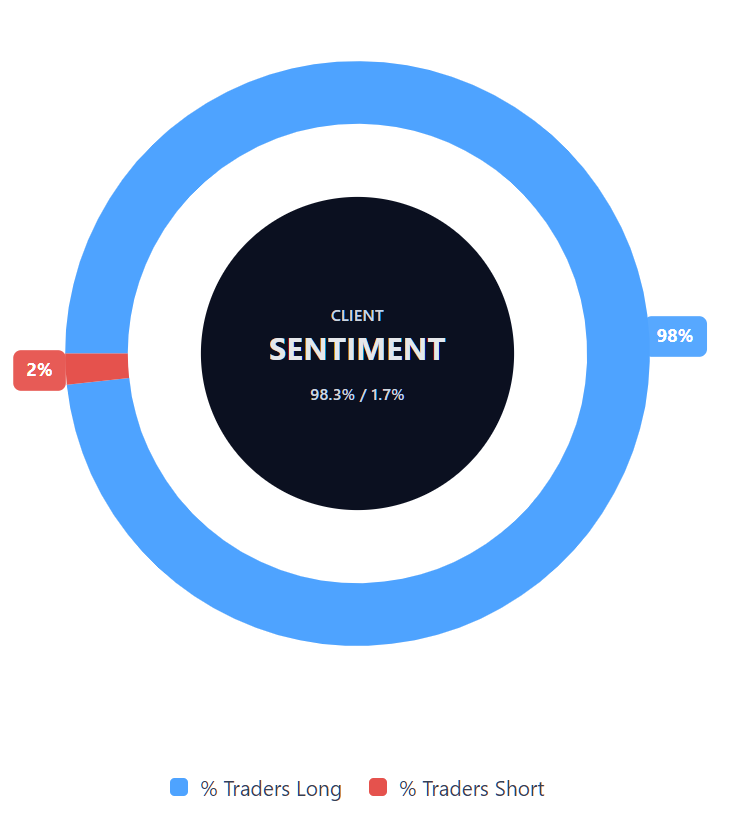
As of 3 December 2025, Capital.com client positioning in Deutsche Telekom CFDs shows buyers at 98.3% versus sellers at 1.7%, representing a strong skew towards long exposure at this moment in time. This snapshot reflects open positions on the platform and can change.
Summary – Deutsche Telekom price 2025
- The DTE share price started 2025 just above €29 and reached a closing high of around €34 in early April.
- Deutsche Telekom traded mostly in the low- to mid-€30s in the first half of the year before retracing towards the high-€20s into year-end.
- As of 3 December 2025, it closed at €27.44, below the April peak but above late-2023 levels.
- Technical readings show the price below its medium- and long-term moving averages, with momentum indicators in neutral territory.
- Client sentiment on Capital.com is heavily skewed towards long positions, with about 98.28% of open CFDs on the buy side at this snapshot in time.
Past performance is not a reliable indicator of future results.
FAQ
Who owns the most Deutsche Telekom stock?
Deutsche Telekom’s largest shareholders typically include the Federal Republic of Germany, which holds a significant stake directly and through the state-owned development bank KfW. Other major shareholders often include institutional investors such as pension funds, asset managers and global investment firms. Exact ownership levels can change as regulatory filings are updated, so the latest disclosures offer the most accurate breakdown.
What is the 5-year forecast for Deutsche Telekom stock?
Five-year forecasts vary across analysts and platforms. They generally rely on expectations for earnings, capital expenditure, competitive dynamics and broader telecom-sector conditions. Many analyst targets referenced in late 2025 placed Deutsche Telekom’s 12-month estimates in the high-€30s, but longer-term projections depend on assumptions about revenue trends, network investment and regulatory developments. These forecasts are speculative and should not be viewed as reliable indicators of future performance.
Is Deutsche Telekom a good stock to buy?
Assessments of Deutsche Telekom as an investment depend on individual goals, risk tolerance and market outlook. Analysts often reference the company’s scale, network investment and dividend policies in their evaluations, while also noting risks such as high capital-expenditure requirements, competitive pressure and regulatory oversight across European markets. Any assessment should weigh both potential opportunities and the uncertainties common in telecom equity markets.
Could Deutsche Telekom stock go up or down?
Deutsche Telekom’s share price, like all publicly traded assets, can move in either direction. Market performance may be influenced by company announcements, financial results, sector sentiment, macroeconomic conditions and investor appetite for telecom equities. Technical indicators, including moving averages and momentum measures, can provide context on short-term behaviour but cannot predict future movements. Prices can rise or fall unpredictably.
Should I invest in Deutsche Telekom stock?
Deciding whether to invest in Deutsche Telekom depends on personal financial circumstances, risk tolerance and investment objectives. The share price has seen periods of gains and retracement over the past two years, reflecting market conditions and developments within the business. As with any equity, the stock carries risks as well as potential opportunities, and past performance is not a reliable indicator of future results. Independent research and professional financial advice may help ensure decisions are appropriate for individual needs.
How can I trade Deutsche Telekom CFDs on Capital.com?
You can trade Deutsche Telekom share price movements through contracts for difference (CFDs) on Capital.com, allowing you to open long or short positions without owning the underlying shares. CFDs are traded on margin – leverage amplifies both profits and losses.