
Deutsche Telekom stock forecast: Q4 results and buyback
Deutsche Telekom is a German telecoms group whose latest full-year results, 2026 guidance, share buyback activity and T-Mobile US exposure remain central to its share price narrative. Past performance is not a reliable indicator of future results. Explore third-party DTE price targets & analysis.
Deutsche Telekom AG (DTE) is trading at €32.565 as of 2:01pm UTC on 18 March 2026, within an intraday range of €32.365–€33.515. Past performance is not a reliable indicator of future results.
Sentiment continues to be shaped by several concurrent developments. Deutsche Telekom’s full-year 2025 results, reported on 26 February 2026, showed Q4 adjusted EBITDA after leases of €10.8 billion , above the company-provided analyst consensus of €10.7 billion. Meanwhile, 2026 core profit guidance of approximately €47.4 billion came in ahead of analyst expectations of €46.4 billion, though free cash flow guidance of €19.8 billion fell slightly short of some estimates (Reuters, 26 February 2026). The stock also reflects the company’s ongoing €2 billion share buyback programme, with the first tranche of up to €550 million targeted for completion by the end of March 2026 (Deutsche Telekom, 5 January 2026), as well as Deutsche Telekom’s confirmed intention to retain its 52.8% stake in T-Mobile US without selling shares during the period (Deutsche Telekom, 11 February 2026). Additionally, a partnership with SpaceX’s Starlink, announced at Mobile World Congress on 2 March 2026, to deliver satellite-to-mobile connectivity across 10 European countries from 2028 has added a longer-term strategic narrative to the stock (Reuters, 2 March 2026).
Deutsche Telekom stock forecast 2026–2030: Third-party price targets
As of 18 March 2026, third-party Deutsche Telekom stock predictions reflect a consolidation in post-earnings.
Berenberg (broker target – buy)
Berenberg reiterates a buy rating on Deutsche Telekom with a 12-month price target of €35.20. The bank cites robust fundamentals and growth potential in AI infrastructure and US operations as central to its view (MarketScreener, 16 March 2026).
Barclays (broker target – buy)
Barclays analyst Mathieu Robilliard reiterates a buy rating on Deutsche Telekom with a 12-month price target of €39.50. The bank maintains its stance amid its ongoing assessment of T-Mobile US service revenue growth and regulatory conditions across the European telecommunications sector (MarketScreener, 17 March 2026).
Investing.com (consensus overview)
Investing.com aggregates 19 analyst views on Deutsche Telekom and records an average 12-month DTE stock forecast of €37.48, with estimates spanning €31–€43 and an overall buy consensus. The rating breakdown shows 15 buy, 2 hold, and 1 sell among the analysts polled, with T-Mobile US contribution and 2026 EBITDA guidance of approximately €47.4 billion underpinning the aggregate view (Investing.com, 17 March 2026).
Predictions and third-party forecasts are inherently uncertain, as they cannot fully account for unexpected market developments. Past performance is not a reliable indicator of future results.
DTE stock price: Technical overview
The DTE stock price trades at €32.565 as of 2:01pm UTC on 18 March 2026, sitting just above the classic pivot at €32.25 and within a mixed moving-average picture . The price holds above the 30-, 50-, 100-, and 200-day SMAs at approximately €32.52, €30.63, €29, and €29.79 respectively, but trails the shorter 10- and 20-day SMAs at approximately €32.90 and €33.02, indicating near-term softness against an otherwise supportive longer-term structure.
Momentum is neutral: the 14-day RSI reads 52.15, placing it in the middle of its range with no clear directional conviction, while the ADX at 28.92 signals that an established trend is present, suggesting that the current directional move retains some structural force despite the oscillator reading.
On the topside, the nearest reference is R1 at €36.20; a convincing daily close above that level would put R2 near €38.31 back in view, with the intraday session high of €33.515 acting as the immediate barrier before any broader recovery attempt can gain traction.
On pullbacks, initial support rests at the classic pivot of €32.25, with the next meaningful shelf provided by the 100-day SMA near €29; a sustained move below the pivot would shift near-term attention towards S1 at €30.14, which sits just above that longer-term moving-average zone (TradingView, 18 March 2026).
This is technical analysis for informational purposes only and does not constitute financial advice or a recommendation to buy or sell any instrument.
Deutsche Telekom share price history (2024–2026)
Deutsche Telekom listed on the Frankfurt Stock Exchange in 1996, with the German government retaining a significant stake via KfW. The shares covered here reflect CFD pricing on the Xetra-listed stock.
DTE’s stock price opened March 2024 near €21.94 and spent the spring in a steady upward drift, closing April at €21.54 before pushing through the €22 mark by early June. The stock held that range through the summer, then dipped to a two-year low of €22.63 on 10 April 2024 before recovering to close the year at €28.87 on 30 December 2024, a gain of roughly 31.6% over 2024.
Into 2025, DTE extended its run, reaching a local peak of €35.96 on 3 March 2025 before pulling back through the spring and finding a floor near €29.76 on 7 April 2025 amid broader market volatility. The stock then recovered steadily through summer and autumn, trading in the €29–€32 range before a sharp leg higher in late January 2026 carried it above €34 by late February 2026, touching a period high of €34.42 on 27 February 2026 following Q4 2025 earnings.
DTE closed at €32.565 on 18 March 2026, approximately 5.4% down from that February peak, but around 12.8% above its 18 March 2025 close of €33.845 on a year-on-year basis.

Past performance is not a reliable indicator of future results. Share prices are indicative and may differ from live market prices.
Deutsche Telekom (DTE): Capital.com analyst view
Deutsche Telekom’s share price has traced a broadly constructive path over the past two years, climbing from the low-€20s in mid-2024 to a period high near €35.96 in March 2025, with the February 2026 earnings release acting as a further catalyst. The group’s strong Q4 2025 adjusted EBITDA, upbeat 2026 guidance, the Starlink satellite-to-mobile partnership, and an active share buyback programme have each contributed to positive sentiment. At the same time, investors should note that T-Mobile US exposure introduces meaningful currency risk, given that a stronger euro against the dollar could weigh on consolidated earnings, and that any deterioration in the German domestic market could offset gains elsewhere.
The recent pullback from the February 2026 highs to around €32.57 illustrates that positive newsflow does not guarantee sustained price appreciation. Macroeconomic headwinds, regulatory shifts in European telecoms, or broader equity market weakness could also place further pressure on the stock. The near-term picture remains mixed, with shorter-term moving averages sitting above the current price, creating a degree of resistance that the stock would need to reclaim convincingly.
Capital.com’s client sentiment for Deutsche Telekom CFDs
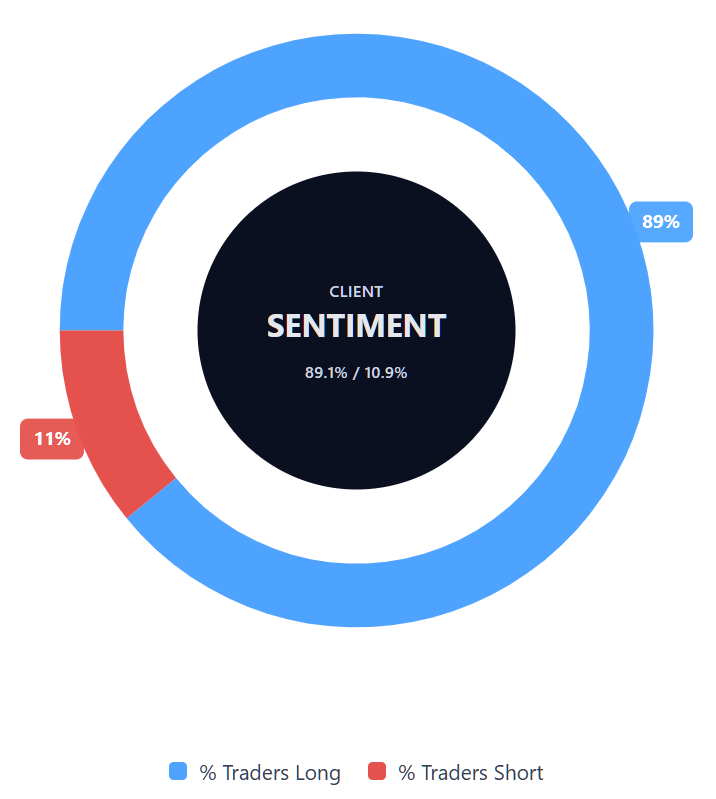
As of 18 March 2026, Capital.com client positioning in Deutsche Telekom CFDs shows a heavily skewed split: 89.1% long and 10.9% short, putting buyers ahead by 78.2 percentage points and placing sentiment firmly in a heavy-buy, one-sided-towards-longs territory. This snapshot reflects open positions on Capital.com at the time of writing and can change rapidly as market conditions evolve.
Summary – Deutsche Telekom 2026
- DTE trades at €32.565 as of 2:01pm UTC on 18 March 2026, down from a February 2026 peak near €34.42 but roughly 12.8% above its year-ago close.
- Short-dated SMAs (10- and 20-day) sit above the current price, creating near-term resistance, while the 14-day RSI at 52.15 and ADX at 28.92 signal a neutral-to-established trend with no strong directional conviction.
- Key price drivers include T-Mobile US earnings contribution, 2026 adjusted EBITDA guidance of approximately €47.4 billion, the ongoing €2 billion share buyback programme, and euro/dollar currency dynamics.
- Deutsche Telekom reported Q4 2025 adjusted EBITDA above analyst consensus on 26 February 2026, with 2026 guidance broadly ahead of expectations, though free cash flow guidance came in slightly below some estimates.
- A Starlink satellite-to-mobile partnership announced on 2 March 2026 adds a longer-term growth narrative, while German labour conditions and regulatory factors represent risks to the near-term outlook.
Past performance is not a reliable indicator of future results.
FAQ
Who owns the most Deutsche Telekom stock?
Deutsche Telekom’s largest shareholder is the German state, via KfW, which has historically retained a significant stake since the company’s privatisation. The group also holds a majority stake in T-Mobile US, which remains an important part of the wider investment case. Ownership can still shift over time as institutional and retail investors adjust their positions, so shareholder data should be checked against the latest company filings or market disclosures.
What is the 5 year Deutsche Telekom share price forecast?
Is Deutsche Telekom a good stock to buy?
Could Deutsche Telekom stock go up or down?
Should I invest in Deutsche Telekom stock?
Can I trade Deutsche Telekom CFDs on Capital.com?
Yes, you can trade Deutsche Telekom CFDs on Capital.com. Trading share CFDs lets you speculate on price movements without owning the underlying asset and to take long or short positions. However, contracts for difference (CFDs) are traded on margin, and leverage amplifies both profits and losses. You should ensure you understand how CFD trading works, assess your risk tolerance, and recognise that losses can occur quickly.