
Germany 40 (DAX) forecast: Oil $100, Rheinmetall guidance
Germany 40 (DE40) slipped as Brent crude topped $100 amid Hormuz shipping disruption, while Rheinmetall guidance and shifting ECB rate expectations weighed on German equities. Past performance is not a reliable indicator of future results. Explore third-party DE40 targets and technical analysis.
The DAX index – referred to as the Germany 40 (DE40) on CFD trading platforms such as Capital.com – is trading at €23,420 in the European afternoon session at 2:30pm UTC on 12 March 2026, having moved within an intraday range of €23,276.7–€23,990.5. Past performance is not a reliable indicator of future results.
Pressure on the DAX reflects a combination of rising energy costs and geopolitical uncertainty, as Brent crude briefly topped $100 per barrel for a second consecutive session amid continued disruption to shipping near the Strait of Hormuz, with roughly one-fifth of global oil supply transiting that chokepoint (Financial Times, 8 March 2026). The broader European equity complex fell in tandem, with the STOXX 600 declining 0.6% on Wednesday, while Rheinmetall's weaker-than-expected 2026 margin and cash-flow guidance weighed further on German blue chips, dragging the stock down 8% (MarketScreener, 11 March 2026). Compounding the risk-off tone, the ECB signalled no rate change at its 19 March meeting even as markets shifted to pricing approximately 30–35 basis points of hikes this year on concern that energy-driven inflation could prove persistent, with the US 10-year Treasury yield also firming back toward the 4.2% area (European Central Bank, 5 February 2026).
Germany 40 forecast 2026–2030: Third-party targets
As of 12 March 2026, third-party Germany 40 predictions reflect divergent assumptions on ECB policy, Middle East energy risks, German export exposure to US tariffs, and industrial earnings resilience. The following briefs summarise publicly available projections from recognised forecast providers, ordered from lower to higher end-2026 target.
Trading Economics (macro model, Q1 and 12-month)
Trading Economics models the DE40 ending Q1 2026 at €23,418, in line with the index's 12 March level, while its 12-month macro regression places the index at €20,996. The model derives these figures from global macro indicators and analyst survey inputs, as the platform notes that near-term pressure reflects the DAX's 4.84% one-month decline amid energy-driven inflation concerns and expectations of ECB tightening (Trading Economics, 10 March 2026).
Coin Price Forecast (algorithmic, end-2026 target)
Coin Price Forecast sets its current end-2026 target for the DAX at €26,469, with a mid-year level of €25,894, revised up from an earlier €25,525 year-end call on 2 February 2026. The model's methodology extrapolates from historical price momentum and assumes no structural shift in monetary conditions, as the platform notes the DAX has risen 2% from its 2026 opening level of €24,490 to date (Coin Price Forecast, 9 February 2026).
Long Forecast (month-by-month range model, end-2026 target)
Long Forecast sets a March 2026 close at €25,203, within a monthly band of €22,502–€27,074, and projects the DAX reaching €28,560 by end-December 2026, with the range widening to €26,561–€30,559 in that month. These projections derive from extrapolated historical price behaviour with sensitivity to interest-rate expectations and geopolitical developments, as the site indicates the forecast is updated daily (Long Forecast, 17 February 2026).
Saxo Bank (macro cross-asset context, March 2026)
Saxo Bank's quick-take notes that the broader European equity complex, including the DAX, faces headwinds from Brent crude above $100 per barrel, ECB rate-hike pricing of 30–35 basis points for 2026, and weak German industrial orders in January. The bank frames current levels as a function of supply-shock repricing rather than a fundamental earnings deterioration, citing Rheinmetall's guidance miss and energy-sector margin pressure as near-term drag factors (Saxo Bank, 12 March 2026).
Investing.com (near-term technical context, late February 2026)
Investing.com's analysis flags that the DAX's near-term direction hinges on clarity around US–EU trade policy, with tariff risk on German exporters compressing forward earnings multiples for industrials. The piece notes the DAX was consolidating in the €24,500–€25,500 area at the time of writing, with technical momentum softening as US 10-year yields firmed toward 4.2% and the dollar index held above 105 (Investing.com, 23 February 2026).
Predictions and third-party forecasts are inherently uncertain, as they cannot fully account for unexpected market developments. Past performance is not a reliable indicator of future results.
DE40 index price: Technical overview
The DE40 index trades at €23,420 as of 2:30pm UTC on 12 March 2026, with all 12 monitored moving averages aligned to sell signals, reflecting a broad and consistent downtrend across short, medium, and long timeframes.
The 20/50/100/200-day SMAs sit at approximately €24,525 / €24,753 / €24,355 / €24,165, all running above current price and acting as a stacked resistance band. The 200-day EMA at €23,871 is the nearest overhead reference from that family and sits roughly 2% above the last price, making it the first meaningful dynamic level to reclaim. With the 20-day SMA well below the 50-day, the short-over-medium alignment is absent, keeping the near-term structure bearish.
Momentum reinforces the downside skew: the 14-day RSI reads 36.07, a lower-neutral reading that indicates sustained selling pressure without yet signalling an oversold extreme. The ADX(14) at 23.45 falls just below the 25 threshold, indicating directional movement without a strongly established trend reading.
On the topside, the classic R1 pivot at €25,703 is the first reference to recover; a daily close above that level would put R2 near €26,121 back in view. Those levels are currently a considerable distance above price, reinforcing the weight of overhead supply.
On a recovery, the classic pivot (P) at €24,988 marks the first reference, while initial downside support rests near the S1 pivot at €24,569. A failure to hold that area would shift focus toward S2 at €23,854, with S3 near €22,721 representing the broader downside reference if selling accelerates (TradingView, 12 March 2026).
This is technical analysis for informational purposes only and does not constitute financial advice or a recommendation to buy or sell any instrument.
Germany 40 index history (2024–2026)
The Germany 40 index closed at €19,832.1 on 31 December 2024 before rising through 2025, ending that year at €24,501.8 – a gain of approximately 23.5% over the calendar year.
2025 saw a broadly steady grind higher through the first half, with the index holding the €23,500–€24,400 range through much of August and September. The picture changed sharply in April 2025, when global tariff fears drove an intraday sell-off to €18,808.7 on 7 April – the sharpest single-session drawdown in the dataset – before a rapid recovery took the index back to €21,551.9 just two days later on 9 April. The index rebuilt through Q4 2025, closing the year near its highs.
2026 opened with the DAX at €24,521.2 on 1 January and briefly touched €25,351.6 on 16 January before pulling back. A more sustained decline set in from late February, with the index slipping from a 27 February close of €25,155.1 to its current level. DE40 closed at €23,405.5 on 12 March 2026, approximately 4.5% down year to date, but 3% higher year on year compared with €22,720.2 on 12 March 2025.

Past performance is not a reliable indicator of future results. Share prices are indicative and may differ from live market prices.
Germany 40 (DE40): Capital.com analyst view
Germany 40 (DE40) delivered a notable recovery through 2025, rising from around €19,832 at end-2024 to close the year near €24,502 – a gain of approximately 23.5% – supported by improving eurozone earnings, ECB rate expectations, and a rebound in German industrial sentiment. That momentum carried into early 2026, with the index briefly touching €25,352 in mid-January. However, the index has since given back those gains, trading near €23,406 as of 12 March 2026, pressured by rising energy costs, US tariff concerns weighing on export-sensitive names, and a sharp April 2025 drawdown to €18,809 that served as a reminder of how quickly risk appetite can reverse.
The near-term picture remains mixed. On one hand, Germany's defence and infrastructure spending commitments could support domestic industrial earnings and provide a floor for the index. On the other hand, persistent energy-cost inflation, ECB policy uncertainty, and continued geopolitical instability represent credible headwinds that could extend the current pullback. Participants with differing views on those macro variables are likely to reach very different conclusions about the index's direction from here.
Capital.com’s client sentiment for Germany 40 CFDs
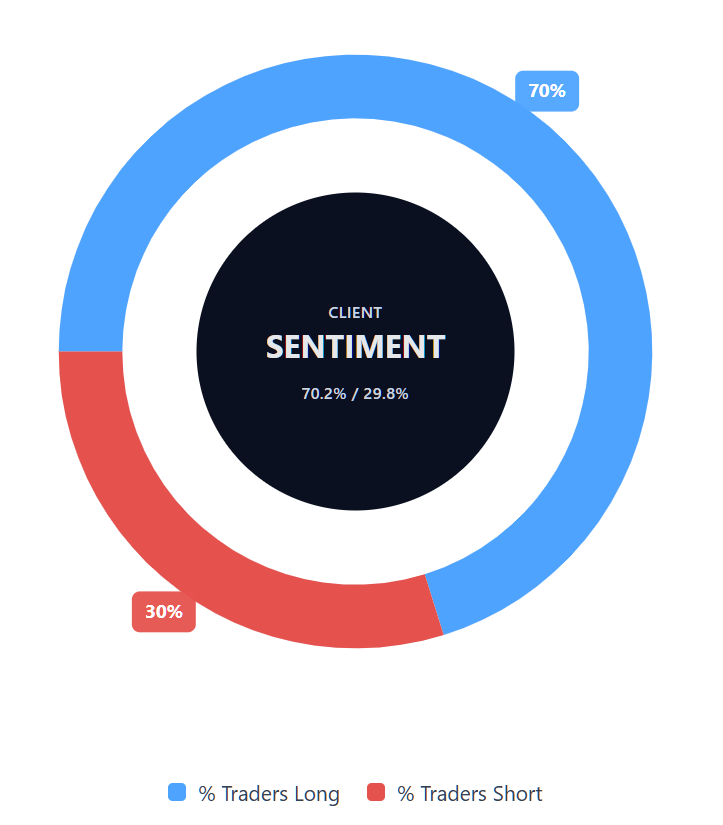
As of 12 March 2026, Capital.com client positioning in Germany 40 CFDs sits at 70.2% buyers vs 29.8% sellers, putting buyers ahead by 40.3 percentage points and placing sentiment in a one-sided, long-leaning range. This snapshot reflects open positions on Capital.com and can shift rapidly as market conditions evolve.
Summary – Germany 40 2026
- As of 2:30pm UTC on 12 March 2026, DE40 trades at €23,420, down approximately 4.5% year to date from a 1 January open of €24,521.
- The index gained around 23.5% through 2025, though an intraday low of €18,809 on 7 April 2025 illustrated the scale of volatility during that period.
- All 12 monitored moving averages are aligned to sell signals, with the 20/50/100/200-day SMAs stacked above current price between €24,165 and €24,753.
- The 14-day RSI reads 36.07, a lower-neutral reading consistent with sustained selling pressure; the ADX at 23.45 indicates directional movement without a strongly established trend.
- Key downside drivers include Brent crude above $100 per barrel, ECB rate-hike pricing of 30–35 basis points, and US tariff exposure weighing on German export-sensitive industrials.
Past performance is not a reliable indicator of future results.
FAQ
What is the 5 year Germany 40 forecast?
Is Germany 40 a good CFD to trade?
Could Germany 40 go up or down?
Should I invest in Germany 40?
Can I trade Germany 40 (DE40) CFDs on Capital.com?
Yes, you can trade Germany 40 CFDs on Capital.com. Trading index CFDs lets you speculate on price movements without owning the underlying asset and to take long or short positions. However, contracts for difference (CFDs) are traded on margin, and leverage amplifies both profits and losses. You should ensure you understand how CFD trading works, assess your risk tolerance, and recognise that losses can occur quickly.