
CaixaBank stock forecast: BPI exits Angola market
CaixaBank is a Spanish bank whose Portuguese unit, Banco BPI, agreed to sell its 33.35% stake in Banco de Fomento de Angola for €388.5m. Explore third-party CABK price targets and technical analysis. Past performance is not a reliable indicator of future results.
CaixaBank S.A. (CABK) was trading at €13.33 as of 10:33 UTC on 8 September 2026, within an intraday range of €13.17–€13.51. Past performance is not a reliable indicator of future results.
The stock has been in focus after CaixaBank's Portuguese unit, Banco BPI, agreed to sell its 33.35% stake in Banco de Fomento de Angola for €388.5m, marking its exit from the Angolan market (Reuters, 4 September 2026). Separately, a technical outage disrupted CaixaBank's mobile app and online banking platform across 7–8 September before services were restored (ADSLZone, 7 September 2026). The developments came as Spanish equities tracked changing expectations around US and euro-area monetary policy (CaixaBank, 4 September 2026).
Third-party CaixaBank outlook: BPI Angola exit
As of 8 September 2026, third-party CaixaBank stock predictions reflect different assumptions around lending growth, capital distribution and valuation.
Morgan Stanley (house forecast)
Morgan Stanley raised its CaixaBank price target to €13.80 from €13, leaving it above the share price cited at the time. The revision reflects its view that some valuation headroom remains despite gains across Spanish banking shares in 2026 (ad-hoc-news, 2 September 2026).
Oddo BHF (house forecast)
Oddo BHF raised its price target to €14.60 from €14 while maintaining an outperform rating. The revised target reflects the firm's updated valuation assumptions and remained above the share price cited at the time (MarketScreener, 3 September 2026).
Alantra Equities (house forecast)
Alantra Equities raised its price target to €14.70 from €13.80 while downgrading CaixaBank to neutral from buy. The combination highlights how a higher price target can accompany a more cautious overall rating (Zonebourse, 7 September 2026).
MarketScreener (consensus forecast)
MarketScreener's analyst panel gives CaixaBank an average target of €12.83, with estimates ranging from €6.80–€14.50. The spread shows the variation in expectations across the analysts tracked (MarketScreener, 8 September 2026).
Simply Wall St (valuation model forecast)
Simply Wall St's most-followed community valuation narrative puts CaixaBank's fair value at €11.93, below the share price cited in the analysis. A separate discounted cash flow model in the same article gives a higher estimate of €16.40, showing how different assumptions can produce contrasting valuations (Simply Wall St, 10 August 2026).
Predictions and third-party forecasts are inherently uncertain, as they cannot fully account for unexpected market developments. Past performance is not a reliable indicator of future results.
CaixaBank latest and upcoming earnings
CaixaBank filed its first-half 2026 results with Spain's securities regulator, the Comisión Nacional del Mercado de Valores (CNMV), on 29 July. Second-quarter net income rose 10% year on year to €1.631bn, while first-half net income increased 8.5% to €3.203bn.
Net interest income rose 3.5% year on year to €2.729bn in the quarter, while return on tangible equity (ROTE), a measure of profitability relative to tangible shareholder capital, stood at 18%, in line with the bank's full-year target of above 18%, according to Reuters.
The common equity tier 1 (CET1) capital ratio stood at 12.54%, while the non-performing loan ratio was 1.78%, with coverage at 81%. Shares fell 6% after the results as CaixaBank kept its 2026–2027 margin and profitability guidance unchanged, despite earnings exceeding analyst forecasts (Reuters, 29 July 2026).
CaixaBank's next scheduled results are due on 29 October 2026, covering the third quarter, according to MarketScreener's company calendar (Investing.com, 12 August 2026).
CABK stock price: technical overview
As of 10:33 UTC on 8 September 2026, the CABK stock price trades above its 20-, 50-, 100- and 200-day simple moving averages (SMAs), at around €13.12, €12.86, €12.14 and €11.27, respectively, according to TradingView. The 20-day SMA remains above the 50-day average, while the 200-day exponential moving average sits near €11.32.
The 14-day relative strength index (RSI) reads around 57.5, while the average directional index (ADX) near 10.5 indicates weak trend strength by conventional thresholds.
TradingView's classic pivot levels put R1 at €13.54 and R2 at €13.91. Below the current price, the central pivot sits near €13, followed by S1 at €12.62 and the 100-day SMA near €12.14. The 200-day SMA sits lower at €11.27. These are technical reference levels rather than indicators of where the price will move next (TradingView, 8 September 2026).
This is technical analysis for informational purposes only and does not constitute financial advice or a recommendation to buy or sell any instrument.
CaixaBank share price history (2024–2026)
CABK’s stock price closed at €5.43 on 9 September 2024 and more than doubled over the following two years. The stock spent much of late 2024 and early 2025 within the €5–€7 range before moving higher through the first half of 2025.
By September 2025, CaixaBank was trading around €8.69. Shares moved above €10 in February 2026 and remained above that level for most of the year, reaching a two-year intraday high of €13.58 on 4 September.
The stock also fell after second-quarter results on 29 July, moving from around €13.02 to €12.33 despite a 10% rise in net income, as the bank kept its 2026–2027 guidance unchanged.
CaixaBank closed at €13.32 on 8 September 2026, around 27.2% higher year to date and 53.3% higher year on year.

Past performance is not a reliable indicator of future results. Share prices are indicative and may differ from live market prices.
CaixaBank (CABK): Capital.com analyst view
CaixaBank shares rose from around €10.62 at the start of 2026 to €13.32 by 8 September, after reaching an intraday high of €13.58 on 4 September (ad-hoc-news, 6 September 2026). The move coincided with growth in lending and consumer credit and a 10% year-on-year rise in second-quarter net income (Reuters, 29 July 2026).
The July results also showed that stronger earnings do not necessarily translate into a higher share price. Shares fell after CaixaBank kept its 2026–2027 guidance unchanged, despite earnings exceeding analyst forecasts (Investing.com, 29 July 2026).
Lending and deposit growth and the sale of BPI's Angolan stake could support earnings or capital flexibility. Conversely, weaker margins, credit quality or economic conditions could weigh on the outlook.
Capital.com’s client sentiment for CaixaBank CFDs
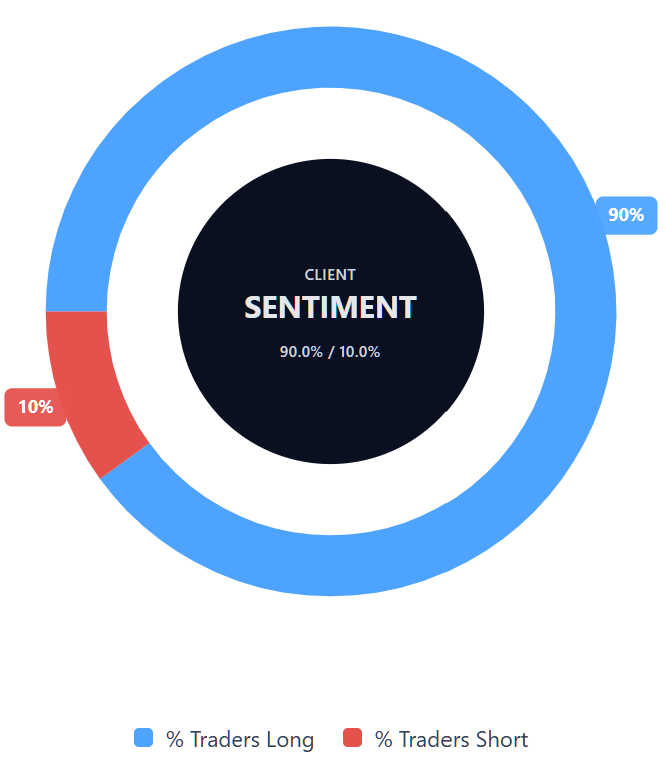
As of 8 September 2026, Capital.com client positioning in CaixaBank CFDs is 90% long and 10% short, a difference of 80 percentage points. This snapshot reflects open positions on Capital.com and can change.
Summary – CaixaBank 2026
- Current price: CaixaBank traded near €13.33 at 10:33 UTC on 8 September 2026, within an intraday range of €13.17–€13.51.
- Technical picture: the price was above its 20-, 50-, 100- and 200-day moving averages, with RSI near 57.5 and ADX indicating weak trend strength.
- Key influences: lending and consumer-credit growth, the BPI stake sale in Angola and analyst rating and price-target revisions could affect the outlook.
- Recent developments: attention has centred on the Angolan stake disposal, a temporary CaixaBankNow outage and analyst commentary following July's second-quarter results.
Past performance is not a reliable indicator of future results.
FAQ
Who owns the most CaixaBank stock?
This article does not cover CaixaBank’s largest shareholders or current ownership structure, so it does not identify who owns the most stock. Shareholdings can change over time as institutional and other investors adjust their positions. For the latest ownership breakdown, readers would need to consult CaixaBank’s regulatory filings, annual report or other official shareholder disclosures rather than the price, earnings and analyst forecast information covered here.
What is the five-year CaixaBank share price forecast?
The forecasts covered in this article do not extend to five years. Recent third-party estimates focus on shorter horizons, with figures ranging from €11.93–€16.40 depending on the broker or valuation model used. A five-year forecast would involve greater uncertainty because lending growth, margins, credit quality, capital distribution and economic conditions can change materially over time. Third-party forecasts can be revised and should not be treated as reliable indicators of future performance.
Is CaixaBank a good stock to buy?
Whether CaixaBank is suitable to buy depends on individual circumstances, objectives and risk tolerance, so this article does not make a recommendation. Potentially supportive factors include lending and deposit growth, higher reported earnings and capital flexibility following the BPI stake sale. However, weaker margins, deteriorating credit quality, softer economic conditions or valuation concerns could weigh on the shares. Analyst views also vary, showing that expectations for the stock are not uniform.
Could CaixaBank stock go up or down?
Yes. CaixaBank shares could move higher or lower as investors respond to earnings, lending growth, margins, credit quality, monetary policy and broader sentiment towards Spanish banks. Stronger earnings, resilient lending or improved capital flexibility could support the price. Conversely, weaker margins, rising bad loans, softer economic activity or more cautious guidance could weigh on it. The July results also showed that better-than-expected earnings do not always lead to a higher share price.
Should I invest in CaixaBank stock?
This article cannot determine whether you should invest in CaixaBank, as that would depend on your financial circumstances, objectives and tolerance for risk. It provides context on recent price performance, earnings, analyst targets and technical indicators rather than a recommendation. CaixaBank’s outlook includes both potentially supportive factors, such as lending growth and capital flexibility, and risks linked to margins, credit quality and economic conditions. Past performance and third-party forecasts do not guarantee future results.
Can I trade CaixaBank CFDs on Capital.com?
Yes, you can trade CaixaBank CFDs on Capital.com. Trading share CFDs lets you speculate on price movements without owning the underlying asset and to take long or short positions. However, contracts for difference (CFDs) are traded on margin, and leverage amplifies both profits and losses. You should ensure you understand how CFD trading works, assess your risk tolerance, and recognise that losses can occur quickly.