
Allianz stock forecast: DAX Pullback, ECB Hold, Oil Risks
Allianz shares have come under pressure as the DAX pulls back, the ECB holds rates and Middle East tensions lift oil prices and inflation concerns. Past performance is not a reliable indicator of future results. Explore third-party ALV price targets and technical analysis.
Allianz SE (ALV) is trading at €352.80 as of 12:35pm UTC on 25 March 2026, within an intraday range of €345.45–€354.70 on Capital.com's feed. Past performance is not a reliable indicator of future results.
The stock has declined approximately 9–11% year to date amid a broader pullback in the DAX, which has shed around 7.4% since the end of 2025 as geopolitical tensions in the Middle East pushed Brent crude higher and stoked stagflation concerns for the European economy (Trading Economics, 25 March 2026). The ECB held all three key interest rates unchanged on 19 March 2026, with the deposit facility remaining at 2%, while warning that conflict in the Middle East could create upside risks to inflation - a backdrop that can weigh on rate-sensitive financial names (Reuters, 19 March 2026).
Allianz stock forecast 2026–2030: Third-party price targets
As of 25 March 2026, third-party Allianz stock predictions reflect a cautious tone, shaped by sector-wide insurer headwinds, the ECB's hold decision on 19 March 2026, and Allianz's record full-year 2025 operating profit of €17.4 billion alongside a €2.5 billion share buyback.
Barclays (Underweight, price target)
Barclays reiterates an Underweight rating on ALV with a specific price target of €350 sitting marginally below the last price of €352.80 on Capital.com's feed as of 25 March 2026. The bank flags structural disruption risk from AI for the property-casualty insurance sector as a primary driver of its below-market target (MarketScreener, 23 March 2026).
Finanzen.net (Barclays Underweight reiteration)
Finanzen.net reports the same Barclays action, confirming the Underweight designation and the €350 ALV stock forecast, adding that analyst Claudia Gaspari leads the coverage note. The reiteration follows a broader Barclays review of European insurers amid rising corporate insolvency rates, which Allianz Trade's own data places approximately 24% above pre-pandemic averages for 2026 (Finanzen.net, 23 March 2026).
Yahoo Finance (analyst consensus, recent capture)
Yahoo Finance's analyst data reflects a pool of broker estimates for ALV that collectively signal a modest implied upside from the €350–€353 trading range, with the consensus skewed by a mix of Hold and cautious ratings following the Barclays action. Analysts cited in the aggregation point to Allianz's strong capital position and record 2025 profits as supportive of current price levels, while flagging macro and sector risks as limiting near-term target upgrades (Yahoo Finance, 25 March 2026).
Predictions and third-party forecasts are inherently uncertain, as they cannot fully account for unexpected market developments. Past performance is not a reliable indicator of future results.
ALV stock price: Technical overview
The ALV stock price trades at €352.80 as of 12:35pm UTC on 25 March 2026, sitting below a descending moving-average stack where the 20/50/100/200-day SMAs stand at approximately €357 / €368 / €370 / €362, all generating sell signals on TradingView's indicator suite. The Hull moving average (9) at €348.1 registers a buy signal, while the 10-day EMA at €353.5 also reads as a buy, reflecting the brief recovery from the intraday low of €345.45 but leaving the price sandwiched between short-term recovery momentum and medium-term overhead pressure. The average directional index (14) at 28.8 indicates that an established trend is in place, consistent with the sustained downward slope of the broader moving-average cluster (TradingView, 25 March 2026).
The 14-day relative strength index sits at 44.2, a neutral reading that places the price in the lower half of the oscillator's range without yet reaching oversold territory. The MACD (12, 26) level of -5.2 also reads as a buy on TradingView, suggesting that the signal line may be turning, though the negative absolute level reflects the broader downtrend context.
On the topside, the classic R1 pivot at €392.2 represents the first reference above the current price; a daily close above that level would put the R2 zone near €402.1 in view. On the downside, the classic pivot (P) at €378.9 sits above the current last price, meaning ALV is already trading beneath its daily pivot, with S1 at €369.0 as the next classic reference. The 100-day SMA shelf near €370.2 and S2 at €355.7 are proximate supports; a sustained move below €355.7 would bring the S3 level near €332.5 into the broader frame (TradingView, 25 March 2026).
This technical analysis is provided for informational purposes only and does not constitute financial advice or a recommendation to buy or sell any instrument.
Allianz share price history (2024–2026)
ALV’s stock price closed at €277.50 on 26 March 2024 and has risen approximately 27.5% over the two years to 25 March 2026, though the path has been far from smooth.
The stock built steadily through late 2024 and into early 2025, reaching levels above €390 by late 2024. That momentum stalled sharply in April 2025, when a broad European equity sell-off pushed ALV to an intraday low of €309.25 on 9 April 2025 - the deepest pullback in the two-year window. The stock recovered through the summer and autumn of 2025, reclaiming the €390 area by year-end, with ALV closing 2025 at €392.30 on 30 December.
2026 has been tougher. ALV opened the year at €387.40 on 2 January, briefly touched highs near €392.70 in early February, then sold off through March as macro headwinds weighed on European equities. ALV closed at €353.70 on 25 March 2026, down approximately 8.7% year to date and roughly flat year on year against its €356.90 close on 25 March 2025.

Past performance is not a reliable indicator of future results. Share prices are indicative and may differ from live market prices.
Allianz (ALV): Capital.com analyst view
Allianz SE's price performance over the past two years reflects the tension between strong company fundamentals and a challenging macroeconomic backdrop. The insurer reported a record operating profit of €17.4 billion for full-year 2025 and announced an 11% dividend increase alongside a €2.5 billion share buyback - measures that signal confidence in the group's capital position. Yet the stock has struggled to hold gains in early 2026, retreating roughly 8.7% year to date as rising corporate insolvency rates, ECB policy uncertainty, and broader DAX weakness weigh on sentiment. Bulls point to Allianz's earnings resilience and income appeal; bears note that Barclays maintained an Underweight rating with a €350 target as recently as 23 March 2026, citing structural disruption risk from AI for the property-casualty insurance sector.
The wider picture is similarly mixed. A stabilising European rate environment could support Allianz's investment income over time, though any renewed inflationary pressure could prompt the ECB to hold rates higher for longer, complicating the valuation outlook. Equally, the group's global diversification across life, asset management, and commercial lines offers some buffer against regional shocks, while also exposing it to geopolitical and currency risks that are difficult to price.
Capital.com’s client sentiment for Allianz CFDs
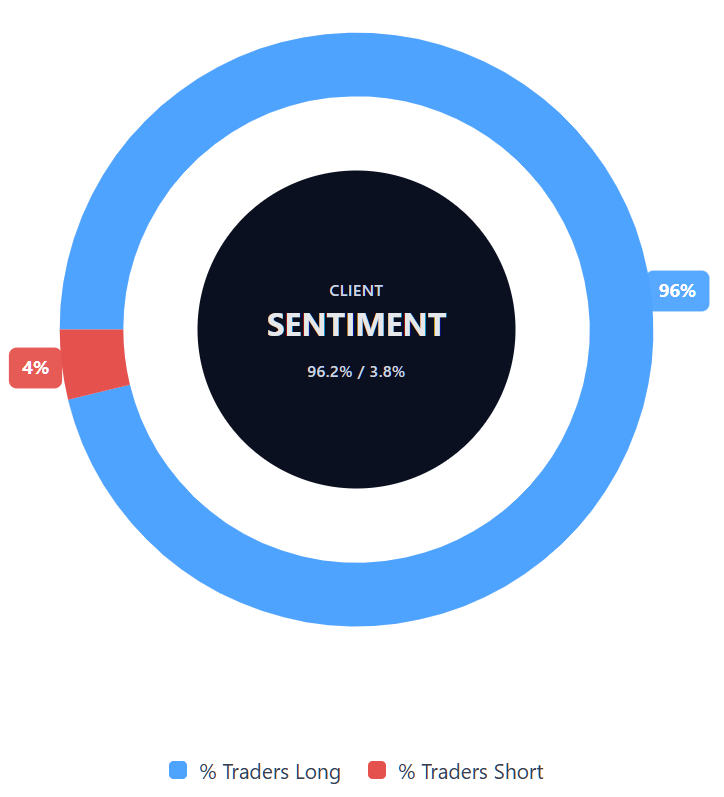
As of 25 March 2026, Capital.com client positioning in Allianz CFDs is skewed: 96.2% long and 3.8% short, putting buyers ahead by 92.4 percentage points and placing sentiment firmly in a heavy-buy, one-sided-long territory. This snapshot reflects open positions on Capital.com and can change.
Summary – Allianz 2026
- ALV trades at €352.80 as of 12:35pm UTC on 25 March 2026, down approximately 8.7% year to date but around 27.5% above its level from March 2024.
- Technical indicators are broadly bearish: the price sits below all key moving averages from the 20-day to the 200-day SMA, with the 14-day RSI at a neutral 44.2 and the ADX at 28.8 signalling an established downtrend.
- The classic daily pivot (P) at €378.90 sits above the current price, with S1 at €369 and S2 at €355.70 as the nearest downside references on TradingView's pivot framework.
- Key drivers include ECB monetary policy following the 19 March 2026 hold, broader DAX weakness, corporate insolvency rates running approximately 24% above pre-pandemic averages, and structural AI disruption risk flagged for the property-casualty insurance sector.
- Allianz reported a record operating profit of €17.4 billion for full-year 2025, proposed an 11% dividend increase, and launched a €2.5 billion share buyback - providing fundamental support contested by cautious analyst ratings.
Past performance is not a reliable indicator of future results.
FAQ
Who owns the most Allianz stock?
Allianz SE’s share register is widely distributed across institutional and retail investors, so ownership can change over time. Large asset managers and investment funds are typically among the biggest holders, alongside insurers, pension funds and index-tracking vehicles. Because positions can shift with fund flows, rebalancing and market conditions, the largest shareholder at one point may not remain the largest for long. Investors should check the latest regulatory filings and company disclosures for the most current ownership data.
What is the 5 year Allianz share price forecast?
A five-year ALV stock forecast is uncertain because it depends on several variables, including earnings growth, interest rates, claims trends, economic conditions and broader sentiment towards European financial stocks. Analyst price targets usually focus on the next 12 months rather than a full five-year horizon. Longer-term scenarios are better viewed as possibilities rather than predictions. Any outlook should be weighed against changing market conditions, company performance and the risks that can affect insurer valuations over time.
Is Allianz a good stock to buy?
Whether Allianz is a good stock to buy depends on an investor’s goals, risk tolerance and time horizon. The company’s recent record operating profit, proposed dividend increase and share buyback may appeal to investors looking at income and capital strength. At the same time, sector pressures, macroeconomic uncertainty and cautious analyst ratings show that risks remain. Rather than treating it as universally attractive or unattractive, it may be more useful to assess how Allianz fits within a broader strategy.
Could Allianz stock go up or down?
Should I invest in Allianz stock?
Whether someone should invest in Allianz stock is a personal decision, not a general recommendation. Investors usually consider factors such as valuation, dividend policy, growth prospects, balance sheet strength and exposure to market or sector risks before making that choice. Allianz’s recent fundamentals may look supportive to some, while others may focus more on cautious broker views and the weaker year-to-date share performance. Personal objectives, financial circumstances and risk appetite should guide any investment decision.
Can I trade Allianz CFDs on Capital.com?
Yes, you can trade Allianz CFDs on Capital.com. Trading share CFDs lets you speculate on price movements without owning the underlying asset and to take long or short positions. However, contracts for difference (CFDs) are traded on margin, and leverage amplifies both profits and losses. You should ensure you understand how CFD trading works, assess your risk tolerance, and recognise that losses can occur quickly.