
Allianz stock forecast: record H1 profit, Q3 earnings ahead
Allianz is a German insurer whose shares are trading near record levels following record first-half operating profit and reports of a possible €5.8 billion acquisition of AA. Explore third-party ALV targets and technicals. Past performance is not a reliable indicator of future results.
Allianz SE (ALV) is trading around €447.95 in early European trading at 8:44am UTC on 7 September 2026, within an intraday range of €446.75–€451.80. Past performance is not a reliable indicator of future results.
The stock remains near record levels as investors assess several corporate developments. Allianz has reportedly shown interest in a roughly €5.8 billion ($6.77 billion) acquisition of UK roadside assistance provider AA, although talks remain unconfirmed and no transaction has been completed (Insurance Age, 3 September 2026). The insurer has also announced a board reshuffle that will reduce its executive committee from nine to eight members by year-end 2026, with Günther Thallinger and Klaus-Peter Röhler departing (ad-hoc-news, 3 September 2026).
These developments follow record first-half 2026 results, with operating profit of €9.4 billion, up 8.6% on the prior-year period (Allianz, 7 August 2026).
Allianz stock outlook: H1 results, potential AA acquisition
As of 7 September 2026, third-party Allianz stock predictions show a broad range of 12-month projections. This reflects differing views on the insurer's valuation following its record first-half operating result.
Below are individually attributed forecasts, ranked from lowest to highest, followed by the broader analyst consensus.
Barclays (Underweight)
Barclays projects a 12-month price target of €353 for Allianz, below the prevailing share price. The bank raised its previous €350 target to €353 while retaining its Underweight rating (finanzen.net, 4 September 2026).
Morningstar (Sell)
Morningstar set a fair value estimate of €412 for Allianz and downgraded its recommendation from Neutral to Sell. Its estimate sits below the prevailing share price, indicating that Morningstar considers the shares above its assessment of fair value (MarketScreener, 27 August 2026).
Goldman Sachs (Buy)
Goldman Sachs projects a price target of €465 for Allianz, up from €450, while maintaining its Buy rating. The target sits above the prevailing share price and represents the bank's 12-month valuation (boerse-express, 28 August 2026).
Citigroup (Neutral)
Citigroup projects a price target of €467.50 for Allianz, up from €411.70, while retaining its Neutral rating. Although the revised target sits above the prevailing share price, the bank left its rating unchanged (finanztrends.de, 26 August 2026).
Investing.com consensus (15 analysts) (Outperform)
A compilation of 15 analysts covering Allianz gives an average 12-month price target of €439.22, slightly below the prevailing share price. Individual estimates range from €325 to €684 (Investing.com, 4 September 2026).
Predictions and third-party forecasts are inherently uncertain, as they cannot fully account for unexpected market developments. Past performance is not a reliable indicator of future results.
Allianz earnings: latest results and next report
Allianz released its second-quarter and first-half 2026 results on 7 August 2026, reporting record operating profit of €4.9 billion for the quarter, up 10.6% year on year, and €9.4 billion for the first half. The company attributed the increase to contributions across all three business segments.
- Total business volume reached €45.6 billion in the second quarter, with Asset Management contributing to growth.
- The Property-Casualty division reported a combined ratio of 91.4%, a measure commonly used to assess underwriting performance in non-life insurance.
- The group's Solvency II ratio, a regulatory measure of capital adequacy, stood at 225% at mid-year. Allianz described this as providing a buffer above regulatory requirements.
- Shareholders' core net income for the quarter was €2.6 billion, 12.7% below the prior-year period.
- Management reaffirmed full-year 2026 operating profit guidance of €17.4 billion, plus or minus €1 billion, alongside its existing €2.5 billion share buyback programme.
Allianz's next scheduled earnings release, covering third-quarter and nine-month 2026 results, falls on 12 November 2026. The company is due to publish its quarterly earnings release and financial supplement, followed by media and analyst conference calls (Allianz, 7 September 2026).
Results above or below market expectations could affect the share price in either direction. Investors may also assess changes to guidance, capital returns and performance across Allianz's individual business segments.
ALV stock price: technical overview
As of 8:44am UTC on 7 September 2026, the ALV stock price trades near €447.95, above its 20-, 50-, 100- and 200-day simple moving averages at approximately €445, €433, €410 and €391, respectively. The shorter-term averages remain above the longer-term measures, providing context for the stock's recent upward price trend, according to data from TradingView.
Momentum indicators provide further context. The 14-day relative strength index (RSI) stands at 56.4. RSI measures the speed and scale of recent price movements on a scale from zero to 100, with readings above 70 and below 30 commonly associated with overbought and oversold conditions, respectively.
The average directional index (ADX) stands at 31.2. ADX measures trend strength rather than direction, with higher readings generally associated with a more established trend, according to TradingView.
The nearest classic pivot resistance stands at €459, followed by €467.30, based on TradingView data. A move above these levels could bring higher technical reference points into focus, while rejection around them could leave the price trading within its recent range.
On the downside, the classic pivot point at €445.20 provides an initial technical reference close to the 20-day simple moving average. The 100-day simple moving average near €410 provides a more distant reference if the price falls further.
The Hull moving average (9) sits at €450.50, slightly above the current price, providing another technical level monitored by some traders (TradingView, 7 September 2026).
This is technical analysis for informational purposes only and does not constitute financial advice or a recommendation to buy or sell any instrument.
Allianz share price history (2024–2026)
In September 2024, ALV’s stock price traded around €284 before rising through the autumn and winter.
A significant decline occurred on 7 April 2025, when the stock fell to an intraday low of €287.40 amid broader market turmoil following sweeping US tariff announcements. The move reversed several months of gains during the session, although the price subsequently recovered above €360 by late April.
Allianz then continued higher through much of 2026 during a period that included record operating profits, share buyback activity and reports of a possible AA transaction. The stock reached an all-time high of €460.50 on 4 September 2026.
Allianz closed at €448.15 on 7 September 2026, around 14.2% higher year to date and 26.9% higher year on year.
Past or simulated past performance is not a reliable indicator of future results.

Past performance is not a reliable indicator of future results. Share prices are indicative and may differ from live market prices.
Allianz (ALV): Capital.com analyst view
Allianz's share price rose from around €387.40 at the start of 2026 to levels near €450 by early September. The move took place alongside record operating profit, continued share buybacks and reports of a potential acquisition of UK roadside assistance provider AA.
These factors could influence the stock differently over time. Higher earnings or continued capital returns may support investors' assessment of Allianz's valuation, while weaker results or changes to guidance could weigh on it.
A potential AA transaction could broaden Allianz's business if completed, but the outcome remains uncertain. Investors would need to weigh any possible strategic benefits against the purchase price, financing, integration costs and execution risks. If the market viewed the terms favourably, the shares could respond positively; concerns over valuation or integration could have the opposite effect.
The insurer's diversified operations across property and casualty, life and health, and asset management may also reduce its dependence on any one business line. However, diversification does not remove exposure to claims volatility, changing interest rates, financial-market conditions or broader economic growth.
The wide spread between individual analyst targets reflects this mixed backdrop. Some forecasts sit above the current price, while others point lower, illustrating how assumptions about earnings, valuation and future conditions can produce different outcomes.
Capital.com’s client sentiment for Allianz CFDs
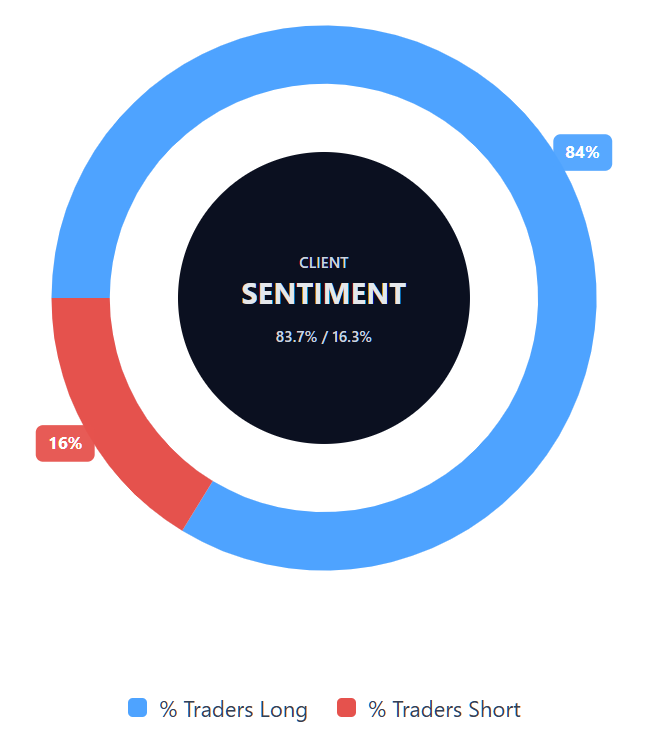
As of 7 September 2026, Capital.com client positioning in Allianz CFDs is weighted towards long positions, with buyers accounting for 83.7% of open positions and sellers 16.3%.
This represents a 67.4-percentage-point difference between the two sides. It shows how Capital.com clients were positioned at the time of the snapshot, rather than indicating how the market will move next.
Client sentiment reflects Capital.com positions only and can change over time.
Summary – Allianz 2026
- As of 8:44am UTC on 7 September 2026, Allianz (ALV) was trading near €447.95, within an intraday range of €446.75–€451.80.
- Recent developments include record first-half operating profit, continued share buybacks, a management reshuffle and reported interest in acquiring AA.
- A potential AA transaction could influence the share price positively or negatively depending on its terms, financing and execution, if a deal proceeds.
- Allianz is due to report its third-quarter and nine-month 2026 results on 12 November 2026.
Past performance is not a reliable indicator of future results.
FAQ
Who owns the most Allianz stock?
The article does not identify Allianz’s largest shareholder, so it would be misleading to name one here without separate ownership data. Allianz is a publicly listed company, meaning its shares are held by a mix of institutional and individual investors. Ownership levels can change over time as investors buy and sell shares, so current shareholder information should be checked against up-to-date company filings or other reliable market data.
What is the five-year Allianz share price forecast?
The article does not provide a five-year ALV stock forecast. The third-party forecasts covered here focus on 12-month price targets, which range from €353 to €467.50 among the individual analysts reviewed, while the 15-analyst consensus stands at €439.22. Longer-term forecasts involve greater uncertainty because earnings, interest rates, claims trends, corporate activity and broader market conditions can all change over time.
Is Allianz a good stock to buy?
Whether Allianz is a suitable stock to buy depends on an individual’s objectives, risk tolerance and view of the company’s outlook. The article highlights several factors investors may consider, including record first-half operating profit, share buybacks, analyst valuation differences and the possible AA transaction. It also notes risks such as claims volatility, changing interest rates, execution risk and broader economic conditions. This information should not be treated as investment advice.
Could Allianz stock go up or down?
Yes. Allianz shares could move in either direction depending on how investors respond to future developments. Stronger earnings, favourable guidance or capital returns could support the share price, while weaker results, higher claims costs or changing market conditions could weigh on it. A potential AA acquisition could also be viewed positively or negatively depending on its terms, financing and execution. Technical indicators and analyst forecasts cannot reliably predict future price movements.
Should I invest in Allianz stock?
The article does not make a recommendation on whether to invest in Allianz. Instead, it presents factors that may influence the share price, including earnings, valuation, interest rates, claims trends, corporate activity and wider market conditions. Analyst forecasts also differ significantly, showing that expectations are not uniform. Any decision to invest should reflect your own financial circumstances, objectives and tolerance for risk, rather than relying on forecasts or past share-price performance alone.
Can I trade Allianz CFDs on Capital.com?
Yes, you can trade Allianz CFDs on Capital.com. Trading share CFDs lets you speculate on price movements without owning the underlying asset and to take long or short positions. However, contracts for difference (CFDs) are traded on margin, and leverage amplifies both profits and losses. You should ensure you understand how CFD trading works, assess your risk tolerance, and recognise that losses can occur quickly.