
Costco stock forecast: Third-party price targets
Costco Wholesale Corporation is a US-listed retailer operating membership-based warehouse clubs globally, generating revenue from bulk merchandise sales, private-label products and annual membership fees. Explore third-party COST price targets and technical analysis.
Costco Wholesale Corporation (COST) is trading around $1,018.29 in Monday’s U.S. session, within an intraday range of $976.95–$1,021.87 as of 3:53pm UTC on 16 February 2026. Past performance is not a reliable indicator of future results.
The move follows recent fundamental updates. Costco reported first-quarter fiscal 2026 revenue of $67.3bn and diluted earnings per share of $4.50 for the 12 weeks ended 23 November 2025, alongside comparable sales growth of 6.4% and digitally enabled sales up 20.5% (GlobeNewswire, 11 December 2026). The company also reported December 2025 net sales of $29.86bn, up 8.5% year on year, with membership-fee income and e-commerce remaining key contributors (Yahoo Finance, 7 January 2026).
Costco stock forecast 2026–2030: Third-party price targets
As of 16 February 2026, third-party Costco stock predictions cluster around a 12-month range in the low-to-mid-$1,000s, based on updated broker research and consensus summaries. These targets typically cover a 12-month horizon and rely on assumptions about earnings growth, comparable sales trends, membership income and valuation relative to peers. They represent third-party opinions, not guarantees of future performance.
Mizuho (broker update)
Mizuho raises its Costco 12-month price target to $1,065 from $1,000, maintaining an Outperform rating. The broker cites expectations of continued top-line momentum, with January U.S. comparable sales excluding fuel seen in the low single-digit growth range, supported by member demand and traffic trends (Investing.com, 3 February 2026).
DA Davidson (broker rating note)
DA Davidson reiterates a Neutral rating with a $1,000 price target. The note highlights valuation considerations following a strong share-price run, stating that Costco’s premium multiple may balance solid fundamentals against potentially more limited upside from current levels (MarketBeat, 5 February 2026).
Bernstein (via news recap)
Bernstein adjusts its COST stock forecast to $1,155 from $1,146 while maintaining an Outperform stance. The update refers to strength in membership renewals and international growth, set against a mixed U.S. retail environment and softer consumer-confidence readings (Yahoo Finance, 12 February 2026).
TradingKey (market movers summary)
TradingKey cites a consensus analyst target of around $1,009, alongside a ‘Moderate Buy’ average rating. The article links this level to expectations of continued profit expansion and steady membership-fee income, while noting that analysts are monitoring how much recent same-store sales and e-commerce performance may already be reflected in the share price (TradingKey, 12 February 2026).
Predictions and third-party forecasts are inherently uncertain, as they cannot fully account for unexpected market developments. Past performance is not a reliable indicator of future results.
COST stock price: Technical overview
On the daily chart, the COST stock price is trading around $1,018 as of 3:53pm UTC on 16 February 2026, holding above a rising cluster of moving averages. The 20-, 50-, 100- and 200-day SMAs sit near 978, 923, 923 and 952 respectively. With the 20-day average above the 50-day and price also above the 10-day SMA near 988, the near-term structure remains supported. The 14-day RSI stands near 68, within the 60–70 band, while the ADX around 32 indicates an established trend.
On the upside, the classic R1 pivot near 1,005 acts as an initial reference level, with R2 around 1,069 in view if price records a sustained daily close above that area. The prior intraday high near 1,020 remains a nearby round-number focus. On pullbacks, initial support appears near the classic pivot around 929, followed by the 100-day SMA close to 923. A move below this zone would expose the S1 level near 864 in a deeper correction (TradingView, 16 February 2026).
Technical analysis reflects historical price action and does not predict future movements.
Costco share price history (2024–2026)
COST’s stock price has moved higher overall over the past two years, rising from the low-$700s in early 2024 to close at $1,018.29 on 13 February 2026. During this period, the stock recorded several upward phases, including a climb from around $722.65 on 1 May 2024 to above $820 by late June, and another move from roughly $810.90 at the end of May 2024 into the high-$800s by early July.
After consolidating in the $800–$900 range through late 2024 and much of 2025, COST traded largely between the mid-$900s and just above $1,000 in mid-2025. It then declined towards $855.05 at the start of 2026 before rebounding. By late January 2026, the share price had recovered to around $940.36, and in February it extended its advance, with prices moving from $968.05 on 2 February to $1,018.29 on 13 February 2026.

Past performance is not a reliable indicator of future results. Share prices are indicative and may differ from live market prices.
Costco (COST): Capital.com analyst view
Costco’s share price is trading near recent highs in early 2026, following a move from the mid-$800s in late 2024 to above $1,000 in February 2026. Third-party analysts often cite revenue growth in fiscal 2025, rising membership-fee income and a solid balance sheet, alongside planned warehouse expansion and continued demand for bulk retail formats, as supportive factors. However, a different interpretation is that the current valuation may increase sensitivity to slower consumer spending or quarterly results that fall short of expectations, particularly if market participants reassess growth assumptions embedded in the price.
At the same time, external research frequently identifies valuation as a key variable for future performance, with the stock trading on earnings multiples above those of many retail peers and the broader market. Some analysts argue that a premium multiple can persist if membership renewals remain high and like-for-like sales continue at a steady pace. Others suggest that margin pressure, tariff developments or a broader retail slowdown could lead to multiple compression, even if revenues continue to expand. As with any actively traded equity, these differing perspectives highlight that Costco’s share price can move higher or lower as new information on earnings, macroeconomic conditions and sector trends becomes available.
Capital.com’s client sentiment for Costco CFDs
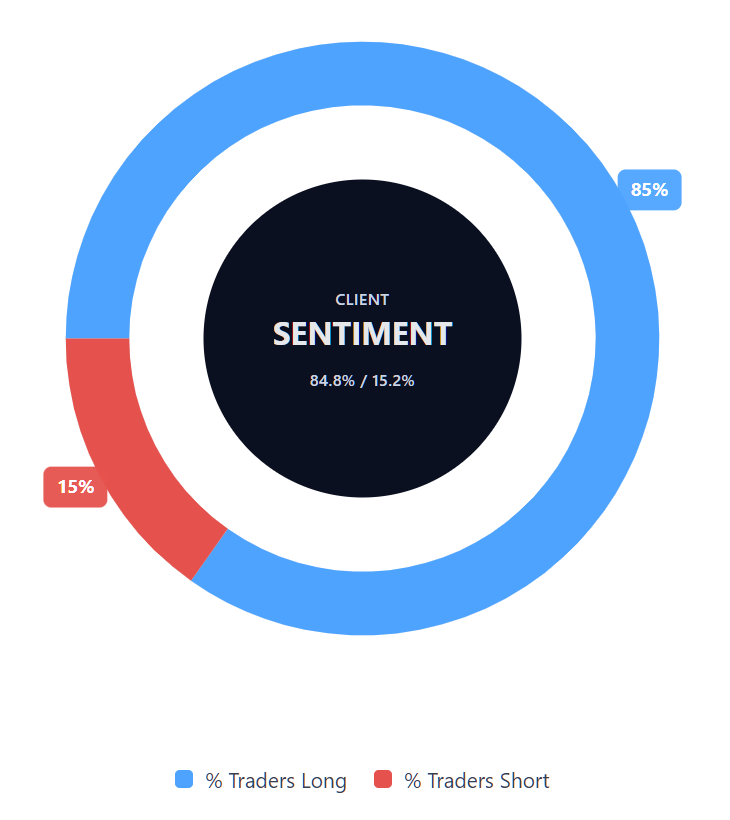
As of 16 February 2026, Capital.com client positioning in Costco CFDs currently shows 84.8% of open positions on the long side and 15.2% on the short side, a difference of 69.6 percentage points in favour of buyers. This reflects internal platform data at a specific point in time and does not indicate future price direction.
Summary – Costco 2026
- Costco (COST) is trading around $1,018 as of 16 February 2026, near the upper end of its recent intraday range.
- Trend indicators on the daily chart show price holding above rising medium- and long-term moving averages, with momentum measures in positive territory.
- External analyst research presents a range of 12-month price targets broadly between $1,000 and the mid-$1,100s, while also noting valuation as a key factor that could influence future performance.
Past performance is not a reliable indicator of future results.