
Telefónica stock forecast: Third-party price targets
Telefónica is a Spanish telecommunications company listed in Madrid, with operations across Europe and Latin America. Explore third-party TEF price targets and technical analysis.
Telefónica, S.A. (TEF) is trading around €3.36 in intraday European dealing on 23 January 2026, within a session range of approximately €3.26–€3.37 on Capital.com’s platform as of 10:51am UTC. Past performance is not a reliable indicator of future results.
Price action is unfolding amid several recent corporate and capital-market developments, including Telefónica’s move to voluntarily deregister from the US Securities and Exchange Commission and delist its American Depositary Shares from the NYSE (Reuters, 17 December 2025), a step expected to end SEC reporting obligations following a transition period (MarketScreener, 20 January 2026). The stock is also trading in the context of the company’s latest available quarterly results, which showed modest year-on-year organic revenue growth of around 0.4% in the third quarter of 2025, supported by contributions from Spain and Brazil, while reported figures were affected by foreign-exchange headwinds (Reuters, 4 November 2025).
Telefónica stock forecast 2026–2030: Third-party price targets
As of 23 January 2026, third-party Telefónica stock predictions show a range of 12-month price objectives between about €2.60 and €5 per share, based on broker research published over the previous six months. These targets are generally framed as full-year or rolling 12-month fair-value estimates rather than precise year-end prices, and they reflect differing views on leverage, cash generation, competitive pressures and regulatory conditions across the group’s core markets.
New Street Research (lower-end target)
New Street Research maintains a ‘reduce’ stance in its TEF stock forecast with a target price of €2.60, placing its 12-month fair-value estimate at the lower end of the current broker range. The firm’s view reflects caution around structural challenges in European telecoms and the group’s balance-sheet constraints, as referenced in the company’s compiled analyst recommendation table (Telefónica, 20 January 2026).
Bank of America (underperform view)
Bank of America keeps an underperform rating on Telefónica with a target price of €3, based on research most recently updated in January 2026. The bank’s stance reflects caution around earnings momentum and sector headwinds in European telecoms, including competitive intensity and regulatory pressure in key markets (Telefónica, 15 January 2026).
Goldman Sachs (buy rating)
Goldman Sachs maintains a buy recommendation with a €4.50 target price for Telefónica. The bank points to potential benefits from cost-efficiency initiatives and asset monetisation, alongside exposure to higher-growth Latin American operations, as factors supporting its more constructive valuation view (Longbridge, 10 January 2026).
Berenberg (hold stance)
Berenberg reiterates a hold rating with a €3.50 target price. The broker highlights a more balanced risk-reward profile as the group continues to focus on deleveraging and portfolio simplification, against a backdrop of ongoing competition in its home market (The Globe and Mail, 13 January 2026).
Predictions and third-party forecasts are inherently uncertain, as they cannot fully account for unexpected market developments. Past performance is not a reliable indicator of future results.
TEF stock price: Technical overview
The TEF stock price is trading around €3.36 as of 10:51am UTC on 23 January 2026, positioned below its main daily moving-average cluster, with the 20-, 50-, 100- and 200-day simple moving averages near €3.40, €3.54, €3.95 and €4.25 respectively. The 14-day RSI sits around 40.8 in the lower-neutral band, while an ADX reading near 45 points to an established trend backdrop, even as price remains below recent moving-average levels.
On the topside, the nearest classic pivot resistance sits at R1 around €3.71, with R2 near €3.92 only coming into focus following a sustained daily close above the first resistance zone. On pullbacks, the classic pivot at approximately €3.54 acts as an initial support reference, followed by S1 around €3.32 as a lower nearby support area, while the 100-day SMA near €3.95 remains a higher-level moving-average reference (TradingView, 23 January 2026).
This technical analysis is provided for informational purposes only and does not constitute financial advice or a recommendation to buy or sell any instrument.
Telefónica share price history (2024–2026)
TEF’s stock price has spent much of the past two years trading within a relatively narrow range around the mid-€3 to low-€4 area, interrupted by several shorter-lived rallies. The stock ended 2024 at around €3.95 on 31 December, after spending much of mid-2024 just above €4, before briefly moving towards the mid-€4s in mid-December and easing back into year-end.
During 2025, the price initially held between roughly €4 and €4.50, before pushing towards the €4.90 area in August. A steadier decline through the final quarter saw the stock close the year at about €3.52 on 31 December. By 23 January 2026, Telefónica was trading around €3.36, leaving it below the mid-2025 highs but still above some of the lower levels seen earlier in the two-year period.

Past performance is not a reliable indicator of future results. Share prices are indicative and may differ from live market prices.
Telefónica (TEF): Capital.com analyst view
Telefónica’s share price has oscillated between the high-€3 and mid-€4 area over the past two years, with 2025 marked by a move towards the upper end of that range before a gradual pullback into year-end. Recent quarterly updates have pointed to modest organic revenue growth and continued contributions from core markets such as Spain and Brazil, which may influence sentiment, while the price has also responded to periods of broader telecom-sector caution and changing expectations around dividends and cash returns.
From a broader driver perspective, steady cash generation, ongoing cost-efficiency initiatives and portfolio reshaping in Latin America may support investor interest, while sector commentary continues to highlight structural challenges for European operators, including competition, regulation and sustained investment requirements in fibre and 5G. At the same time, efforts to streamline the balance sheet, refine dividend policy and pursue savings targets can enhance financial flexibility, but may also weigh on income-focused investors or contribute to shorter-term price volatility if expectations shift.
Capital.com’s client sentiment for Telefónica CFDs
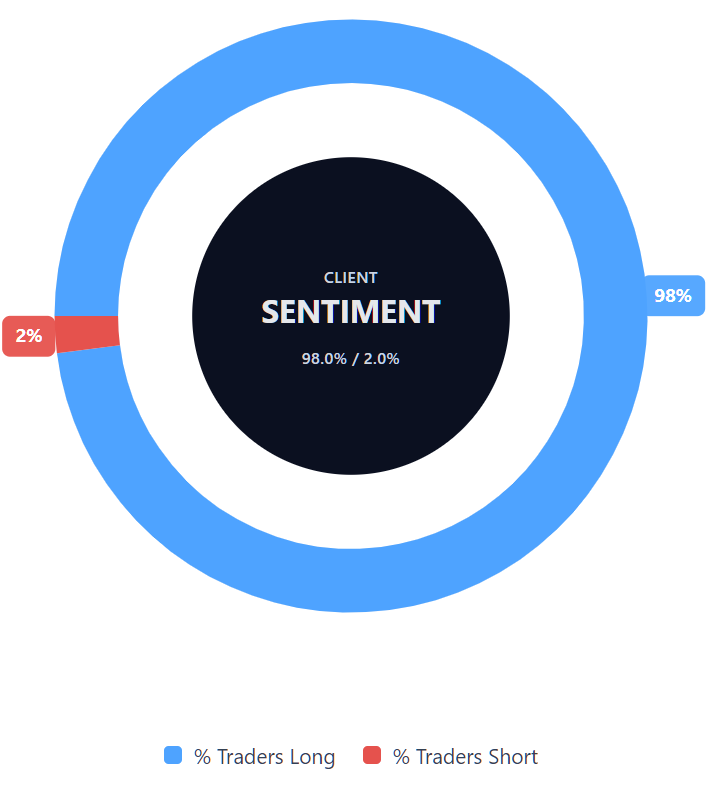
As of 23 January 2026, Capital.com client positioning in Telefónica CFDs remains heavily skewed towards long positions, with buyers accounting for 98% versus sellers at 2%, a difference of around 96 percentage points. This snapshot reflects open positions on Capital.com at the time and can change.
Summary – Telefónica 2026
- Telefónica traded largely between approximately €4 and €4.70 through much of 2025 before easing back towards the mid-€3 area into year-end, closing near €3.52 on 31 December 2025.
- As of 23 January 2026, the shares trade around €3.36, below the 2025 highs but still within the broader mid-€3 to mid-€4 range observed over the past two years.
- Daily technical indicators show the price sitting below the main 20-, 50-, 100- and 200-day moving averages, with the 14-day RSI in lower-neutral territory and an elevated ADX indicating a well-established trend environment.
- Intraday pivot levels place nearby resistance around €3.71, with initial support at the €3.54 pivot and a lower reference area near €3.32 marking the next notable downside level.
Past performance is not a reliable indicator of future results.
FAQ
Who owns the most Telefónica stock?
Telefónica has a broad and diversified shareholder base, with ownership spread across institutional investors, asset managers and retail shareholders. No single investor is reported to hold a controlling stake in the company. Large global funds and pension managers typically feature among the largest shareholders, reflecting Telefónica’s inclusion in major European equity indices. The Spanish state does not hold a majority position, and ownership levels can change over time as institutions adjust their holdings.
What is the five-year Telefónica share price forecast?
There is no single agreed five-year TEF stock forecast. Most published analyst targets focus on shorter, typically 12-month, horizons rather than longer-term projections. Longer-term outcomes are more often discussed in terms of potential drivers, such as cash generation, leverage trends, competitive conditions and regulatory developments, rather than specific price levels. As with all equities, longer-term forecasts involve a high degree of uncertainty and can change as new information emerges.
Is Telefónica a good stock to buy?
Whether Telefónica is considered a good stock depends on individual objectives, time horizons and risk tolerance. Analysts currently express a range of views, reflecting differing assessments of balance-sheet progress, cash flow stability and competitive pressures in European telecoms. Some focus on cost controls and exposure to Latin America, while others highlight ongoing structural challenges in the sector. This content is for information only and does not constitute investment advice, and outcomes may differ from expectations.
Could Telefónica stock go up or down?
Like all publicly traded shares, Telefónica’s stock price can move both up and down. Price movements may reflect company-specific factors such as earnings updates, balance-sheet actions or strategic decisions, as well as broader influences including sector trends, regulation, interest rates and overall market sentiment. Short-term volatility can also occur around news releases or shifts in investor positioning. Past price behaviour does not indicate how the stock will perform in the future.
Should I invest in Telefónica stock?
Deciding whether to invest in Telefónica is a personal decision that depends on your financial situation, objectives and tolerance for risk. Share prices can be affected by market volatility, company performance and external factors beyond management’s control. You may wish to consider how Telefónica fits within a broader portfolio and seek independent financial advice where appropriate. This content is for information only and does not constitute a recommendation to invest.
Can I trade Telefónica CFDs on Capital.com?
Yes, you can trade Telefónica CFDs on Capital.com. Trading share CFDs lets you speculate on price movements without owning the underlying asset and to take long or short positions. However, contracts for difference (CFDs) are traded on margin, and leverage amplifies both profits and losses. You should ensure you understand how CFD trading works, assess your risk tolerance, and recognise that losses can occur quickly.