
Repsol stock forecast: Third-party price targets
Repsol is a Spain-based energy company listed on European exchanges, operating across upstream, refining, chemicals and energy transition activities, with its share price influenced by commodity markets and company results. Explore third-party REP price targets and technical analysis.
Repsol, S.A. (REP) is trading around €15.52 in intraday European dealing as of 2:59pm UTC on 22 January 2026, moving within a session range of approximately €15.55–€16.31 on Capital.com’s platform. Past performance is not a reliable indicator of future results.
The stock is trading against a backdrop of recent company results showing net income of about €1.177 billion through September 2025. Management has highlighted contributions from refining margins and commercial activity, while sector sentiment continues to be influenced by energy prices and Spain’s broader equity performance (MarketScreener, 30 October 2025). Repsol is also in focus after reports that it, alongside other European firms, has applied for or may seek US licences to export Venezuelan oil (Reuters, 15 January 2026). This comes alongside separate news that US LNG supplier Venture Global secured an arbitration ruling in its favour in a long-term LNG contract dispute with Repsol, adding to the legal and regulatory context surrounding the group’s international operations (Investing.com, 22 January 2026).
Repsol stock forecast 2026–2030: Third-party price targets
As of 22 January 2026, third-party Repsol stock predictions show a clustered range of one-year and 12-month views, based on differing samples of covering banks and brokers. These figures are indicative, may change without notice, and are not guaranteed outcomes.
Stockopedia (analyst consensus marker)
Stockopedia’s research snapshot for Repsol notes that analysts’ consensus REP stock forecast is about €16.40 per share, marginally below a contemporaneous closing price of around €16.50, as referenced in a January 2026 update. The note adds that this consolidated target sits alongside consensus expectations for next-year earnings per share of around €2.45, with estimates subject to revision as commodity cycles and corporate guidance evolve (Stockopedia, 12 January 2026).
MarketScreener (consensus snapshot)
MarketScreener’s consensus table shows that the average analyst target price for Repsol stood around €16.72, framed by a high target of €20 and a low of €13.30. The service notes an Outperform-type mean recommendation from 24 analysts, reflecting a balance between oil and gas price assumptions, refining margin expectations and views on capital returns (MarketScreener, 22 January 2026).
Investing.com (consensus forecast)
Investing.com’s Repsol consensus page indicates that, based on projections from 24 analysts, the average 12-month share price forecast stands at approximately €16.72, with a high estimate of €20 and a low of €13. The platform notes that this spread reflects differing assumptions around refining margins, upstream production levels and the pace of Repsol’s low-carbon investment strategy, set against broader movements across European energy equities (Investing.com, 22 January 2026).
Predictions and third-party forecasts are inherently uncertain, as they cannot fully account for unexpected market developments. Past performance is not a reliable indicator of future results.
REP stock price: Technical overview
The REP stock price is trading near €15.52 as of 2:59pm UTC on 22 January 2026, sitting just below a broad moving-average band. The 20-, 50-, 100- and 200-day simple moving averages are clustered around approximately €16.11, €16.12, €15.58 and €13.95 respectively. The 14-day RSI, near 44, sits in a mid-neutral zone, while an ADX reading close to 13 suggests a weakly defined trend rather than a strong directional phase.
On the topside, the nearest classic pivot above spot lies around €16.62 (R1), with R2 near €17.31 coming into view only after a sustained daily close above the first resistance area. The classic pivot near €15.91 marks initial support, followed by the 100-day SMA around €15.58 as the next downside reference. A break below S1 near €15.22 could open the way to the lower part of the recent pivot grid (TradingView, 22 January 2026).
This technical analysis is for informational purposes only and does not constitute financial advice or a recommendation to buy or sell any instrument.
Repsol share price history (2024–2026)
Over the past two years, REP’s stock price has moved from a relatively tight €11–€12 range in late 2024 into a firmer upward trend through 2025 and early 2026. The stock closed at €11.72 on 31 December 2024 before edging higher through the first half of 2025, then accelerating from levels just above €10 in April 2025 to finish the year at €15.96 on 31 December 2025. This move unfolded through a sequence of higher prices during the summer and autumn months.
So far in 2026, REP has continued to trade with an upward bias, with closing prices generally holding between about €15.70 and €16.95. A local high near €17.30 was recorded on 6 January 2026 before the price eased back towards the mid-€15s. By 22 January 2026, the stock was last seen around €15.59, remaining well above levels seen at the same point a year earlier.

Past performance is not a reliable indicator of future results. Share prices are indicative and may differ from live market prices.
Repsol (REP): Capital.com analyst view
Repsol’s share price has climbed over the past two years, moving from the low-€12 area in early 2024 to trade around the mid-€15s by late January 2026. This progress has included several consolidation phases, reflecting shifts in broader equity markets and energy prices. Price action has tended to respond to changes in commodity prices, demand expectations and macro-driven risk sentiment, rather than following a linear path.
From a fundamental perspective, recent results have shown Repsol generating positive net income and operating cash flow in a more challenging environment, while continuing shareholder distributions through dividends and buybacks, which can support interest in the shares. At the same time, lower year-on-year earnings, production variability and planned investment commitments mean that weaker commodity prices or project delays could weigh on performance. Strategic expansion into low-carbon and retail energy activities may offer diversification over time, but these initiatives also introduce execution, regulatory and policy risks that could influence valuation outcomes in either direction.
Capital.com’s client sentiment for Repsol CFDs
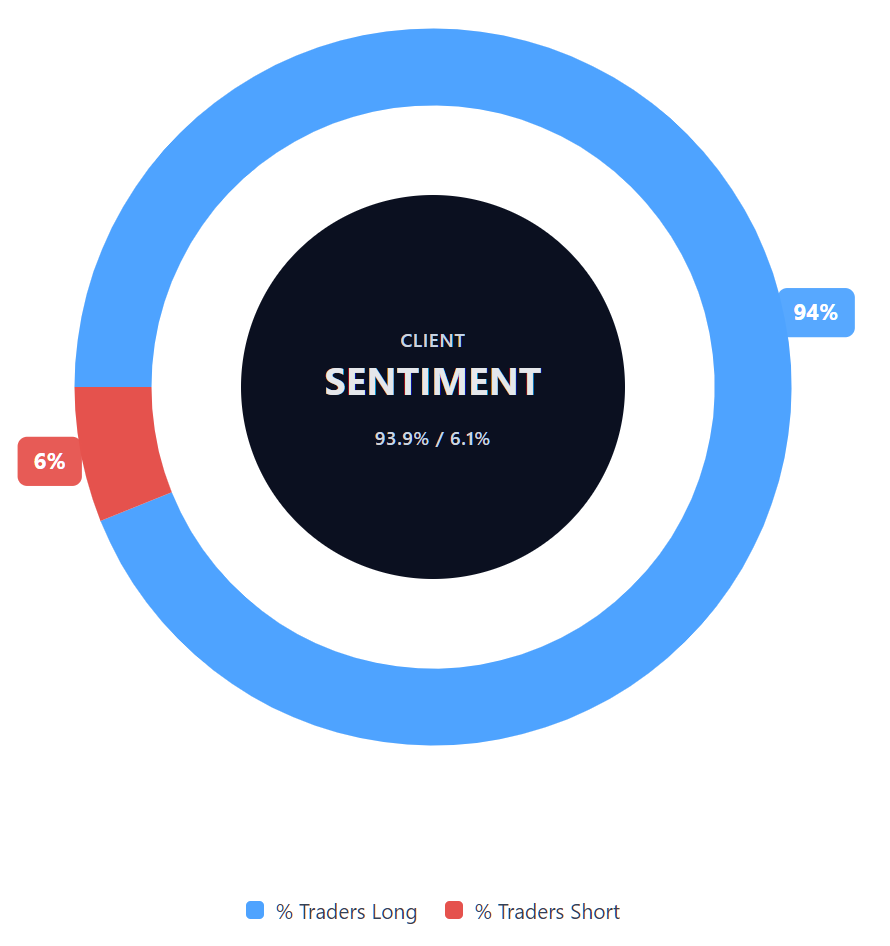
As of 22 January 2026, Capital.com client positioning in Repsol CFDs is skewed towards long positions, with around 93.9% of clients holding longs versus 6.1% holding shorts, leaving a difference of approximately 87.8 percentage points. This imbalance suggests concentrated long exposure rather than a broadly even distribution of positions. The data reflects open positions on Capital.com at a specific point in time and may change as clients adjust their trades.
Summary – Repsol 2026
- Repsol’s share price rose from around €11.40 in January 2025 to approximately €15.96 by 31 December 2025, marking a strong year of gains.
- In January 2026, Repsol trades near €15.52 on Capital.com, within an intraday range of roughly €15.55–€16.31 on 22 January.
- Moving averages show the price oscillating around the €16 area, with longer-term 100- and 200-day averages still lower, indicating that the 2025 rally lifted the stock above prior trading bands.
- Recent financial updates highlight positive net income and ongoing shareholder distributions against a more volatile earnings backdrop, with both traditional hydrocarbon exposure and low-carbon investments continuing to shape the balance of risks and potential returns.
Past performance is not a reliable indicator of future results.
FAQ
Who owns the most Repsol stock?
Repsol has a broad shareholder base that includes institutional investors, asset managers and retail shareholders, alongside strategic stakes linked to Spanish and international investment entities. No single shareholder holds an outright controlling position, meaning ownership is relatively diversified. This structure can influence how the share price responds to earnings updates, sector developments and changes in institutional positioning, rather than being driven by decisions from one dominant owner.
What is the 5-year Repsol share price forecast?
There is no single, reliable five-year REP stock forecast. Longer-term projections tend to vary widely and depend on assumptions around oil and gas prices, refining margins, capital allocation and the company’s multi-energy strategy. Most published analyst targets focus on 12-month horizons, reflecting the uncertainty involved in longer-term forecasting, particularly in cyclical and commodity-linked sectors.
Is Repsol a good stock to buy?
Whether Repsol is considered a 'good' stock depends on individual objectives, risk tolerance and market expectations. The company operates in a sector exposed to commodity price fluctuations, regulatory developments and global demand trends, while also pursuing diversification into lower-carbon activities. Past price performance and analyst targets can provide context, but they do not offer certainty about future outcomes. This information is for analysis only and does not constitute investment advice.
Could Repsol stock go up or down?
Repsol’s share price may move higher or lower over time, depending on factors such as energy prices, earnings performance, macroeconomic conditions and shifts in investor sentiment. Company-specific developments, including investment plans, legal matters or changes in refining margins, can also influence price movements. Like many equities, Repsol has experienced periods of both upward movement and pullbacks, underlining the inherent uncertainty and risk involved.
Should I invest in Repsol stock?
Deciding whether to invest in Repsol stock is a personal decision that depends on your financial situation, objectives and understanding of risk. Shares can be volatile, particularly within energy-related sectors, and past performance is not a reliable indicator of future results. Before making any investment decision, it’s important to assess your own circumstances and, if appropriate, seek independent financial advice rather than relying solely on forecasts or analyst commentary.
Can I trade Repsol CFDs on Capital.com?
Yes, you can trade Repsol CFDs on Capital.com. Trading share CFDs lets you speculate on price movements without owning the underlying asset and to take long or short positions. However, contracts for difference (CFDs) are traded on margin, and leverage amplifies both profits and losses. You should ensure you understand how CFD trading works, assess your risk tolerance, and recognise that losses can occur quickly.