
Trading the Dow 30 as it Benefits from Rotation
Rotation out of AI and into value the name of last week’s game helping keep the Dow’s technicals positive, while in sentiment retail traders briefly flirt with majority short bias.
U.S. equity index futures are up slightly following last week’s action where the S&P 500 closed lower (w/w –0.7% to 6,827) due to Friday’s pullback and more so the tech-heavy Nasdaq 100 (w/w –2.2% to 25,196) amid ongoing rotation out of AI and growth stocks and into value, with the Dow 30 (w/w +1% to 48,458) a beneficiary. It was a tough Friday for the semiconductor sphere, with shares of Nvidia (-3.3%) extending their losses as investors moved out of AI-related stocks following Oracle (-4.5%) and Broadcom’s (-11.4%) weakness, despite the latter beating earnings and raising guidance and the former pushing back against reports of data center delays for OpenAI.
Treasury yields ended higher on the mid to further end of the curve causing a steepening, while market pricing (CME’s FedWatch) shows expectations for a Federal Reserve (Fed) on hold in the near term, with the first potential 25bp (basis point) cut of next year a coin toss in March 2026. There wasn’t much in terms of data to digest out of the U.S., but we heard from Fed’s Goolsbee (dissenter) “pretty optimistic” rates will be a “fair bit lower” next year but “uncomfortable front-loading too many rate cuts” and can’t assume inflation will be transitory, Schmid (the other dissenter) against a rate cut at their most recent FOMC (Federal Open Market Committee) meeting as little changed since their previous meeting where he also dissented, but Paulson more concerned about job risks relative to inflation and that the data on the economy are stale and Daly that she favored a rate cut. President Trump said Kevin Warsh is at the top of his list for the next Fed Chair to replace the current Jerome Powell, and that he ought to consult with the president on rate decisions.
Week ahead
It’s a light start with Empire’s manufacturing, NAHB’s housing market index, and more FOMC members speaking, but it’ll pick up notably and on multiple fronts. A plethora of data tomorrow including the delayed Non-Farm Payrolls, CPI on Thursday alongside the weekly claims, and UoM’s revised figures release on Friday. In earnings, there’s Micron and General Mills on Wednesday, Nike (a Dow 30 component) and FedEx on Thursday, and Paychex on Friday. We’ve already gotten the Fed’s policy decision out of the way, but globally the attention will be on whether the Bank of Japan hikes this Friday.
Dow 30’s technical overview, strategies and levels
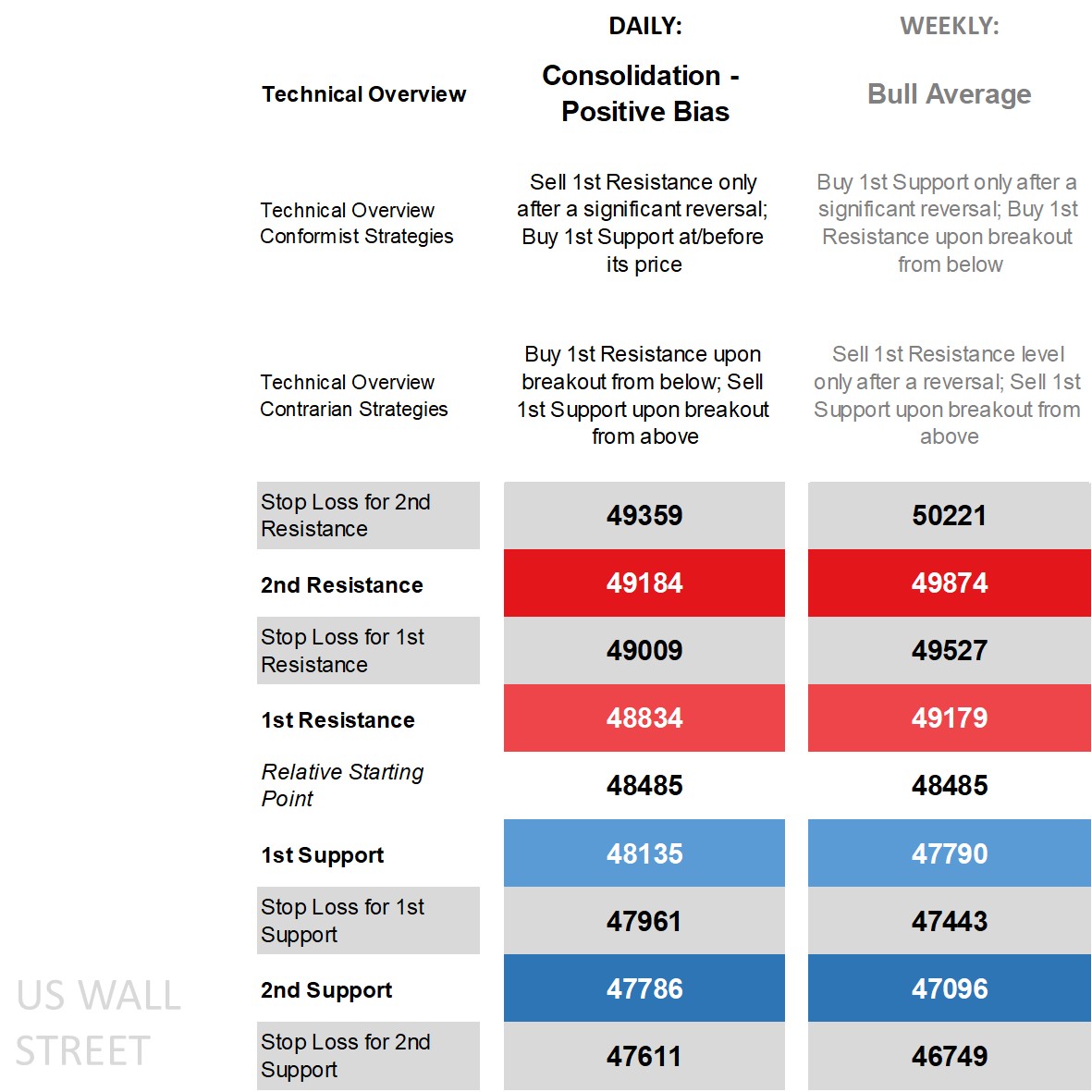
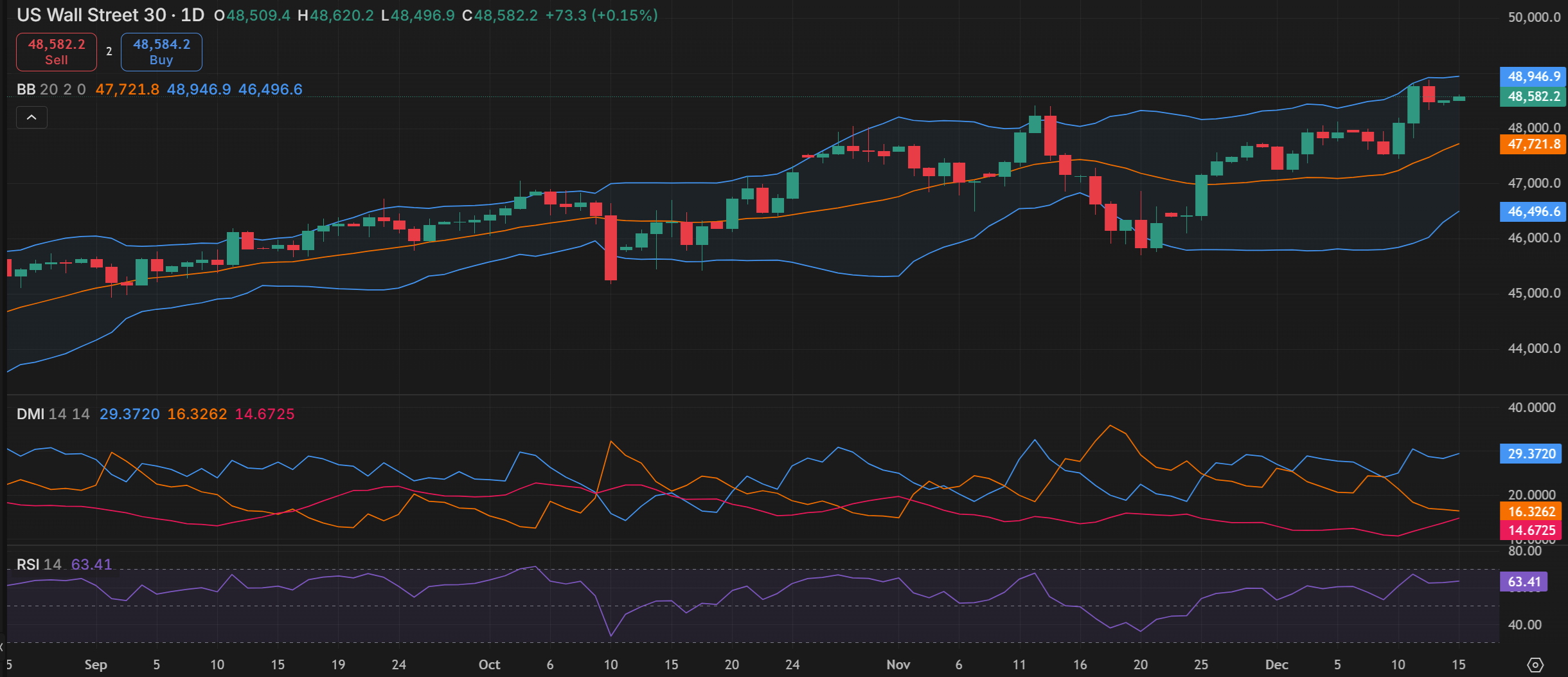
Looking at the daily time frame and price is above all its main moving averages (MA), not too far off the upper end of the Bollinger Band, on the DMI (Directional Movement Index) front the +DI well over the -DI to label it as positive, an RSI (Relative Strength Index) below overbought territory though late last week close to reaching it, and an ADX (Average Directional Movement Index) climbing but yet to reach trending territory.
Positive technical bias no doubt, but in terms of classifying the overview and the wide channel makes it difficult to distinguish between ‘consolidatory with positive bias’ and the weekly technical overview’s ‘bull average’. There isn’t much left to tilt the former’s overview to match the latter as it did in the past, which would translate into buys for conformists off the 1st Resistance (via breakout) and 1st Support (only after a significant reversal) and sell strategies for contrarians who expect the rotation theme’s days to be limited.
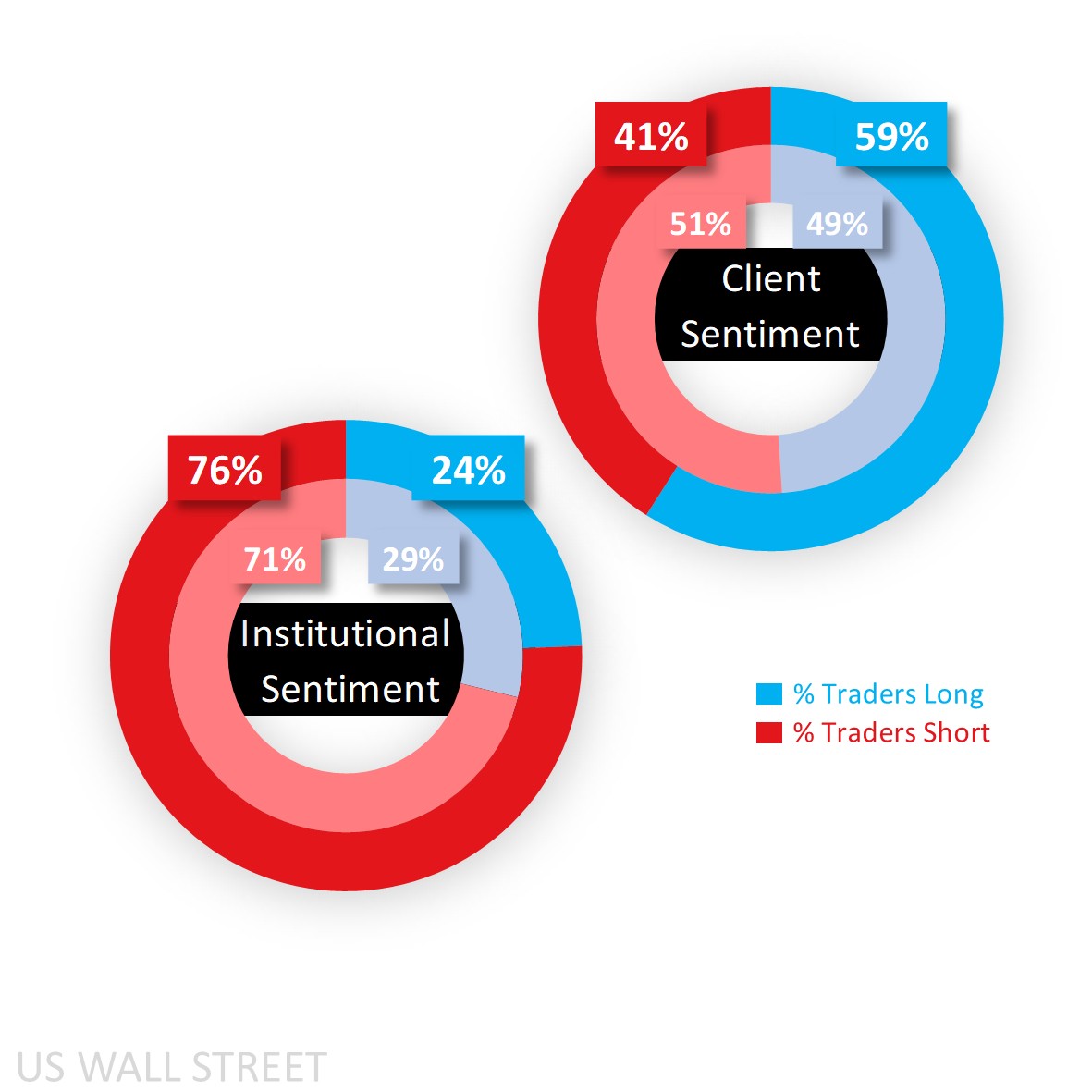
Capital.com’s client sentiment for Dow 30
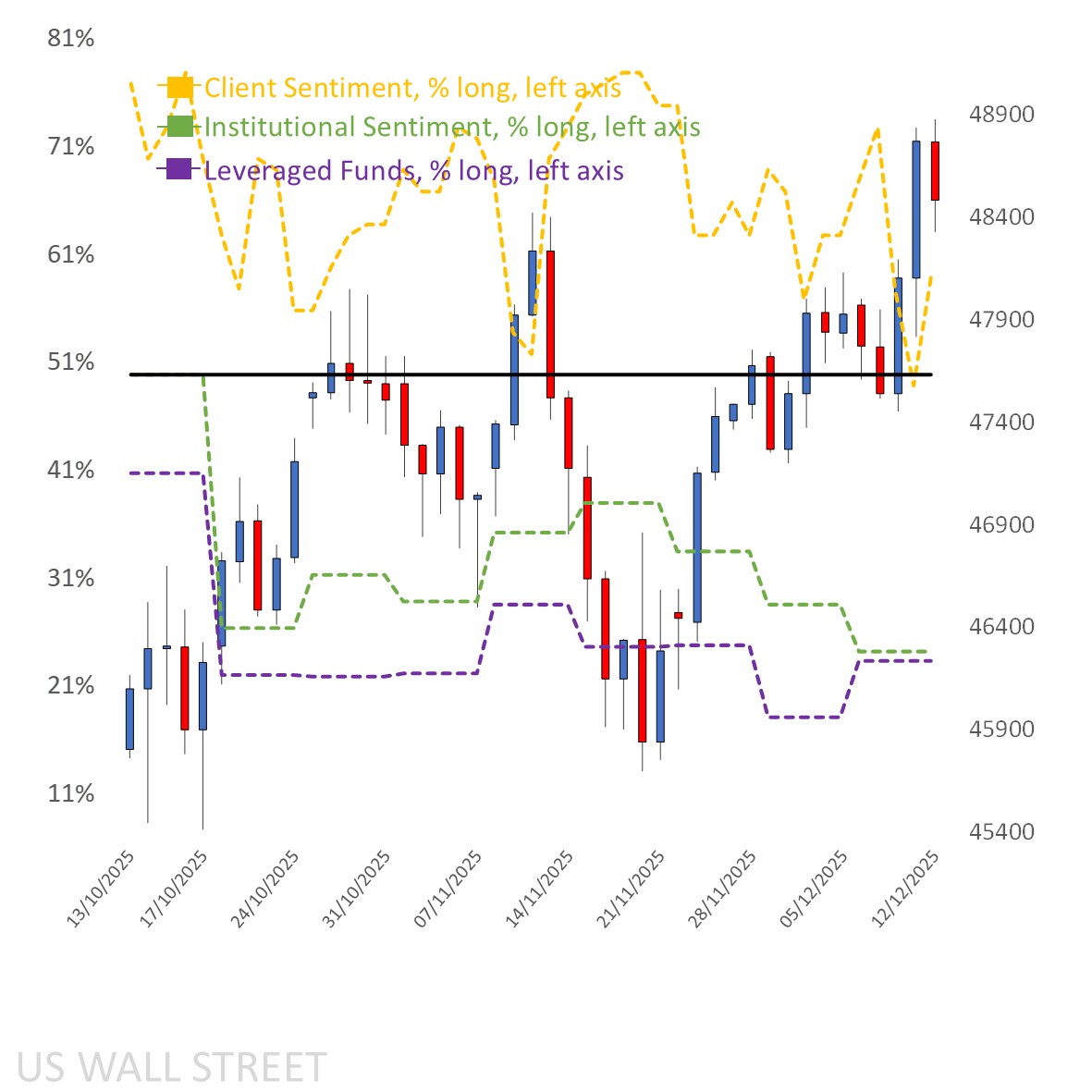
In sentiment, the string of consistent majority buy bias among retail traders briefly came to an end last Thursday when the Dow jumped to a record high causing some longs to close out and other shorts to initiate. It went from heavy buy to slight sell 51% swiftly before Friday’s pullback in price caused longs to emerge again and shifted the bias back to majority buy albeit a moderate 59%.
CoT (Commitment of Traders) speculator data is delayed due to the government shutdown, but the CFTC is catching up quickly, with the latest figures as of November 21 showing they were net short in the Dow and nearing extreme sell territory at 76% from 71% from the report prior. However, there’s a relatively strong correlation on the momentum front for Dow traders, and given the index had suffered retreat then before recovering will likely translate into a big reduction in that sell bias when the figures are updated for December.
Client sentiment mapped on the daily chart
Source: Capital.com
Period: October 2025 – December 2025
Past performance is not an indicator of future results.
Dow 30’s chart on Capital.com’s platform with key technical indicators
Source: Capital.com
Period: August 2025 – December 2025
Past performance is not an indicator of future results.