

SPY trading strategy: S&P 500 ETF analysis

The term ‘SPY trading strategies’ describes a group of approaches that use SPY as the main trading vehicle or as a reference point for broader US equity direction. Because SPY combines broad market exposure with high liquidity, it’s become a common instrument for active traders as well as longer-term market participants.
SPY is the ticker for the State Street SPDR S&P 500 ETF Trust, a fund that tracks the price and yield performance of the S&P 500 Index. The index covers the large-cap segment of the US equity market, so SPY is often used as a broad measure of US market sentiment rather than a view on one company or sector.
This article is for educational purposes only and does not constitute investment advice.
What is the SPY trading strategy?
The SPY trading strategy is a broad term for trading methods built around the SPDR S&P 500 ETF Trust. Some traders use it to follow short-term moves in the US equity market. Others use it for swing trading, options strategies, or as a way to express a view on market direction without analysing a large number of individual shares.
In practice, SPY strategies tend to fall into three broad groups:
- Directional trading: where the aim is to trade an expected move higher or lower.
- Volatility trading: where the focus is on whether the market will move more or less than expected.
- Range-based trading: where you expect SPY to remain within a defined area for a set period. Which approach you use depends on the timeframe, the product being traded, and your risk tolerance.
SPY options
SPY options are also a large part of this discussion. ETF options cleared by OCC are American-style, which means they may be exercised on any business day up to and including the expiration date. Cboe rules also allow short-term SPY options expirations across the trading week, including Monday, Tuesday, Wednesday, Thursday, and Friday expirations. That gives traders more flexibility when using short-dated strategies.
Calculating the SPY trading strategy
There is no single SPY formula because the calculation depends on the strategy being used.
Directional trading
For directional traders, one of the simpler frameworks is a moving average crossover. In this setup, a shorter moving average is compared with a longer one. If the shorter average moves above the longer average, some traders may interpret that as a sign that momentum is strengthening. If it moves below, they may interpret that as a sign that momentum is weakening. The exact settings vary, which is why there is no universal ‘best’ SPY setting.
Long straddle
For options traders, the calculations are more precise. A long straddle involves buying a call and a put with the same strike price and expiration. The break-even points at expiration are the strike price plus the total premium paid and the strike price minus the total premium paid. In simple terms, SPY has to move far enough in either direction to cover the total premium outlay before the strategy breaks even at expiration.
Iron condor
An iron condor uses two option spreads to define a trading range. The seller receives a net premium at entry, and the maximum gain is that premium if SPY remains within the short strikes at expiration. The maximum loss is limited and is generally the width of one side of the spread minus the premium received. This structure is often used when the expectation is for more limited price movement rather than a large directional break.
The calculation method depends on what is being measured: trend, volatility, or range.
How to use the SPY trading strategy
A practical way to think about SPY is to match the strategy to the timeframe.
A day trader may focus on intraday direction, short-dated options, or same-day expiry setups. Cboe defines 0DTE options as contracts that expire at the end of the current trading day. That means short-term SPY trading can offer precision, but it can also become highly reactive late in the session.
A swing trader may use SPY differently. Instead of reacting to very short-term movement, the focus is often on broader chart structure, such as support and resistance, trend direction, or whether price is holding above or below a moving average on daily charts. In that context, SPY is often treated as a liquid proxy for broad US equity sentiment rather than as a pure short-term trading instrument.
Whichever timeframe you choose, the same basic process usually applies.
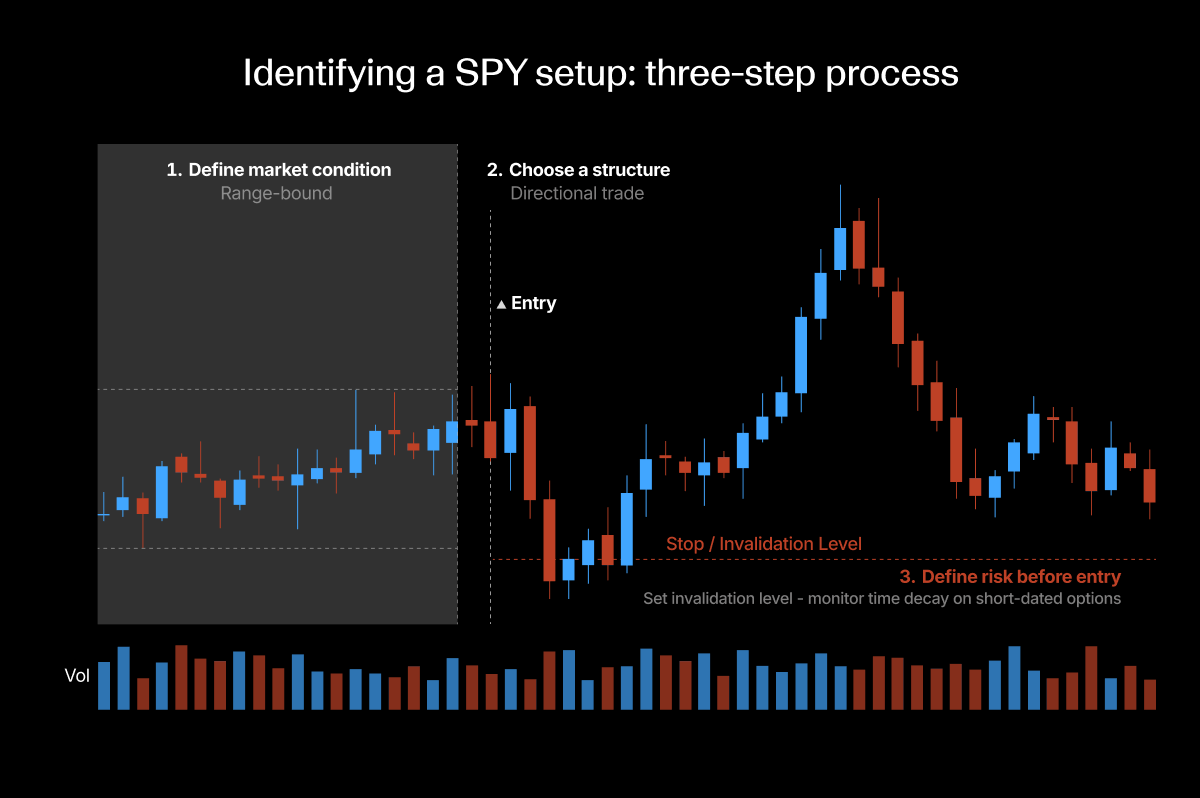
- Step 1: Define the market conditionTrending, range-bound, or event-driven.
- Step 2: Choose a structure that fits that viewSuch as a directional trade, a straddle, or a range strategy.
- Step 3: Define risk before entryThis includes factors that could invalidate the setup. This matters especially with short-dated options, where time decay and intraday price sensitivity can change the position quickly.
Liquidity is one reason traders are drawn to SPY, but liquidity does not remove risk. A trading plan should account for volatility, costs, and the possibility that the market does not behave as expected.
Advantages and disadvantages of the SPY trading strategy
SPY can offer a simple and flexible way to analyse or trade broad US equity market direction, but it also has limitations that depend on the product, timeframe, and market conditions.
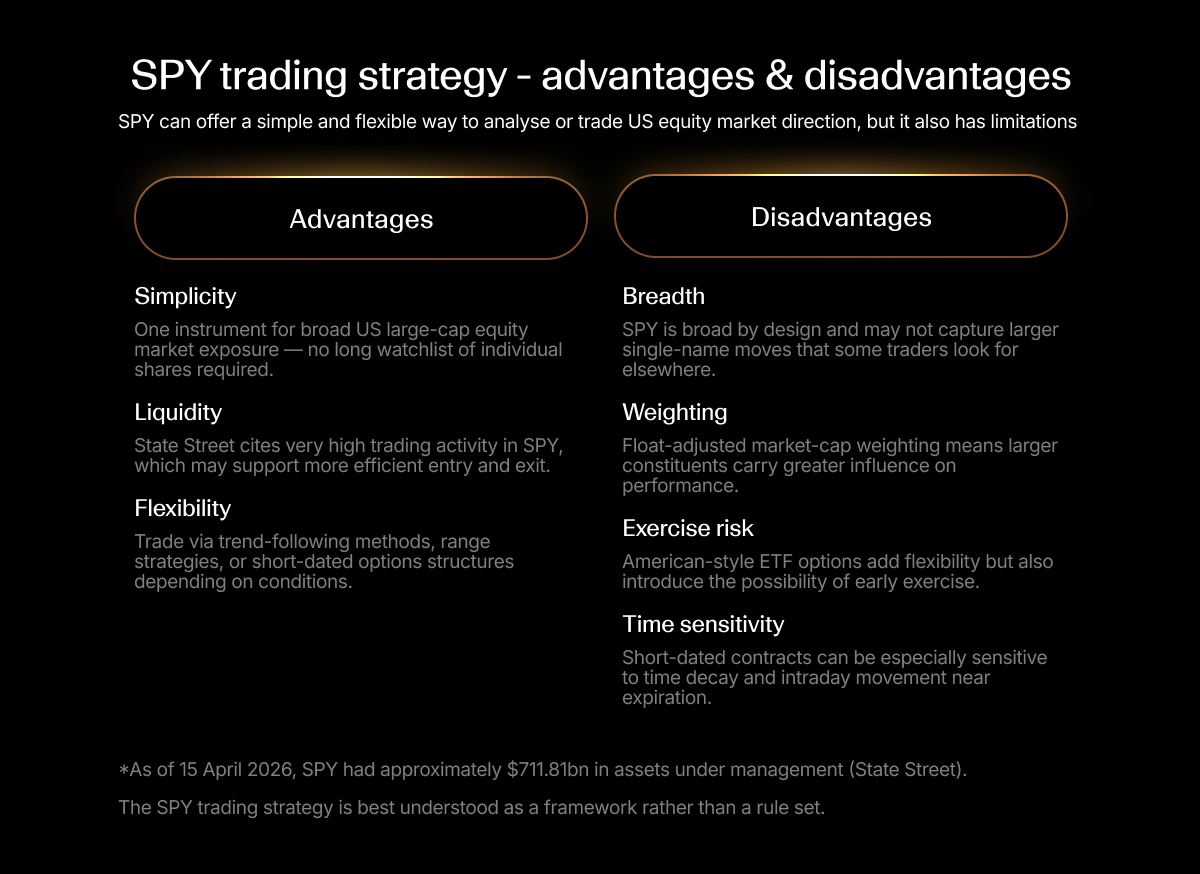
For that reason, the SPY trading strategy is best understood as a framework rather than a rule set. It can be adapted to different styles, but it still depends on market context, disciplined risk management, and a clear understanding of the product being used.
Create an account Open a demo account

