

FOMC outlook boosts risk appetite, but was it too optimistic?
Markets welcome the Fed's policy outlook but concerns about complacency regarding inflation limit the upside in risk appetite
Risk appetite improved on Wednesday after the Federal Reserve delivered a widely expected 25-basis-point rate cut and revealed a voting split that, while divided, was not nearly as hawkish as feared. The Federal Open Market Committee lowered the fed funds rate to 3.75% from 4.00%, its lowest level since October 2022. The decision exposed meaningful disagreement inside the central bank: Trump-appointed Stephen Miran dissented in favour of an even deeper cut, while two policymakers argued for staying on hold. But critically for investors, the division stopped there, the five-hawk revolt some had anticipated never materialized.
Markets interpreted this as a green light. Equities surged, Treasury yields fell and risk appetite flooded back into the system. Traders effectively concluded that the Fed is willing to let the economy run hot, embracing the idea that policy is shifting from restrictive toward accommodative even as growth shows resilience. The exuberant reaction suggests investors believe the Fed may have erred on the dovish side or at least leaned further in that direction than markets expected before the meeting.
The dot plot tells the story
Beyond the vote split, the updated dot plot provided another potential moment for policymakers to signal independence. Instead, officials delivered almost no change. Rate expectations for 2027 and 2028 barely budged and the distribution still shows no expectation that fed funds will rise back above 4% for many years to come.
In theory, a more fractured committee should help counter political pressure; in practice, this looks like division without resolve. The committee is no longer perfectly aligned, but neither is it offering a coordinated effort to assert central-bank independence. The result is a policy path that remains dovish, predictable and highly market friendly.
Inflation is almost forgotten
Perhaps most striking was Chair Jerome Powell’s tone. The official statement called inflation “somewhat elevated,” but Powell offered no fresh warnings at the press conference, even as tariffs and cost-pressures have reemerged as political flashpoints. The new projections show inflation estimates drifting lower across the board, with unanimous confidence that price growth will return to the 2% target by 2028.
Market pricing mirrors this tranquillity. For the past few months, inflation-swap curves have steadily declined, with the gap between one-year and two-year expectations nearly closing. Traders clearly believe tariff-related price spikes will be short-lived and that the disinflation process is well advanced. In essence, both markets and policymakers are behaving as if the inflation fight is largely over, a major reason this week’s dovish vote split has been met with such enthusiasm.
Was it too optimistic?
The Fed cut rates, avoided an internally explosive showdown, left its long-term rate projections unchanged and struck a calm tone on inflation. For markets, that combination amounts to a de facto easing signal, even if policymakers insist that they remain data dependent. With concerns over renewed inflation fading and no hawkish bloc stepping forward to challenge the shift, investors are acting as though the Fed is prepared to support growth well into 2025 and beyond.
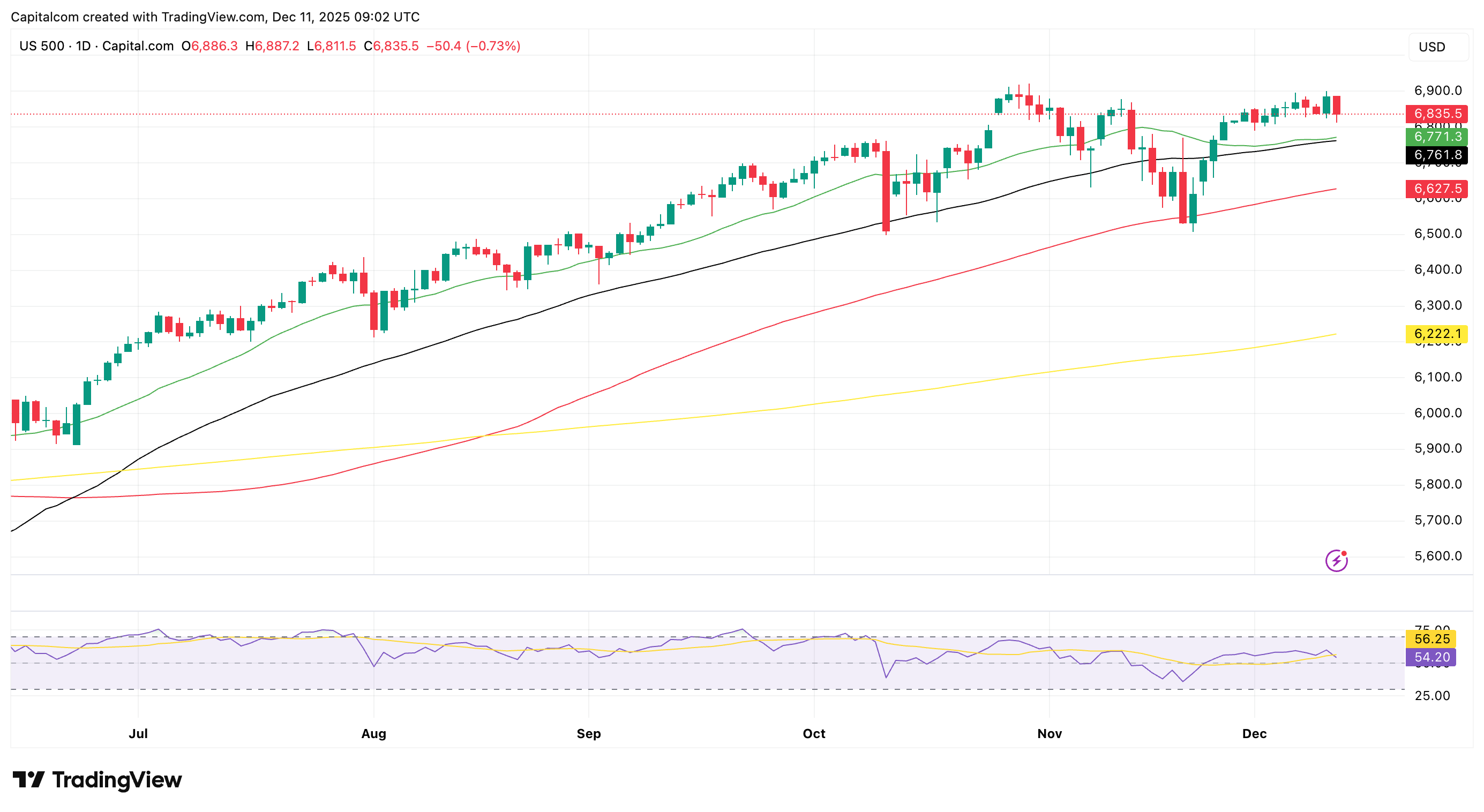
However, that may ultimately prove too optimistic. In fact, major US equity indices have unwound Wednesday’s gains, even as the US dollar and yields continue to face bearish pressure. Gold has also failed to capitalise on the more dovish tone, with the precious metal remaining anchored around $4,200 still unable to find a clear direction. This setup suggests that traders may be slightly cautious about Wednesday’s meeting, and whether the Fed might be underestimating inflation risk, which would mean more macro uncertainty later. That uncertainty hurts stocks and gold, even when yields fall.
The S&P 500 daily chart
Past performance is not a reliable indicator of future results.