

Market opening trading strategy: An educational guide

Market opening trading strategies focus on the first part of a trading session, when activity may increase and price moves can become more pronounced. It’s commonly used by day traders who want to focus on intraday volatility rather than hold positions overnight.
This opening period draws attention because it reflects overnight developments, pre-market positioning, and the arrival of institutional orders. Economic releases, earnings reports, and geopolitical events can all influence how the session begins. For that reason, some traders treat the open as a key reference point for the rest of the day.
Highlights
This article is for educational purposes only and does not constitute investment advice.
What is the market opening trading strategy?
The market opening trading strategy is a day trading method based on price behaviour near the start of a session. Rather than trading at random points during the day, you focus on a clearly defined time window after the market opens and use the information created in that period to build a trade plan.
The idea is straightforward. You observe the price range formed soon after the market opens, then use that range to identify possible breakout or mean-reversion setups. The strategy is most often applied to major indices, but you can also adapt it to forex pairs, individual shares, commodities and, in some cases, crypto markets.
In practice, this may involve marking the highest and lowest prices recorded during the first 30–60 minutes of trading. These levels form the opening range. If price later moves beyond that range, some traders interpret it as a sign of momentum. If price opens with a noticeable gap from the previous close, others may look for a move back towards that earlier closing level.
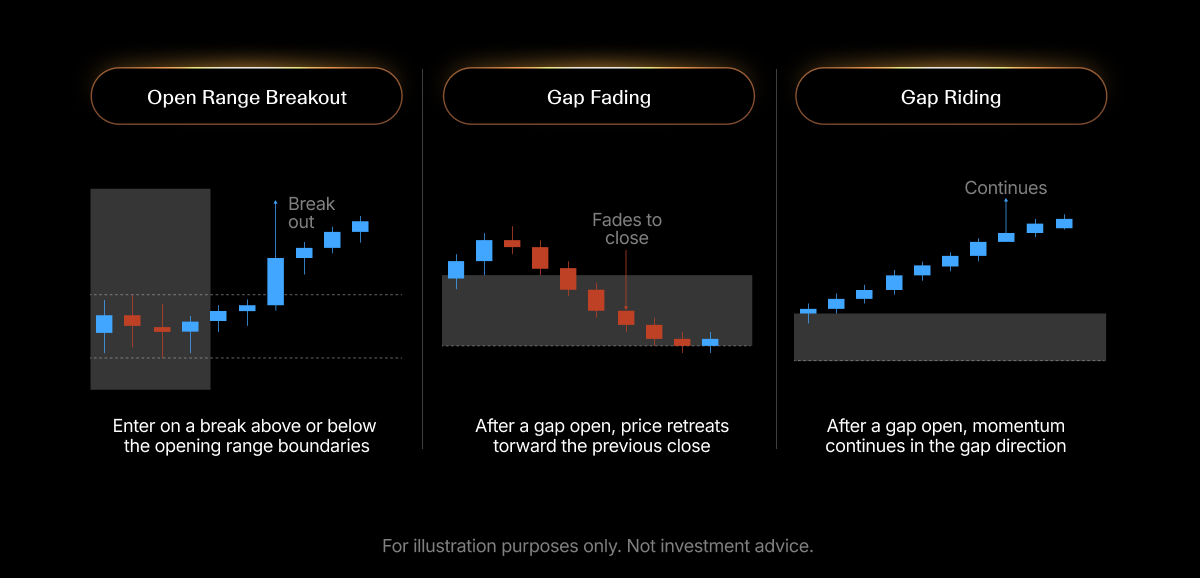
Three versions of the strategy are especially common:
- Open range breakout (ORB): traders wait for price to break above or below the opening range.
- Gap fading: traders look for price to retrace towards the previous day’s close after an opening gap.
- Gap riding: traders trade in the direction of the opening gap if momentum remains strong.
The strategy is most closely associated with stock indices because these markets have clearly defined cash opens and often react sharply to overnight news. However, you can apply the same logic to other assets where opening activity creates a visible shift in volume and volatility.
Calculating the market opening trading strategy
The calculation begins with the opening range. For many European indices, traders track the first 40 minutes of trading, for example 9am–9.40am for some continental European cash indices, or 8am–8.40am for the FTSE 100, in local exchange time. For some US markets, a 30-minute opening range is more common.
Once that range is established, the trader marks:
- The highest price reached during the opening window.
- The lowest price reached during the opening window.
These two levels act as reference points. Traders may treat a move above the opening high as a potential long entry trigger, while a move below the opening low may act as a potential short entry trigger.
*Standard stop-loss orders are not guaranteed. Guaranteed stop-loss orders (GSLOs) incur a fee if activated.
How to use the market opening trading strategy
You can break the strategy into a few key stages, from preparation at the open to managing the trade once the setup forms.
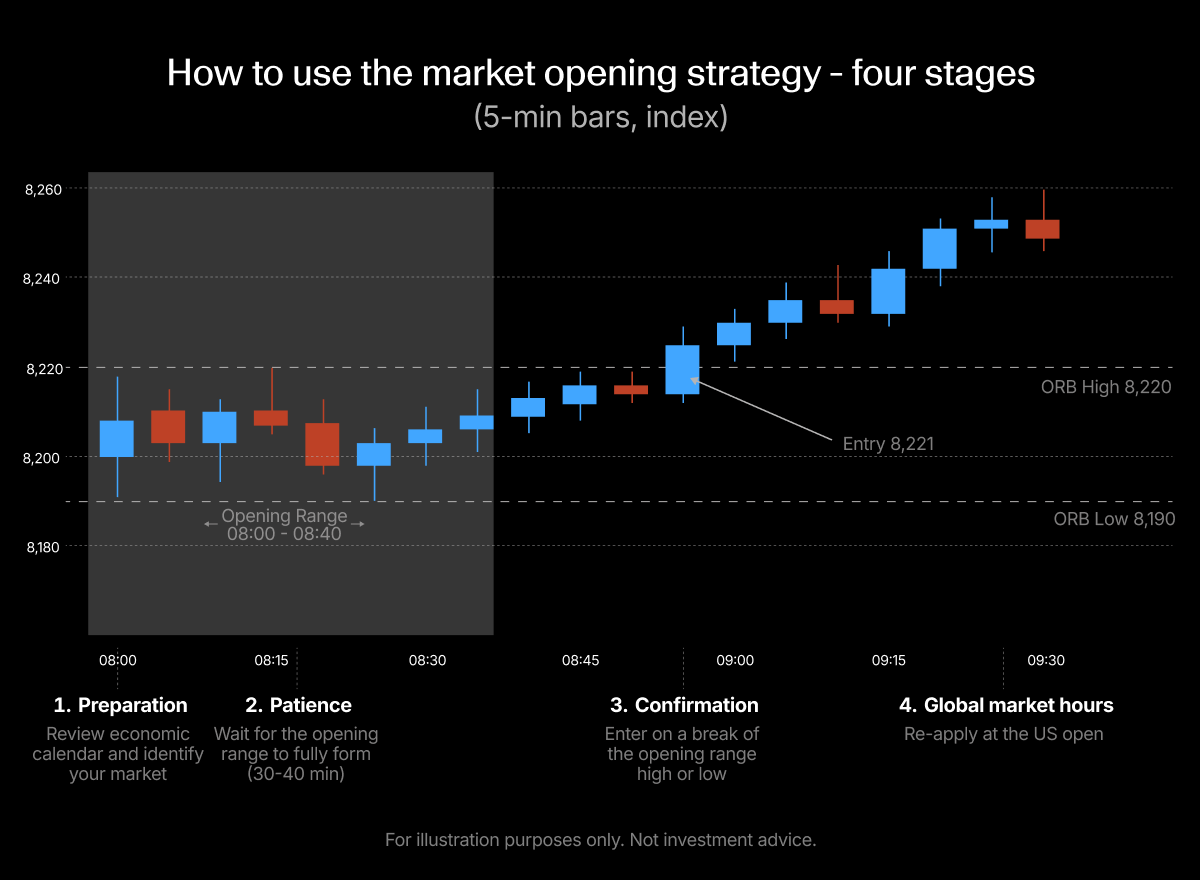
- 1. PreparationYou’ll usually identify the market you want to track, check for scheduled economic releases or company news, and decide which opening session matters most to that instrument.
- 2. PatienceOne of the core ideas behind this strategy is that the first few minutes can be noisy. Rather than entering immediately at the open, you may wait until the opening range has formed. This helps separate early volatility from a more structured move.
- 3. ConfirmationIn an open range breakout setup, you wait for price to move beyond the high or low of the range, then manage the position using pre-defined stop-loss and target levels. In a gap fading setup, you look for signs that the opening move is losing momentum and that price may return towards the prior close. In a gap riding setup, you watch whether volume supports the gap and whether the direction holds.
- 4. Consider global market hoursSome traders apply the approach more than once during the day. For example, you might monitor the local open in the morning and then watch again when US markets open in the afternoon, as US session volatility can influence European instruments.
Because the method depends on short-term price action, traders commonly pair it with tools that help define market conditions. ATR is often used for exits, volume may help assess conviction behind a move, and VWAP can provide additional intraday context. Some traders also use session indicators or price imbalance concepts to refine timing, though you can understand the core strategy without them.
Advantages and disadvantages of the market opening trading strategy
The market opening trading strategy can offer a clear structure for intraday trading, but it also has limitations to consider.
Advantages
- Clarity: the strategy gives you a defined time window, visible price levels, and a framework for entries and exits. It can also suit you if you prefer short holding periods and want to avoid overnight exposure.
- Focus: instead of monitoring markets all day, you can focus on a specific session window where liquidity and activity are often higher. In some cases, that can reduce screen time.
- Flexibility: although it's most closely associated with indices, you can adapt it to several asset classes if the market has sufficient liquidity and a meaningful session open.
Disadvantages
- Heightened volatility: the opening period can be highly erratic, especially in the first 15–30 minutes. False breakouts are common, and stop-losses can be triggered quickly before price settles into a clearer direction.
- Not every session produces a tradable setup: some days remain range-bound or directionless, which can reduce the strategy’s usefulness. It also requires discipline, because entering too early can undermine the logic of waiting for the opening structure to form.
- The strategy depends on real-time attention: prices can move quickly at the open, and execution conditions may change just as quickly in volatile markets. Wider spreads or fast reversals can affect outcomes, especially in less liquid instruments.
Create an account Open a demo account

