
Volkswagen stock forecast: Everllence sale in focus
Volkswagen is a German automaker whose latest Q1 results showed lower revenue and profit, alongside €1bn in overhead cost reductions. Explore third-party VOW price targets and technical analysis. Past performance is not a reliable indicator of future results.
Volkswagen AG (VOW) is trading at €91.75 in early European trading on Monday, 15 June 2026, within an intraday range of €88.56–€92, according to Capital.com’s quote feed at 10:20am UTC. Past performance is not a reliable indicator of future results.
Sentiment remains shaped by several cross-cutting factors. Volkswagen's Q1 2026 results, published on 30 April, showed operating profit of €2.50bn on revenue of €75.70bn, down 2% year-on-year (Volkswagen Group, 30 April 2026). The company also said it had reduced overhead costs by €1bn as part of its ongoing transformation programme (Volkswagen Group, 30 April 2026). At the sector level, European automakers continue to face pressure from President Trump's threat to raise US tariffs on EU vehicle imports from 15% to 25%, a move criticised by European officials and analysts, who warned of significant output losses for Germany's automotive industry (CNBC, 20 May 2026). Reuters also reported on 1 June 2026 that Volkswagen is close to selecting a buyer for its Everllence engine unit, valued at €8bn–€9bn, as the group presses ahead with asset disposals aimed at supporting its balance sheet (Reuters, 2 June 2026).
Third-party Volkswagen outlook: Q1 pressure and tariff risks
As of 15 June 2026, third-party Volkswagen stock predictions point to a broadly constructive sell-side view, though one tempered by macro headwinds, including US tariff uncertainty and subdued Chinese demand. The targets below are denominated in euros and refer to the preference share (VOW3) listed on Xetra.
RBC Capital Markets (Outperform, single-broker)
RBC Capital Markets reiterates an Outperform rating on VOW, with a 12-month price target of €131. The bank sees restructuring delivery and the potential disposal of the Everllence engine unit as near-term catalysts, while acknowledging continued exposure to US import tariff developments (MarketScreener, 25 May 2026).
Simply Wall St (consensus aggregate)
Simply Wall St compiles a 20-analyst consensus for VOW, showing an average 12-month price target of €112.08, marginally revised upward from €111.13 in the prior period, with estimates ranging from €85 to €149. The platform attributes the slight upward revision to modest positive adjustments to analyst earnings models following the group's Q1 cost-reduction progress (Simply Wall St, 11 June 2026).
MarketScreener (sell-side consensus)
MarketScreener aggregates 21 analyst ratings on VOW, producing a mean Outperform consensus, an average 12-month price target of €111.54, a high of €151 and a low of €85.80. The spread in estimates reflects differing views on the pace of Volkswagen's restructuring, its China market recovery, and the net impact of any US tariff escalation on group revenue (MarketScreener, 28 May 2026).
Google Finance (single analyst)
Google Finance reports one Wall Street analyst 12-month price target for VOW of €113, representing an implied upside of approximately 26.7% to the last close price of €89.20. This single-broker figure sits in the lower half of the broader consensus range aggregated across multi-analyst platforms (Google Finance, 15 June 2026).
Predictions and third-party forecasts are inherently uncertain, as they cannot fully account for unexpected market developments. Past performance is not a reliable indicator of future results.
Volkswagen earnings: latest results and upcoming dates
Volkswagen published its Q1 2026 results on 30 April 2026, reporting group sales revenue of €75.70bn, down 2% year-on-year from €77.60bn in Q1 2025 (Volkswagen Group, 30 April 2026). Operating result fell 14.3% to €2.50bn from €2.90bn in the prior-year period, below the consensus estimate of approximately €4bn compiled by LSEG (CNBC, 30 April 2026). The group's operating return on sales came in at 3.3%, versus 3.7% a year earlier, as US import tariffs, costs related to the discontinuation of ID.4 production at the Chattanooga plant, and restructuring charges weighed on the headline figures (Volkswagen Group, 30 April 2026). Net cash flow in the Automotive Division improved to €2bn, compared with -€0.80bn in Q1 2025, which the group attributed to lower capital expenditure and a working capital release (Volkswagen Group, 30 April 2026).
The group maintained its full-year 2026 guidance, targeting sales revenue growth of 0%–3% and an operating return on sales of 4.0%–5.5%, against 2.8% in 2025 (Volkswagen Group, 30 April 2026). Analysts surveyed by Visible Alpha expect a full-year margin of approximately 5.2%, near the upper end of that range. Looking further ahead, Volkswagen reiterated its ambition to reach an operating margin of 8%–10% by 2030, supported by continued cost and investment discipline (Reuters, 10 March 2026).
On the corporate calendar, Volkswagen's 66th Annual General Meeting takes place virtually on 18 June 2026, three days from the time of writing, with CEO Oliver Blume expected to confirm binding job reduction targets (Volkswagen Group, 5 May 2026). The Half-Yearly Financial Report, covering the first six months of 2026, is scheduled for 24 July 2026, and the Interim Report for January–September 2026 is due on 29 October 2026 (Volkswagen Group, 9 June 2026).
VOW stock price: technical overview
The VOW stock price is trading at €91.75 as of 10:20am UTC on 15 June 2026, within an intraday range of €88.56–€92. The price is sitting just above the 20-day simple moving average (SMA) at €91.02 and the classic pivot point at €91.63, according to TradingView data. The broader moving average picture remains mixed-to-bearish: the 10-, 20-, 30- and 50-day SMAs cluster in the €90–€91 range, while the 100- and 200-day SMAs sit higher at approximately €93.94 and €96.50 respectively. The Hull moving average (9) at €88.48 remains below the last price.
On momentum, the 14-day relative strength index (RSI) reads 54.55, placing it in upper-neutral territory, while the average directional index (ADX) (14) registers 14.83, below the 15 threshold. Together, these readings suggest limited trend conviction at present.
To the upside, the classic R1 pivot at €97.82 is the first reference above current levels. A daily close above that level would put R2 near €101.78 in view. On the downside, the classic pivot point at €91.63 is the initial reference, followed by S1 at €87.67. A sustained move below S1 would risk a deeper pullback towards the S2 area near €81.48 (TradingView, 15 June 2026).
This is technical analysis for informational purposes only and does not constitute financial advice or a recommendation to buy or sell any instrument.
Volkswagen share price history (2024–2026)
VOW’s stock price has had a volatile two years, moving from above €115 to below €84 before partially recovering, as macro shocks and company-specific headwinds drove sentiment.
The share started the window around €113–€114 in mid-June 2024, briefly touching a two-year high of €115.05 on 15 July 2024 before a broader global equity sell-off in early August dragged it back towards €101. A sharper leg lower followed through the second half of 2024: profit warnings, deepening losses in China, and a wage standoff with unions pushed VOW to a multi-year trough of €83.19 on 3 December 2024, as Volkswagen announced plans to close German factories for the first time in its history.
A partial recovery took hold into early 2025, with the stock climbing back towards €111–€112 in March as restructuring progress and a resolution to the labour dispute supported sentiment. That rebound proved fragile. President Trump’s April 2025 tariff announcements sent VOW sharply lower, with the share sliding to €86.54 on 9 April 2025. A relief rally through May–December 2025 carried the stock back to €107.91 on 16 December 2025, its highest close since the previous summer. Momentum then faded into 2026, with VOW opening the year at €107.71 before renewed tariff concerns and a weak Q1 2026 earnings report weighed on the stock through spring.
VOW closed at €91.70 on 15 June 2026, approximately 14.9% down year to date and broadly flat year on year, up 0.4% from €91.35 on 15 June 2025.

Past performance is not a reliable indicator of future results. Share prices are indicative and may differ from live market prices.
Volkswagen (VOW): Capital.com analyst view
Volkswagen’s preference share (VOW) enters the second half of June 2026 at €91.75, trading well below the levels seen at the start of the year as restructuring costs, weak Chinese demand, and the continuing threat of US tariffs on EU vehicle imports weigh on sentiment. On the constructive side, Q1 2026 results showed progress on overhead reduction, with costs cut by €1bn in the quarter, and management maintained its full-year operating margin guidance of 4.0%–5.5%. The Annual General Meeting on 18 June 2026 and the half-year report on 24 July 2026 are the next events likely to shape how investors assess that guidance.
Material risks remain. Any escalation in US tariffs beyond the current 15% rate, or a further deterioration in Volkswagen’s China market share, could pressure earnings beyond current consensus expectations. Conversely, a resolution to tariff uncertainty or stronger-than-expected H1 results could support a move closer to the sell-side consensus target of around €111. Some analysts cite the stock’s valuation discount to its 10-year historical average as a potential positive, though that discount has persisted for several quarters without a sustained recovery.
Capital.com’s client sentiment for Volkswagen CFDs
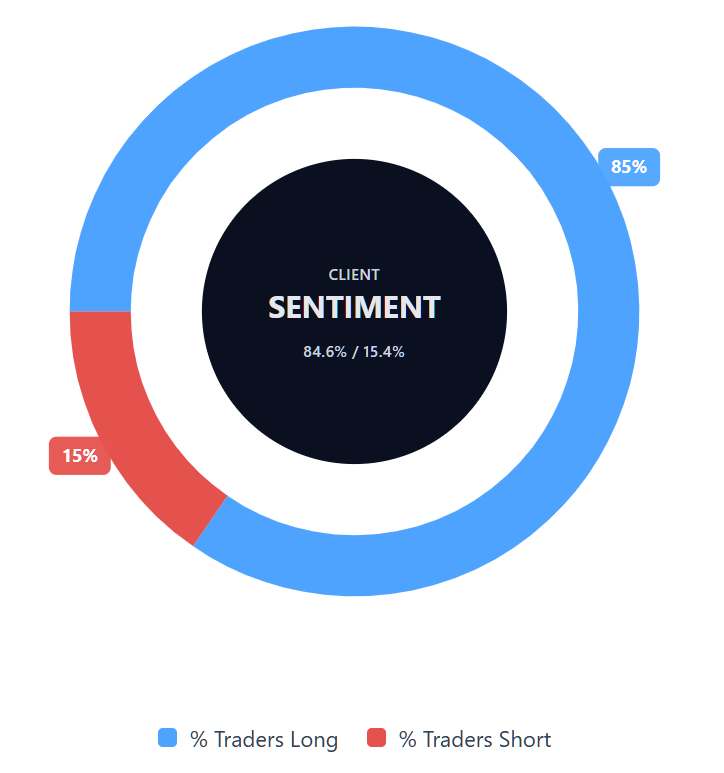
As of 15 June 2026, Capital.com client positioning in Volkswagen CFDs shows 84.6% long versus 15.4% short, putting buyers ahead by 69.2 percentage points. This indicates a strong long skew among open positions on Capital.com, though client sentiment can change quickly as market conditions evolve.
Summary – Volkswagen 2026
- VOW trades at €91.75 as of 10:20am UTC on 15 June 2026, down approximately 14.9% year to date and broadly flat year on year.
- Key drivers include US tariff threats on EU vehicle imports, weaker Chinese market volumes, and the pace of Volkswagen’s cost restructuring programme.
- Volkswagen’s Q1 2026 results showed a 14.3% year-on-year decline in operating profit to €2.50bn, partly offset by €1bn in overhead cost savings.
- Volkswagen’s Annual General Meeting takes place on 18 June 2026, with the half-year financial report scheduled for 24 July 2026.
Past performance is not a reliable indicator of future results.
FAQ
Who owns the most Volkswagen stock?
Volkswagen’s ownership structure is unusual because voting control is concentrated among a small number of major shareholders. Porsche Automobil Holding SE is the largest shareholder by voting rights, while the State of Lower Saxony also holds a significant stake. Qatar Holding is another major investor. This structure means Volkswagen is not only shaped by public market investors, but also by long-term strategic shareholders with substantial influence over corporate decisions.
What is the five-year Volkswagen share price forecast?
Five-year VOW stock forecasts vary widely because they depend on assumptions about restructuring progress, electric vehicle demand, China sales, margins, tariffs and broader market conditions. The article focuses on shorter-term third-party targets, where analyst estimates range from €85.80 to €151, with an average near €111–€112. Longer-term forecasts should be treated with caution, as unexpected economic, regulatory or company-specific developments can significantly change the outlook.
Is Volkswagen a good stock to buy?
Whether Volkswagen is a good stock to buy depends on individual objectives, risk tolerance, time horizon and wider portfolio exposure. The article highlights both supportive factors, including cost reductions, asset disposals and maintained margin guidance, and risks such as US tariff uncertainty, weak Chinese demand and restructuring execution. Analyst views are broadly constructive but not uniform. This means Volkswagen may appeal to some investors, while remaining unsuitable for others.
Could Volkswagen stock go up or down?
Volkswagen stock could move in either direction. A resolution to tariff uncertainty, stronger-than-expected results or clearer evidence of restructuring progress could support the share price. However, higher US tariffs, weaker China volumes, margin pressure or slower cost savings could weigh on performance. Technical indicators in the article also point to limited trend conviction at the time of writing, suggesting price direction remains sensitive to new data and market sentiment.
Should I invest in Volkswagen stock?
The decision to invest in Volkswagen stock should be based on independent research and, where appropriate, professional advice. The article provides context on recent performance, analyst targets, earnings, technical indicators and key risks, but it does not make a recommendation. Investors should consider how Volkswagen fits their wider financial goals, risk appetite and diversification needs, while remembering that past performance and third-party forecasts are not reliable indicators of future returns.
Can I trade Volkswagen CFDs on Capital.com?
Yes, you can trade Volkswagen CFDs on Capital.com. Trading share CFDs lets you speculate on price movements without owning the underlying asset and to take long or short positions. However, contracts for difference (CFDs) are traded on margin, and leverage amplifies both profits and losses. You should ensure you understand how CFD trading works, assess your risk tolerance, and recognise that losses can occur quickly.