HomeVisa stock forecast: Third-party price targets

Visa stock forecast: Third-party price targets

Visa Inc. is a US-listed global payments technology company that operates a worldwide card network, processing electronic transactions between consumers, businesses and financial institutions. Explore third-party V price targets and technical analysis.
By Dan Mitchell
Visa stock forecast
Photo: Shutterstock.com

Visa Inc. (V) is trading around $315.13 as of 11:52am on 17 February 2026 (UTC), moving within an intraday range of $313.43–$324.95 on Capital.com’s quote feed. Past performance is not a reliable indicator of future results.

The stock is trading after Visa reported fiscal first-quarter 2026 results showing net revenue of about $10.9bn, up roughly 13–15% year on year (Visa, 29 January 2026), and processed transaction volumes rising around 9%, as higher payment volumes and cross-border activity supported earnings (Yahoo Finance, 2 February 2026). The move also comes against a broadly steady US equity backdrop, with the S&P 500 finishing up 0.1% at 6,836.17 on 17 February 2026, limiting wider index volatility around large-cap financials (Nasdaq, 17 February 2026).

Visa stock forecast 2026–2030: Third-party price targets

As of 17 February 2026, third-party Visa stock predictions indicate a clustered range in the high-$300s to low-$400s per share, based on broker and data-vendor consensus snapshots. These third-party figures are indicative only and reflect the underlying assumptions and models of the respective providers, rather than any view from Capital.com. They should not be interpreted as investment advice.

24/7 Wall St. (consensus median)

24/7 Wall St. reports that the median one-year V stock forecast stands at $397.54, derived from a consensus of 41 covering analysts at that time. The outlet notes that this median target implied more than 20% upside from the then-current share price, based on assumptions of continued double-digit revenue growth and stable margins in its longer-term scenario analysis (24/7 Wall St., 2 February 2026).

Barchart (Wall Street target roundup)

Barchart states that the mean Visa price target from 38 Wall Street analysts is around $402.17, with the highest individual price objective at $450 and the lowest implying a smaller premium to spot. The article highlights that RBC Capital Markets reaffirmed a buy rating with a $395 target on 3 February 2026, as analysts weighed expected earnings growth against broader macroeconomic risks (Barchart, 4 February 2026).

MarketBeat (brokerage consensus alert)

MarketBeat reports that 31 analysts had an average one-year price objective of roughly $392.29 per share, calculated from their most recent ratings over the prior year. The service refers to a broad ‘buy’ consensus, as recent research updates from major banks incorporated expectations for steady transaction volumes and Visa’s scale in global card networks (MarketBeat ,10 February 2026).

Public.com (retail-facing consensus gauge)

Public.com states that 22 analysts assigned Visa an aggregated price prediction around $401.68 for 2026, presented as the average of their 12-month targets rather than a single-house forecast. The platform notes that this figure was derived from published broker research, as analysts adjusted targets in response to changes in interest-rate expectations and sector sentiment towards payment networks (Public.com, 13 February 2026).

Stock Analysis (data-vendor consensus)

Stock Analysis reports that 20 analysts covering Visa had an average 12-month price target of $400.95, with individual estimates ranging from a low of $330 to a high of $450 per share. The site describes this as consistent with a ‘Strong Buy’ consensus rating, while acknowledging uncertainty around economic conditions and regulatory developments in contributors’ models (Stock Analysis, 17 February 2026).

Predictions and third-party forecasts are inherently uncertain, as they cannot fully account for unexpected market developments. Past performance is not a reliable indicator of future results.

V stock price: Technical overview

The V stock price is trading around $315.13 as of 11:52am on 17 February 2026 (UTC), below its short- and medium-term moving-average cluster, with the 20/50/100/200-day SMAs grouped near 327 / 337 / 338 / 345, which signals a softer near-term bias relative to the recent trend range. The 14-day RSI sits near 34, in lower-neutral territory rather than oversold, while ADX around 21 points to a modest, not yet dominant, directional trend.

On the topside, the first area to watch is the classic R1 pivot near 346. A sustained daily close above this level would bring R2 near 371 into focus. On pullbacks, the classic pivot around 334 marks initial support, followed by the 100-day SMA near 338 as the next notable moving-average shelf. A clear move below this zone would open the way towards S1 in the 309–310 area (TradingView, 17 February 2026).

This technical analysis is for informational purposes only and does not constitute financial advice or a recommendation to buy or sell any instrument.

Visa share price history (2024–2026)

V’s stock price has spent most of the past two years trending higher from the high-$260s in mid-2024 to the mid-$300s by mid-2025, before easing back below $320 in early 2026 amid profit-taking and broader market swings. Through late 2024, the stock climbed from around $268 in August to just above $320 by December, then moved on to close at $352.65 on 31 December 2025 after trading much of that year in the $330–$370 band.

By 17 February 2026, Visa was changing hands at $315.13. This places the share price below last year’s peaks but still well above levels seen in mid-2024, pointing to a two-year period of overall gains despite several sharp pullbacks along the way. As with any equity, past performance is not a reliable indicator of future results.

Past performance is not a reliable indicator of future results.

Visa (V): Capital.com analyst view

Over the past two years, Visa’s share price has generally trended higher, moving from the high-$260s in mid-2024 to trade mostly in the mid-$300s range for much of 2025 before slipping back towards the low-$300s in early 2026. This pattern reflects periods when the market responded positively to Visa’s earnings profile and global payments footprint, as well as phases of volatility linked to shifts in interest-rate expectations and the broader consumer-spending outlook.

Looking ahead, traders may monitor factors such as digital payments adoption, cross-border transaction volumes and broader equity-market conditions. At the same time, regulatory developments, competitive pressures, weaker macroeconomic data or broader risk-off moves in global markets could weigh on sentiment. As a result, Visa may remain an actively traded large-cap stock for both short- and longer-term participants, while price direction continues to respond to earnings updates, policy signals and changes in overall market risk appetite. This commentary is provided for general information only and does not constitute investment advice.

CFDs are complex instruments and come with a high risk of losing money rapidly due to leverage. Past performance is not a reliable indicator of future results.

Capital.com’s client sentiment for Visa CFDs

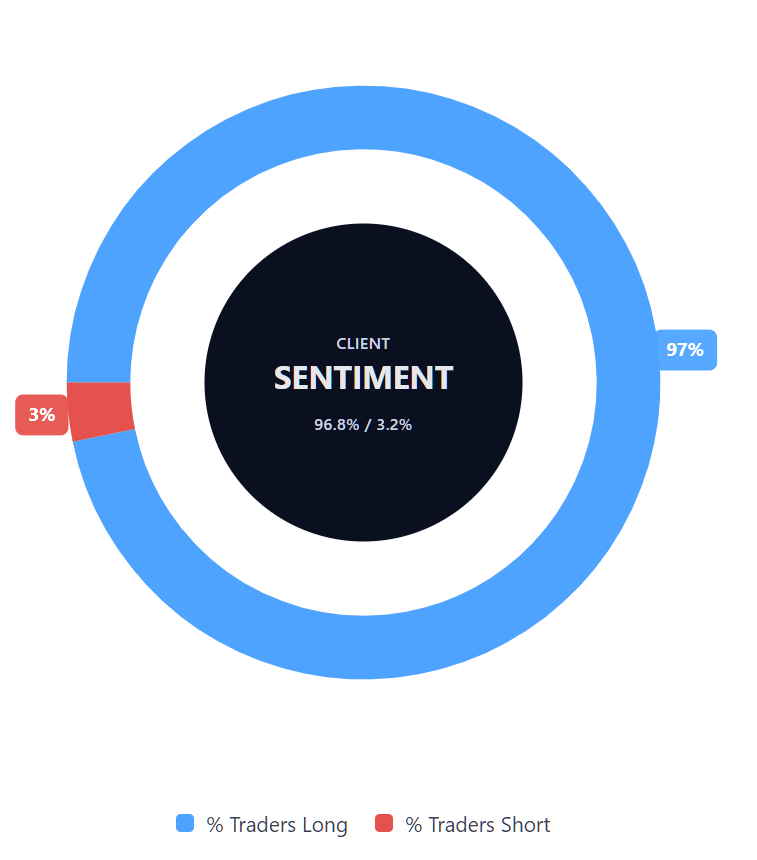
As of 17 February 2026, Capital.com client positioning in Visa CFDs is heavily skewed to the long side, with 97.1% buyers versus 2.9% sellers, putting long positions ahead by around 94.2 percentage points. This snapshot reflects open positions on Capital.com at the time of writing and can change as traders adjust their exposure. Client sentiment data should not be viewed in isolation when assessing market conditions.

Image

Summary – Visa 2026

Past performance is not a reliable indicator of future results.

FAQ

Who owns the most Visa stock?

Visa is a publicly listed company, and its largest shareholders typically include major institutional investors, such as global asset managers and investment funds. These institutions hold shares on behalf of clients, pension funds and other investors. Ownership levels can change over time as funds rebalance their portfolios or adjust exposure. You can usually find up-to-date information on major shareholders in regulatory filings and on financial data platforms.

What is the five-year Visa share price forecast?

There is no single agreed five-year V stock forecast. Most published targets focus on 12-month projections, reflecting analysts’ financial models and assumptions at a specific point in time. Longer-term estimates depend on variables such as revenue growth, margins, competitive dynamics, regulation and global economic conditions. Any multi-year projection is inherently uncertain and should be viewed as indicative rather than predictive.

Is Visa a good stock to buy?

Whether Visa is considered a ‘good’ stock depends on your objectives, risk tolerance and time horizon. Analysts often assess factors such as earnings growth, market share, competitive positioning and valuation when forming their views. However, share prices can rise or fall based on company performance and broader market conditions. This information is general in nature and does not constitute investment advice or a recommendation to buy or sell any instrument.

Could Visa stock go up or down?

Visa’s share price can move in either direction. It may respond to earnings results, transaction volumes, regulatory developments, interest-rate expectations and wider equity-market sentiment. Technical factors and trader positioning can also influence short-term movements. As with all equities, price fluctuations can be significant, and past performance is not a reliable indicator of future results.

Should I invest in Visa stock?

The decision to invest in Visa stock depends on your financial circumstances, investment goals and risk appetite. Shares carry market risk, and capital is at risk if the price falls. You may wish to consider your diversification strategy and conduct independent research before making any investment decision. This content is for general information only and does not constitute financial advice.

Can I trade Visa CFDs on Capital.com?

Yes, you can trade Visa CFDs on Capital.com. Trading share CFDs lets you speculate on price movements without owning the underlying asset and to take long or short positions. However, contracts for difference (CFDs) are traded on margin, and leverage amplifies both profits and losses. You should ensure you understand how CFD trading works, assess your risk tolerance, and recognise that losses can occur quickly.

Capital.com is an execution-only brokerage platform and the content provided on the Capital.com website is intended for informational purposes only and should not be regarded as an offer to sell or a solicitation of an offer to buy the products or securities to which it applies. No representation or warranty is given as to the accuracy or completeness of the information provided.

The information provided does not constitute investment advice nor take into account the individual financial circumstances or objectives of any investor. Any information that may be provided relating to past performance is not a reliable indicator of future results or performance.

To the extent permitted by law, in no event shall Capital.com (or any affiliate or employee) have any liability for any loss arising from the use of the information provided. Any person acting on the information does so entirely at their own risk.

Any information which could be construed as “investment research” has not been prepared in accordance with legal requirements designed to promote the independence of investment research and as such is considered to be a marketing communication.