
Rheinmetall AG price forecast: Third-party price targets
Rheinmetall AG continues to attract attention across the defence and industrial sectors, with its share price shaped by contract activity, shifting geopolitical conditions and broader market sentiment.
Rheinmetall AG (RHM) is trading around €1,542.44 in early European trading on 17 December 2025. Intraday prices on Capital.com’s platform have moved between €1,476.51 and €1,546.56 as of 2:15pm UTC. Past performance is not a reliable indicator of future results.
Recent trading has taken place against a backdrop of new contract announcements and broader sector shifts. In early December, Rheinmetall reported a new Bundeswehr order for 120 mm tank ammunition worth several hundred million euros (Rheinmetall, 8 December 2025), along with a high triple-digit million euro Skyranger 30 air-defence contract from the Netherlands (AeroMorning, 15 December 2025). Meanwhile, European defence shares have come under pressure following reports of progress in Ukraine peace discussions and evolving security assurances for Kyiv (Reuters, 16 December 2025).
Rheinmetall stock forecast 2025–2030: Analyst view
Third-party 12-month RHM stock forecasts published between October and December 2025 generally fall within the low-€2,000s, based on third-party broker estimates for the company’s Xetra-listed shares. These figures typically represent forward 12-month expectations from publication and refer to the underlying stock, not CFD pricing.
Bernstein
Bernstein increased its target to €2,050 following a sharp share-price decline since September. The analysts argued that the correction had already priced in a bear-case scenario and pointed to what they viewed as an improved balance of risks. They highlighted potential upside from continued defence order activity and execution on existing programmes amid sustained European security spending (Bernstein, 11 December 2025).
J.P. Morgan
J.P. Morgan reiterated a buy rating with a €2,250 target, placing its figure toward the top of the reported range. The note referenced Rheinmetall’s updated 2030 ambitions, ongoing defence procurement demand and German budget allocations for military spending (MarketScreener, 10 December 2025).
Consensus aggregates (Investing.com)
Investing.com’s mid-December 2025 RHM stock forecast showed an average 12-month target of about €2,207.8 from 18 analysts, with individual estimates spanning €1,770 to €2,500. The platform notes that these projections depend on assumptions of continued defence order intake and revenue growth linked to European rearmament plans (Investing.com, 17 December 2025).
Consensus aggregates (ValueInvesting.io)
ValueInvesting.io reported an average target near €2,248.90, implying potential upside of just over 40% from the model’s reference price. The aggregation reflects analyst forecasts embedded in a valuation approach that assumes multi-year revenue and earnings expansion alongside elevated defence spending (ValueInvesting.io, 17 December 2025).
Predictions and third-party forecasts are inherently uncertain, as they cannot fully account for unexpected market developments. Past performance is not a reliable indicator of future results.
RHM stock price: Technical overview
As of 2:15pm UTC on 17 December 2025, Rheinmetall AG last traded at €1,542.44, moving within a daily range of €1,476.51 to €1,546.56 on Capital.com’s feed. On the daily chart, price sits below the short- and medium-term simple moving averages, with the 20-, 50-, 100- and 200-DMAs around 1,540, 1,667, 1,724 and 1,669 respectively. This places recent action beneath a broad cluster of moving averages.
Momentum indicators also point to a neutral tone. The 14-day RSI near 44.7 sits mid-range, while an ADX close to 19.5 suggests the presence of a trend that isn’t strongly directional.
Classic pivot levels place initial resistance at R1 around 1,713 and R2 near 1,946, which would come into view only if price closed above the first resistance area. On the downside, the classic pivot near 1,572 offers an initial support reference, while the 200-day SMA at about 1,669 serves as a wider technical marker above spot. A move through S1 near 1,339 could risk deeper retracement beyond the recent intraday range (TradingView, 17 December 2025).
This technical analysis is for informational purposes only and isn’t financial advice or a recommendation to buy or sell any instrument.
Rheinmetall share price history
RHM’s stock price has undergone a substantial re-rating over the past two years, rising from roughly €285–€290 in late December 2023 to above €1,500 by mid-December 2025. The stock spent most of 2024 below €600, gradually firming through the spring and summer before ending the year near €620.
Momentum accelerated in early 2025, with RHM climbing from around €600 in January to above €1,000 by late February. A volatile spring followed, with the price advancing from the mid-€600s in mid-January to more than €1,880 by early June. The early-June peak preceded a choppy consolidation phase through the summer and autumn, with the stock mostly trading between €1,600 and €1,900 before slipping below €1,500 in late November. December 2025 has seen a recovery, with the price rising from a 1 December close near €1,446 to €1,546.56 on 17 December 2025. This compares with a €612.42 close on 17 December 2024.

Past performance is not a reliable indicator of future results. Share prices are indicative and may differ from live market prices.
Capital.com analyst view
The RHM stock price has moved from the high-€200s in late 2023 to above €1,500 by mid-December 2025, based on the history outlined above. The trajectory has included periods of steady growth followed by rapid accelerations, corrections and consolidation phases, with notable volatility during 2025. After the early-June rally towards the €1,800–€1,900 area, the stock retreated below €1,500 in November before recovering into mid-December.
Several factors could influence price direction from here. Continued defence order flow, government procurement programmes and ongoing geopolitical uncertainties may support revenue expectations. Conversely, any easing in geopolitical tensions, adjustments to defence budgets or delays to procurement could alter sentiment and affect valuation assumptions. The volatility seen in 2025 also shows that sharp pullbacks can occur after extended rallies, while consolidation phases may emerge as the market reassesses earnings visibility and wider macro conditions.
Capital.com’s client sentiment for Rheinmetall CFDs
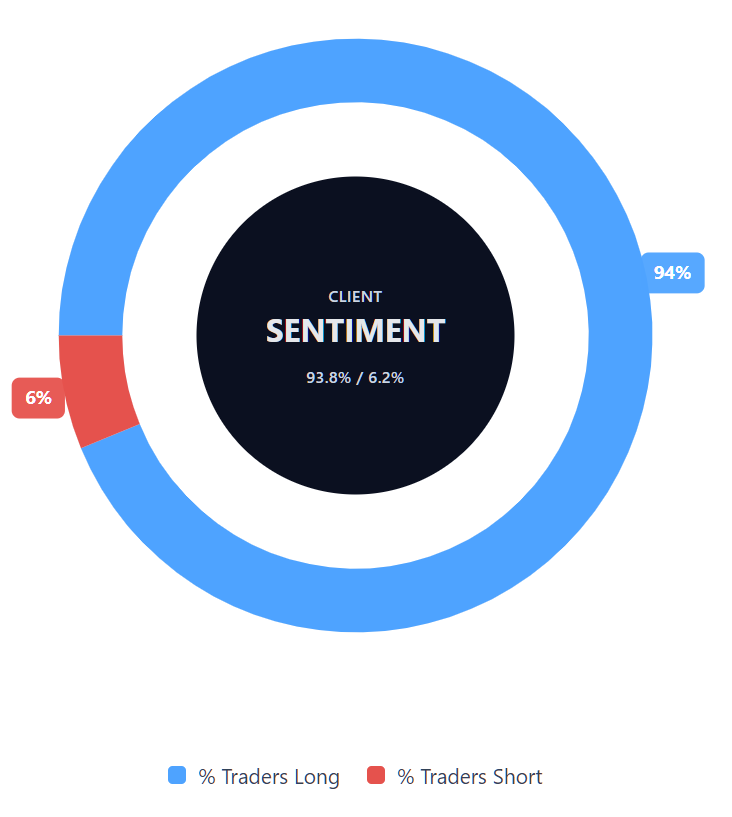
As of 17 December 2025, Rheinmetall CFD positioning on Capital.com currently shows 93.8% buyers and 6.2% sellers, a clear skew towards long positions. This reflects open positions on the platform and can vary as traders adjust their exposure.
Summary – Rheinmetall price 2025
- Rheinmetall AG’s share price has risen sharply through 2025, moving from around €600 in early January to above €1,500 by mid-December, with periods of pronounced volatility along the way.
- The stock advanced towards the €1,800–€1,900 area in early June before entering a choppy consolidation phase and later slipping below €1,500 in late November.
- By 17 December 2025, it closed at €1,546.56, noticeably higher than the €612.42 recorded a year earlier, reflecting a significant year-on-year re-rating.
- Technical indicators place the price below a broad cluster of daily moving averages, with mid-neutral RSI levels and moderate trend strength suggesting active but not strongly directional trading conditions.
Past performance is not a reliable indicator of future results.
FAQ
Who owns the most Rheinmetall stock?
Rheinmetall AG’s largest shareholders are typically institutional investors such as asset managers, pension funds and other financial institutions. These holdings can change over time as positions are adjusted or updated through regulatory disclosures. Public share registers and the company’s own reports provide the most current information on major shareholders.
What is the 5-year forecast for Rheinmetall stock?
Longer-term forecasts beyond 12 months vary widely and aren’t consistently available across public sources. Most research referenced in the article focuses on 12-month targets, which cluster around the low-€2,000s based on third-party estimates. Forecasts over several years depend on assumptions about defence spending, programme delivery and broader economic conditions, all of which may shift. As always, past performance isn’t a reliable indicator of future results, and long-term projections carry a high degree of uncertainty.
Is Rheinmetall a good stock to buy?
Whether Rheinmetall is appropriate for any individual depends on their financial circumstances, objectives and risk tolerance. Analysts currently hold differing views: some highlight long-term contracts and defence demand, while also noting risks such as budget constraints, procurement changes or geopolitical developments. This isn’t a recommendation to buy or sell Rheinmetall shares. Traders should rely on independent research when forming their own judgements.
Could Rheinmetall stock go up or down?
Rheinmetall’s share price, like all listed equities, can rise or fall in response to a range of factors. These may include changes in defence procurement, geopolitical developments, company results, macroeconomic conditions and broader sector sentiment. The price history discussed in the article shows periods of rapid appreciation as well as sharp corrections. Market volatility is possible at any time.
Should I invest in Rheinmetall stock?
Only you can decide whether investing in Rheinmetall aligns with your goals and risk appetite. The information provided outlines both supportive elements, such as long-term orders, and potential risks, including delays to major programmes or changes in government spending priorities. None of this constitutes financial advice. Independent research and a clear understanding of the risks involved are important before making any investment decision.
How can I trade Rheinmetall CFDs on Capital.com?
You can trade Rheinmetall AG CFDs on Capital.com by opening an account, depositing funds and searching for ‘RHM’ on the platform. Contracts for difference (CFDs) let you speculate on rising or falling prices without owning the underlying shares. CFDs are traded on margin, and leverage magnifies both gains and losses.