
UnitedHealth stock forecast: January earnings, 2026 guidance
UnitedHealth Group is a US-listed healthcare company whose shares have moved following its January results, which showed $447.6bn in 2025 revenue, revised 2026 guidance and a $2.21 quarterly dividend. Explore third-party UNH price targets and technical analysis.
UnitedHealth Group Incorporated (UNH) is trading near $292.26 in Friday’s US session, moving within an intraday range of $283.15-$293.17 at 4:22pm on 27 February 2026, as quoted on Capital.com. The stock remains volatile after a sharp pullback in recent weeks, with prices fluctuating around levels seen after its latest quarterly update and 2026 guidance revisions. Past performance is not a reliable indicator of future results.
The move follows ongoing investor reaction to UnitedHealth Group’s January earnings release. The company reported 2025 revenues of about $447.6bn and an adjusted fourth-quarter profit of $2.11 per share (UnitedHealth, 27 January 2026). It also flagged that 2026 revenues are expected to exceed $439.0bn, implying a first year-on-year decline in decades as it ‘right-sizes’ parts of the business (Bloomberg, 27 January 2026).
UnitedHealth stock forecast 2026–2030: Third-party price targets
As of 27 February 2026, third-party UnitedHealth stock predictions reflect assumptions following the latest results and 2026 guidance reset. These projections can change and may differ materially from future market outcomes as new information on earnings, regulation and medical cost trends emerges.
Benzinga (broker cluster)
Benzinga’s survey of analyst updates carries an average 12-month UNH stock forecast of about $410.14 – with individual targets ranging between $198 and £675. The outlet notes that these brokers retain Buy or outperform stances as they weigh revenue guidance cuts and litigation risk against the company’s diversified health insurance and services platform (Benzinga, 27 February 2026).
AInvest (post-earnings recap)
AInvest states that, following UnitedHealth’s fourth-quarter 2025 revenue miss and a 2026 outlook cut of around $15bn versus prior Wall Street expectations, several banks reduced their price targets in late February 2026. Mizuho lowered its 12-month target to $350 and Truist Securities to $370. According to the summary, these revisions reflect concerns over slower growth, rising medical costs and regulatory headwinds, even as the group maintains a significant presence in Medicare and Medicaid (AInvest, 23 February 2026).
Public.com (consensus overview)
Public.com reports that 24 analysts covering UnitedHealth have assigned a consensus 12-month price target of about $373.12 per share, alongside an overall Buy rating. The platform notes that this aggregate figure implies upside relative to trading levels at the time of publication, but remains sensitive to changes in assumptions around medical cost ratios, Medicare Advantage margins and US healthcare spending growth (Public.com, 25 February 2026).
Simply Wall St (valuation check)
Simply Wall St reports an analyst consensus price target near $364.63. The analysis attributes this gap to a cautious 2026 outlook following cyberattack and cost-trend issues, while noting that most covering analysts continue to model earnings and cash flows consistent with a higher medium-term valuation (Simply Wall St, 25 February 2026).
MarketBeat (stock move recap)
Oppenheimer reduces its UnitedHealth 12-month target from $415 to $385 per share, while maintaining an outperform rating. The broker linked the lower target to updated company guidance and a broader reassessment of managed-care valuations, with investors focusing on reimbursement, utilisation trends and regulatory scrutiny (MarketBeat, 23 February 2026).
Predictions and third-party forecasts are inherently uncertain, as they cannot fully account for unexpected market developments. Past performance is not a reliable indicator of future results.
UNH stock price: Technical overview
The UNH stock price is trading near $292.26 as of 4:22pm UTC on 27 February 2026. The price sits below the classic pivot at 308 and between the 20-, 50-, 100- and 200-day SMAs, clustered around approximately 283, 313, 326 and 315 respectively. The 14-day RSI, near 46.8, remains in neutral territory. An ADX reading around 35 suggests a defined trend backdrop rather than a purely range-bound market.
On the topside, traders often monitor the classic resistance level at R1 near 336. A sustained daily close above this zone could bring the R2 region around 386 into focus. On pullbacks, the classic pivot at 308 may act as an initial reference level. Below that, attention may shift towards S1 near 259. Technical levels indicate areas of interest rather than fixed outcomes. This analysis is for informational purposes only and does not constitute financial advice or a recommendation to buy or sell any instrument.
(TradingView, 27 February 2026)
This technical analysis is provided for informational purposes only and does not constitute financial advice or a recommendation to buy or sell any instrument.
UnitedHealth share price history (2024–2026)
UNH’s stock price has undergone a marked repricing over the past two years, moving from above $600 in late 2024 to below $300 by February 2026. The stock finished 2024 at about $506.50 on 31 December. It then traded largely between $500 and $620 through November and early December, before starting 2025 near $504.61 on 2 January and trending lower into the spring.
After peaking in the mid-$500s in early 2025 and reaching the high-$580s to $590s in April, UNH entered a more sustained decline. The share price moved from a close near $586.97 on 16 April 2025 to roughly the mid-$300s by October and the low-$300s towards year-end. The decline accelerated in early 2026. From a close near $337 on 2 January, the stock fell towards the mid-$270s following late-January volatility, before stabilising in February and ending at about $292.55 on 27 February 2026.

Past performance is not a reliable indicator of future results. Share prices are indicative and may differ from live market prices.
UnitedHealth (UNH): Capital.com analyst view
UnitedHealth’s share price has repriced significantly into early 2026, falling from levels above $500 in early 2025 to under $300 by late February 2026. Market participants have responded to revised guidance, higher medical costs and operational disruption linked to the prior Change Healthcare cyberattack.
The updated 2026 outlook signals a potential 2% year-on-year revenue decline to slightly above $439bn. At the same time, management has indicated expectations of higher earnings from operations and continued cash generation. These mixed signals create uncertainty around the near-term trajectory and help explain the divergence in external analyst targets.
Key variables include Medicare Advantage reimbursement rates, utilisation trends and progress in resolving operational issues. Tighter reimbursement or persistently elevated medical costs could continue to weigh on margins. Conversely, evidence of cost control, improved utilisation trends or stronger-than-expected performance in Optum’s services arm could alter market expectations.
Capital.com’s client sentiment for UnitedHealth CFDs
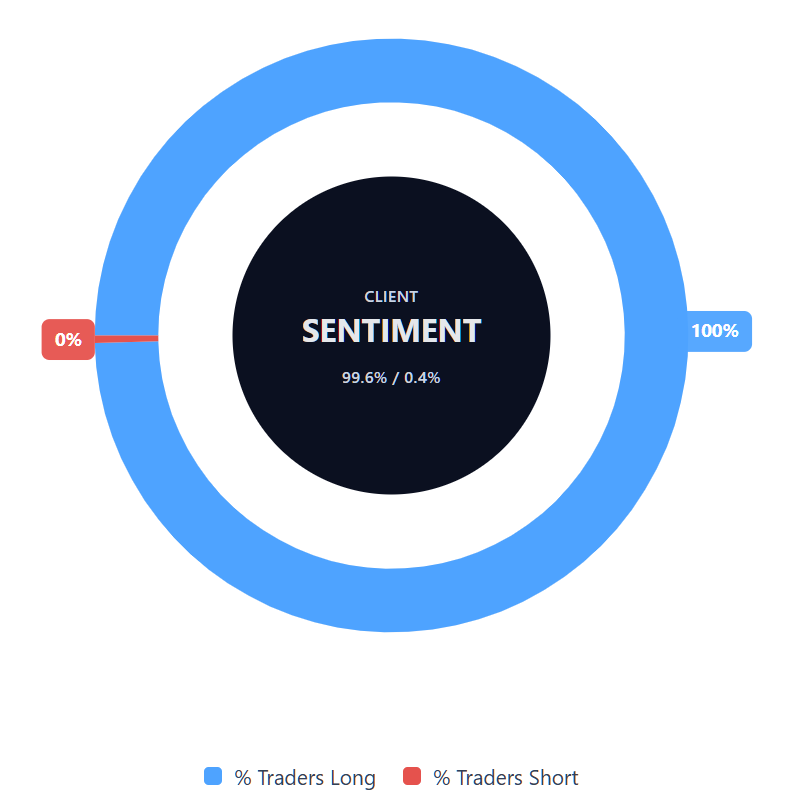
As of 27 February 2026, Capital.com client positioning in UnitedHealth CFDs shows buyers at 99.6% and sellers at 0.4%, leaving a net long skew of approximately 99.3 percentage points. This data reflects open positions held by Capital.com clients at the time of writing and can change without notice. It does not indicate future price direction.
Summary – UnitedHealth 2026
- As of 4:22pm UTC on 27 February 2026, UnitedHealth traded near $292.26, well below highs above $600 recorded in late 2024 and the mid-$500s seen in early 2025.
- Technical indicators show the price trading between key moving averages, with RSI in neutral territory and ADX pointing to an established trend environment rather than a flat range.
- Recent price action has followed a weaker 2026 revenue outlook, higher medical cost trends, Medicare Advantage and reimbursement dynamics, and continued fallout from the Change Healthcare cyberattack.
- News flow in early 2026 has centred on the projected year-on-year revenue decline, updated margin expectations and ongoing regulatory scrutiny, all of which remain relevant to forward-looking assessments.
Past performance is not a reliable indicator of future results.
FAQ
Who owns the most UnitedHealth stock?
UnitedHealth Group is a publicly listed company, and its largest shareholders are typically institutional investors, including asset managers and pension funds. Firms such as Vanguard, BlackRock and State Street have historically ranked among its biggest holders, based on regulatory filings. Ownership levels can change as funds rebalance portfolios or adjust allocations. The most up-to-date information is available in the company’s annual reports and filings with the US Securities and Exchange Commission (SEC).
What is the 5-year UnitedHealth share price forecast?
There is no single verified five-year UNH stock forecast. Most publicly available analyst targets focus on a 12-month horizon and, according to the third-party sources cited above, currently cluster in the mid-$300s. Longer-term projections depend on assumptions about earnings growth, healthcare regulation, medical cost trends and macroeconomic conditions. These forecasts are inherently uncertain and can change materially as new financial data or policy developments emerge.
Is UnitedHealth a good stock to buy?
Whether UnitedHealth is considered ‘a good stock to buy’ depends on an individual’s objectives, risk tolerance and investment timeframe. The company is one of the largest US healthcare providers by revenue, yet it operates in a sector exposed to regulatory, cost and operational risks. Recent guidance revisions and share price volatility underline that outcomes remain uncertain. Investors and traders often assess fundamentals, valuation metrics, technical factors and broader market conditions before making decisions. This information is for general purposes only and does not constitute investment advice.
Could UnitedHealth stock go up or down?
UnitedHealth’s share price can move in either direction. Future performance may reflect earnings updates, changes in Medicare Advantage reimbursement rates, medical cost trends, regulatory developments and broader equity market conditions. Technical indicators can highlight trend dynamics or momentum, but they do not predict outcomes. As with any listed equity, company-specific news and macroeconomic factors can both influence price movements.
Should I invest in UnitedHealth stock?
Deciding whether to invest in UnitedHealth stock requires careful consideration of your financial situation, goals and tolerance for risk. Shares and share CFDs carry the risk of capital loss, and past performance does not guarantee future results. You may wish to conduct your own research and, where appropriate, seek independent financial advice. Any decision should align with your broader portfolio strategy and risk-management approach.
Can I trade UnitedHealth CFDs on Capital.com?
Yes, you can trade UnitedHealth CFDs on Capital.com. Trading share CFDs lets you speculate on price movements without owning the underlying asset and to take long or short positions. However, contracts for difference (CFDs) are traded on margin, and leverage amplifies both profits and losses. You should ensure you understand how CFD trading works, assess your risk tolerance, and recognise that losses can occur quickly.