
Tesla stock forecast: Terafab project
Tesla is a US-listed electric vehicle and energy company, with March 2026 coverage focused on the Terafab project and a year-on-year rise in European registrations. Past performance is not a reliable indicator of future results. Explore third-party TSLA price targets and technical analysis.
Tesla, Inc. (TSLA) is trading at $388.70 as of 3:58pm UTC on 25 March 2026, within an intraday range of $377.12–$394.24. Past performance is not a reliable indicator of future results.
Sentiment around TSLA appears to have been supported by several converging catalysts over the past two weeks. On 21 March 2026, CEO Elon Musk unveiled the Terafab Project, a joint venture between Tesla, SpaceX, and xAI to vertically integrate AI chip production (Tom's Hardware, 22 March 2026), targeting 100–200 billion chips annually using 2-nanometre technology at an estimated cost of $20 billion (Reuters, 22 March 2026). Additionally, data published by the European Automobile Manufacturers' Association (ACEA) and reported on 24 March showed Tesla's European registrations rose 11.8% year on year in February 2026 to 17,664 units, ending a thirteen-month consecutive decline (The Wall Street Journal, 24 March 2026). At the macro level, US equities drew broad support on 25 March after the White House delivered a ceasefire proposal to Iran, easing geopolitical risk and pushing oil prices lower. Brent crude fell towards $88 per barrel, reducing broader cost pressures across the market (Fortune, 25 March 2026).
Tesla stock forecast 2026–2030: Third-party price targets
As of 25 March 2026, third-party Tesla stock predictions span a wide range, shaped by divergent assumptions around the robotaxi rollout timeline, Full Self-Driving (FSD) commercialisation, near-term margin compression, and the contribution of Tesla's AI and energy businesses to long-term valuation.
HSBC (reduce – street-low)
HSBC reiterates a Reduce rating and cuts its 12-month price target to $119, from $133. The bank cites material weakness in Tesla's core automotive business and says FSD remains commercially unproven at scale, concluding that the stock's premium valuation is difficult to justify on near-term fundamentals (Yahoo Finance, 20 March 2026).
Stifel Nicolaus (buy – above consensus)
Stifel Nicolaus carries a $508 TSLA stock forecast, reflecting a Buy-equivalent stance above the Wall Street consensus. The firm's case rests on Tesla's structural lead in consumer-facing autonomy and the medium-term revenue potential of a scaled robotaxi network (Investing.com, 17 March 2026).
Morgan Stanley (equal-weight – at consensus)
Morgan Stanley sets a $415 price target alongside an Equal-Weight rating. The bank acknowledges Tesla's AI and autonomy optionality while flagging execution risk in the Cybercab ramp and persistent margin headwinds that may constrain near-term upside (Investing.com, 18 March 2026).
MarketBeat (consensus – 41-analyst aggregate)
MarketBeat's aggregated consensus across 41 analysts places the average 12-month price target at $406.84, with a distribution of 9 Sell, 13 Hold, and 19 Buy recommendations producing a composite Hold rating. The note flags mixed near-term signals, including a sharp jump in China-made EV deliveries and UK energy licence approval, set against FSD safety concerns, insider net selling of approximately $38.3 million over the prior 90 days, and a trailing price-to-earnings ratio near 362x (MarketBeat, 14 March 2026).
Public.com (consensus – multi-contributor)
Public.com's aggregation across 27 contributing analysts sets the average TSLA price target at $396.23, with 26% at Strong Buy, 22% at Buy, 30% at Hold, and 22% combined at Sell or Strong Sell. The central estimate sits within approximately 2% of the last quoted price of $388.70, indicating that the street's midpoint has converged closely with current trading levels (Public.com, 24 March 2026).
Predictions and third-party forecasts are inherently uncertain, as they cannot fully account for unexpected market developments. Past performance is not a reliable indicator of future results.
TSLA stock price: Technical overview
The TSLA stock price trades at $388.70 as of 3:58pm UTC on 25 March 2026, sitting below its key moving-average shelf but holding above the nearest short-term averages. The 10-day simple moving average (SMA) at $387.66 and the Hull moving average (9) at $378.38 both register buy signals on TradingView, while the 20/50/100/200-day SMAs at approximately $395 / $412 / $428 / $396 all generate sell signals, placing price in a zone where short-term momentum has recently firmed but the broader moving-average structure remains a layer of overhead resistance.
Momentum is mixed. The 14-day relative strength index (RSI) sits at 45.92 – a neutral reading that indicates neither oversold nor overbought conditions – while the average directional index (ADX) at 25.47 suggests an established, if not strong, trend is present. The moving average convergence/divergence (MACD) level at −8.49 and a momentum (10) reading of −17.19 both carry sell signals, pointing to residual downward pressure in the intermediate trend.
On the upside, the classic pivot point sits at $408.80, with R1 at $430.06 as the next reference. A daily close back above $408.80 would put the R1 area in view. The Ichimoku base line at $392.40 and the 20-day SMA near $395 form a nearby overhead band that price is currently trading below.
On pullbacks, the Hull moving average (9) near $378.38 and the classic S1 at $381.24 represent the first area of potential support, with the Fibonacci S1 at $390.15 and Camarilla S1 at $398.03 offering reference points on lesser retracements. Losing the $378–$381 zone would open the path towards the classic S2 at $359.98 (TradingView, 25 March 2026).
This is technical analysis for informational purposes only and does not constitute financial advice or a recommendation to buy or sell any instrument.
Tesla share price history (2024–2026)
TSLA’s stock price spent much of early 2024 under pressure, sliding from around $176 at the start of the year to a two-year low close of $141.53 on 22 April 2024 – a period marked by softer-than-expected delivery numbers and broader caution around EV demand growth. The stock then spent the summer in a narrow recovery band, trading in the $175–$265 range before a sharp post-US election rally in November 2024 sent it surging to $355.34 by 11 November.
That momentum carried through year-end, with TSLA reaching a closing high of $489.84 on 22 December 2025 – the top of the dataset – before trimming gains into the 2025 year-end close of $450.09. The early months of 2025 brought a significant pullback, with the stock falling to a closing low of $215.30 on 10 March 2025 amid broader market volatility and concerns over margins and demand. It recovered sharply from there, closing the year up around 12% versus the start of 2025.
TSLA opened 2026 at $439.70 on 2 January and has drifted lower since, trading at $389.03 as of 25 March 2026 – approximately 11.5% down year to date, though still around 35.4% above its level on the same date one year prior.

Past performance is not a reliable indicator of future results. Share prices are indicative and may differ from live market prices.
Tesla (TSLA): Capital.com analyst view
Tesla's price trajectory over the past two years reflects the tension between its long-term positioning as an AI and autonomous-vehicle company and the near-term reality of slowing EV volume growth and margin compression. The post-election surge to highs near $490 in late 2025 captured the market's enthusiasm around policy tailwinds and the Terafab chip announcement, while the subsequent pullback towards the $389 area into March 2026 suggests those expectations are being recalibrated against delivery data and rising capital expenditure commitments. The European sales recovery reported in February 2026 offers a counterpoint to the demand concerns, though it remains one data point in an otherwise mixed picture.
On the other hand, the wide spread in analyst price targets – from below $150 to $600 – illustrates how differently market participants are pricing the autonomous driving and robotics opportunity against execution risk. A successful Cybercab rollout or accelerated FSD adoption could shift the narrative materially. Equally, further margin deterioration or regulatory hurdles could weigh on sentiment regardless of the longer-term thesis.
Capital.com’s client sentiment for Tesla CFDs
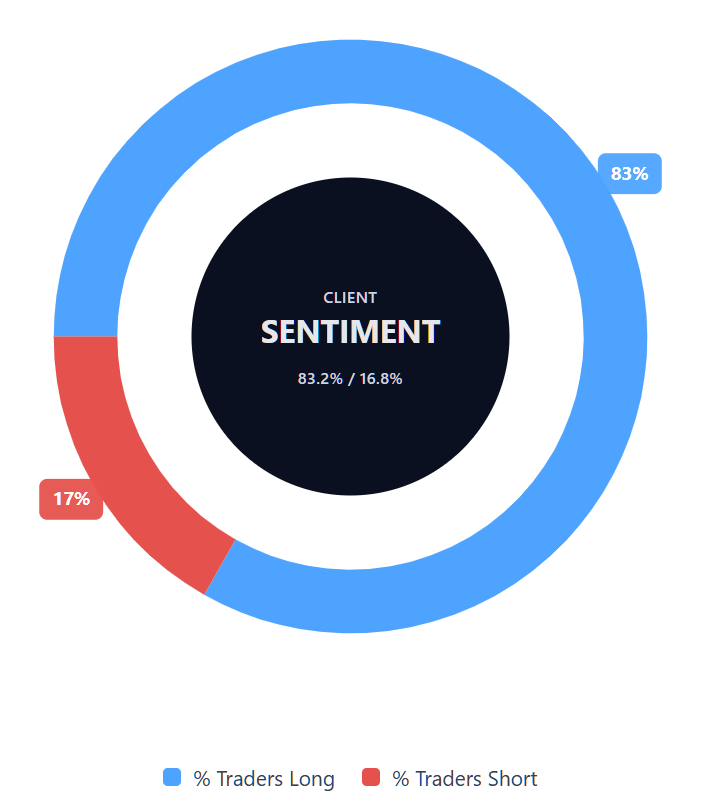
As of 25 March 2026, Capital.com client positioning in Tesla CFDs shows a 83.2% long vs 16.8% short, which puts buyers ahead by 66.4 percentage points and places sentiment firmly in one-sided territory on the long side. This snapshot reflects open positions on Capital.com and can change rapidly as market conditions evolve.
Summary – Tesla 2026
- Tesla (TSLA) trades at $388.70 as of 3:58pm UTC on 25 March 2026, around 11.5% below its 2026 open of $439.70 but 35.4% above the same date last year.
- Technical indicators are mixed: short-term SMAs (including the 10-day SMA) register buy signals while the 20/50/100/200-day SMAs all sit above price, generating sell signals; the RSI at 45.92 is neutral.
- The MACD and momentum (10) indicators carry sell signals, while the ADX at 25.47 suggests an established trend is in place, though it is not at an extreme reading.
- Key price drivers include the Terafab AI chip project announcement, a rebound in European registrations in February 2026, and broader US equity market sentiment lifted by easing geopolitical tensions.
Past performance is not a reliable indicator of future results.
FAQ
Who owns the most Tesla stock?
Tesla’s largest individual shareholder is widely understood to be Elon Musk, based on his long-standing equity stake and voting power in the company. However, ownership levels can change over time through share sales, option exercises, compensation awards and regulatory filings. Large institutional investors also hold significant positions through asset managers and index funds. For readers following Tesla, it’s worth checking the company’s latest filings for the most current ownership breakdown.
What is the 5 year Tesla share price forecast?
There is no single accepted five-year TSLa stock forecast. Longer-term projections vary widely because they depend on assumptions about electric vehicle demand, margins, autonomous driving, energy storage, regulation and broader market conditions. In the article, even 12-month analyst targets show a very wide range, which highlights the uncertainty around longer-term estimates. Five-year forecasts should therefore be treated as scenarios rather than precise expectations, especially in a stock with shifting sentiment and valuation.
Is Tesla a good stock to buy?
Whether Tesla is a good stock to buy depends on an individual’s goals, risk tolerance, time horizon and view of the company’s future prospects. The article presents a mixed picture: Tesla has exposure to themes such as AI, autonomy and energy, but it also faces margin pressure, execution risk and valuation debate. That balance means there is no universal answer. Readers should view both the potential opportunities and the risks before making any investment decision.
Could Tesla stock go up or down?
Tesla stock could move in either direction, depending on how company-specific and broader market factors develop. The article highlights several possible drivers, including the Terafab announcement, changes in vehicle registrations, margin trends, robotaxi progress and general equity-market sentiment. Technical indicators also point to a mixed setup rather than a clear one-way trend. As with many high-profile growth stocks, price moves can be influenced by both fundamentals and market expectations, sometimes quite quickly.
Should I invest in Tesla stock?
Deciding whether to invest in Tesla stock is a personal decision and not something this article can answer for any individual reader. The content is designed to inform, not advise. Tesla may appeal to those interested in long-term innovation themes, but the stock also carries meaningful uncertainty around execution, competition, regulation and profitability. Anyone considering an investment should assess whether the level of risk fits their own objectives and financial circumstances before taking action.
Can I trade Tesla CFDs on Capital.com?
Yes, you can trade Tesla CFDs on Capital.com. Trading share CFDs lets you speculate on price movements without owning the underlying asset and to take long or short positions. However, contracts for difference (CFDs) are traded on margin, and leverage amplifies both profits and losses. You should ensure you understand how CFD trading works, assess your risk tolerance, and recognise that losses can occur quickly.