
Oracle stock forecast: New CFO, AI spend
Oracle is a US technology company whose recent price action has reflected its Q3 FY2026 results, a new CFO appointment and reported restructuring linked to cloud and AI investment.
Past performance is not a reliable indicator of future results. Share prices are indicative and may differ from live market prices. Explore third-party ORCL price targets and technical analysis.
Oracle Corporation (ORCL) is trading at $149.05 as of 1:51pm UTC on 8 April 2026, with an intraday range of $140.32–$149.86. Past performance is not a reliable indicator of future results.
Sentiment around ORCL has been shaped by several concurrent developments. Oracle announced the appointment of Hilary Maxson, formerly group CFO at Schneider Electric, as its new Chief Financial Officer, effective 6 April 2026, a move Reuters noted came as the company ramps up AI infrastructure investment amid close investor scrutiny of capital expenditure (Reuters, 6 April 2026). Separately, Forbes reported a restructuring involving approximately 30,000 layoffs as Oracle redirects resources towards cloud and AI spending (Forbes, 6 April 2026). At the macro level, renewed US tariff pressure has weighed on equities more broadly, with the S&P 500 and Nasdaq under sustained selling pressure through early April 2026 (Yahoo Finance, 15 March 2026). Oracle's Q3 FY2026 results, published on 10 March 2026, showed total revenue of $17.2 billion, up 22% year on year in USD, and remaining performance obligations of $553 billion, though investor focus has remained on the pace and cost of AI-driven capital deployment (Oracle Investor Relations, 10 March 2026).
Oracle stock forecast 2026–2030: Third-party price targets
As of 8 April 2026, third-party Oracle stock predictions span a wide range, shaped by the company's accelerating AI infrastructure commitments, elevated capital expenditure, and a share price decline of more than 50% from its September 2025 peak. The following targets reflect broker and consensus estimates captured between 25 March and 8 April 2026.
Bank of America (buy reaffirmation)
Bank of America reaffirms a Buy rating on Oracle, with a $200 ORCL stock forecast, implying roughly 29.7% upside from the prior close at the time. The firm cites Oracle's Q3 FY2026 beat with EPS of $1.79 against the $1.71 consensus estimate, and revenue of $17.19 billion, up 21.7% year on year, as well as Q4 FY2026 EPS guidance of $1.96–$2, as near-term fundamental support (MarketBeat, 24 March 2026).
Stephens (equal weight initiation)
Stephens initiates coverage of ORCL with an Equal Weight rating, declining to assign an explicit price target at the time of publication. The firm's more cautious stance comes amid ongoing investor concern over Oracle's debt load and capital expenditure trajectory as it scales Oracle Cloud Infrastructure for AI workloads (MarketBeat, 7 April 2026).
Public.com (consensus snapshot)
Public.com aggregates Wall Street analyst estimates, placing the average 12-month consensus price target at $259.36, with a Buy consensus rating across the covering analysts. The platform notes that this aggregate reflects multiple independent 12-month forecasts and sits within a broad range of individual estimates (Public.com, 6 April 2026).
MarketBeat (broker consensus)
MarketBeat aggregates coverage from 40 brokerages, reporting an average consensus price target of $260.71, a Moderate Buy consensus rating, and a breakdown of 3 Strong Buy, 27 Buy, 9 Hold, and 1 Sell. The consensus reflects a broad mix of views, with individual 12-month targets ranging from $160 to $400, as analysts weigh Oracle's AI backlog against near-term margin and leverage headwinds (MarketBeat, 7 April 2026).
Stock Analysis (consensus overview)
Stock Analysis reports a Buy consensus from 35 analysts covering ORCL, with an average 12-month price target of $261.29, a low estimate of $160, and a high estimate of $400. The spread reflects divided analyst opinion on the pace of free cash flow recovery amid heavy AI-driven capital expenditure, with several brokers having materially reduced targets following Q3 FY2026 earnings in March 2026 (Stock Analysis, 8 April 2026).
Predictions and third-party forecasts are inherently uncertain, as they cannot fully account for unexpected market developments. Past performance is not a reliable indicator of future results.
ORCL stock price: Technical overview
The ORCL stock price trades at $149.05 as of 1:51pm UTC on 8 April 2026, sitting just beneath the 20-day simple moving average (SMA) at $149.59 and broadly below the full moving average stack, according to TradingView data. The 20/50/100/200-day SMAs stand at approximately $150 / $153 / $177 / $218, all above the current last price, and each registers a sell signal; there is no bullish alignment across the SMA family at this time.
Momentum indicators are broadly neutral to soft. The 14-day relative strength index (RSI) reads 42.44 – in the lower half of neutral territory and consistent with a stock under distribution pressure rather than at an oversold extreme. The average directional index (ADX) at 12.95 indicates a weak, poorly defined trend, which suggests the recent directional move lacks strong conviction.
On the upside, the classic pivot point (P) at $151.94 is the nearest reference above the last price; a daily close through this level could bring R1 at $166.93 into view. On the downside, classic S1 sits at $132.12, with S2 at $117.13 representing the next reference if S1 were to give way. The Hull moving average (9) at $146.13 lies just below the current last price and represents a nearby short-term technical reference on any pullback (TradingView, 8 April 2026).
This is technical analysis for informational purposes only and does not constitute financial advice or a recommendation to buy or sell any instrument.
Oracle share price history (2024–2026)
ORCL’s stock price closed at $123.34 on 9 April 2024, trading in a relatively tight band through mid-2024, before Q1 FY2025 earnings momentum and growing enthusiasm around its AI cloud contracts drove a sustained rally. The stock ended 2024 at $167.43, up roughly 35.7% over the calendar year.
That upward trend accelerated sharply through 2025. ORCL reached an intraday peak of $345.78 on 10 September 2025, its highest level in the two-year window, as investor confidence in Oracle's AI infrastructure buildout and a surging remaining performance obligations backlog reached record highs. The stock was broadly trading above $280 from late September through mid-October 2025.
A sharp reversal followed Oracle's Q2 FY2026 earnings release in December 2025, when results and guidance disappointed parts of the market. ORCL opened at $223.40 on 10 December 2025 and closed at $198.49 the same day – a single-session drop of around 11.1%. The stock continued to slide into early 2026, with a particularly steep intraday low of $132.45 on 5 February 2026 amid a broad tech sell-off.
ORCL closed at $149.23 on 8 April 2026, approximately 23.7% down year to date from its closing price on 2 January 2026 of $195.53, and roughly 56.8% below the September 2025 intraday peak.

Past performance is not a reliable indicator of future results. Share prices are indicative and may differ from live market prices.
Oracle (ORCL): Capital.com analyst view
Oracle's price story in 2025–2026 reflects the tension between an impressive structural opportunity and the near-term costs of capturing it. The company's Oracle Cloud Infrastructure (OCI) revenue surged 84% year on year to $4.9 billion in Q3 FY2026, with remaining performance obligations reaching $553 billion, pointing to a substantial contracted revenue pipeline. That backdrop supports the argument that the stock's decline from its September 2025 intraday peak of $345.78 to around $149 by early April 2026 represents a valuation reset rather than a fundamental deterioration. On the other hand, Oracle's capital expenditure is projected at approximately $50 billion for fiscal 2026, pushing free cash flow negative and pushing total debt above $100 billion – factors that leave the stock sensitive to any shift in interest rate expectations or a moderation in AI infrastructure demand.
The macro environment adds a further layer of complexity. Renewed US tariff pressure in early April 2026 has weighed on broader technology equities, and Oracle's high leverage means its cost of financing remains a live concern, particularly if rates stay elevated. At the same time, the appointment of a new CFO in April 2026 and a one-time $25 billion bond issuance have been noted by some analysts as steps that may reduce near-term financing uncertainty. Whether the contracted backlog converts to profit at the pace the market requires remains the central open question.
Capital.com’s client sentiment for Oracle CFDs
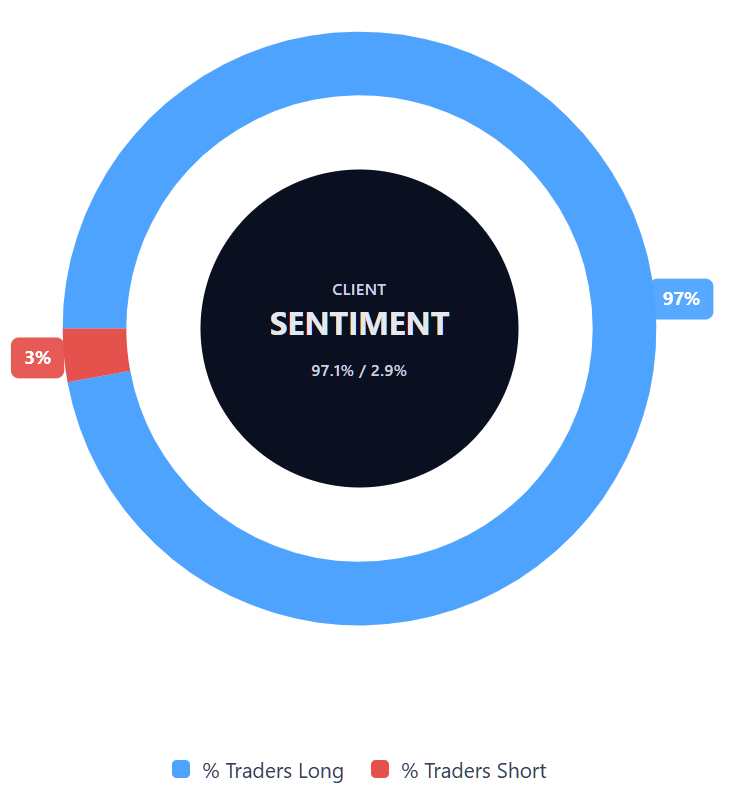
As of 8 April 2026, Capital.com client positioning in Oracle CFDs shows 97.1% buyers vs 2.9% sellers, putting buyers ahead by 94.2 percentage points and placing sentiment firmly in heavy-buy, one-sided territory. This snapshot reflects open positions on Capital.com and can change.
Summary – Oracle 2026
- Oracle (ORCL) is trading at $149.05 as of 1:51pm UTC on 8 April 2026, down roughly 56.8% from its September 2025 intraday peak of $345.78.
- Key drivers include Oracle's $553 billion remaining performance obligations backlog and 84% year-on-year OCI revenue growth, set against $50 billion in projected capital expenditure and debt exceeding $100 billion.
- Renewed US tariff pressure in April 2026 has weighed on broader technology equities, adding a macro headwind to Oracle's already elevated leverage profile.
- Recent developments include the appointment of Hilary Maxson as CFO on 6 April 2026, a reported restructuring of approximately 30,000 roles, and Q3 FY2026 revenue of $17.19 billion, up 21.7% year on year.
Past performance is not a reliable indicator of future results.
FAQ
Who owns the most Oracle stock?
What is the 5 year Oracle share price forecast?
Is Oracle a good stock to buy?
Could Oracle stock go up or down?
Oracle stock could move in either direction, as its price remains sensitive to both company-specific and broader market factors. Supportive factors may include cloud revenue growth, progress in AI infrastructure and confidence in future earnings delivery. On the other hand, pressure could come from weaker sentiment in technology stocks, concerns over debt and capital expenditure, or disappointment around margins and cash flow. In practice, share prices often react to a combination of fundamentals, guidance and wider market conditions.
Should I invest in Oracle stock?
Whether you should invest in Oracle stock is a personal decision rather than a general conclusion. It depends on factors such as your financial circumstances, investment goals, time horizon and tolerance for risk. Oracle may appeal to investors looking at large-cap technology exposure, but it also carries risks linked to valuation, execution and macroeconomic conditions. For that reason, it’s important to research the stock carefully and consider whether it fits your broader strategy before making any investment decision.
Can I trade Oracle CFDs on Capital.com?
Yes, you can trade Oracle CFDs on Capital.com. Trading share CFDs lets you speculate on price movements without owning the underlying asset and to take long or short positions. However, contracts for difference (CFDs) are traded on margin, and leverage amplifies both profits and losses. You should ensure you understand how CFD trading works, assess your risk tolerance, and recognise that losses can occur quickly.