
Novo Nordisk stock forecast: Guidance cut, buyback, expansion
Novo Nordisk is a Danish pharmaceutical company whose February 2026 guidance cut, DKK 15 billion buyback and Ireland expansion remain central to current market focus. Past performance is not a reliable indicator of future results. Explore third-party NVO price targets and technical analysis.
Novo Nordisk A/S (NVO) is trading at $36.66 as of 3:37pm UTC on 25 March 2026, within an intraday range of $36.46–$37.38. Past performance is not a reliable indicator of future results.
Sentiment continues to reflect the company's February 2026 full-year guidance, in which Novo Nordisk projected adjusted sales to fall 5%–13% at constant exchange rates for the year, citing pricing pressure from its Most Favoured Nation (MFN) agreement with the US administration, intensifying competition from Eli Lilly's tirzepatide products, and the expiry of the semaglutide molecule patent in certain international markets (Reuters, 3 February 2026). The company has also been advancing a 15 billion DKK share buyback programme initiated on 4 February 2026, with 7,847,992 B shares repurchased at an average price of 266.53 DKK as of 20 March 2026 (The Globe and Mail, 24 March 2026), while it announced a €432 million ($506 million) manufacturing expansion at its Athlone, Ireland, facility on 2 March 2026 to increase oral GLP-1 production capacity as a longer-term supply investment (Reuters, 2 March 2026).
Novo Nordisk stock forecast 2026–2030: Third-party price targets
As of 25 March 2026, third-party Novo Nordisk stock predictions have continued to shift, as brokerages reassess growth assumptions for the GLP-1 franchise following Novo Nordisk's February guidance cut and a weak CagriSema trial readout.
Bernstein (new Underperform coverage, 175 DKK target)
Bernstein analyst Justin Smith has initiated coverage of NVO with an Underperform rating and a price target of 175 DKK for the Copenhagen-listed shares, equivalent to approximately $31 for the ADR, placing it at the low end of the current range. The firm argues that the earnings downgrade cycle is not yet complete, citing weakening volume market share for Ozempic and Wegovy in the US, greater-than-expected price deflation, a limited pipeline catalyst path, and the anticipated semaglutide compound-patent expiry in the US by 2032 as factors that could contribute to further mix deterioration and margin contraction (MarketScreener, 19 March 2026).
TD Cowen (downgrade to Hold, $42 target)
TD Cowen downgrades Novo Nordisk from Buy to Hold and trims its 12-month NVO stock forecast to $42 from $45, after shares had already declined sharply from February highs. The firm cites intensifying GLP-1 competitive dynamics and semaglutide loss-of-exclusivity risk as the primary drivers, while noting the company's Hims & Hers distribution agreement and ongoing 15 billion DKK share-repurchase programme as partial mitigants (MarketBeat, 10 March 2026).
CCB (new Outperform coverage, $43.29 target)
CCB initiates coverage on Novo Nordisk with an Outperform rating and a 12-month price target of $43.29 for the ADRs, implying modest upside from prices near $36–$38 at the time of initiation. The bank's constructive stance reflects a view that current valuations more fully reflect near-term headwinds, amid expectations for demand recovery in the company's core obesity and diabetes franchise over the medium term (MarketScreener, 20 March 2026).
Berenberg (reaffirmed Buy, 300 DKK target)
Berenberg reaffirms a Buy rating on Novo Nordisk while trimming its price target for the Copenhagen shares to 300 DKK from 360 DKK, reflecting lower CagriSema sales assumptions following recent clinical data. The bank retains its positive stance amid expectations that the company's broader GLP-1 portfolio and manufacturing investments could support a recovery in earnings over the medium term (MarketScreener, 12 March 2026).
MarketBeat (consensus overview, $49.93 average target)
MarketBeat aggregates coverage from multiple brokerages and reports a consensus Hold rating for NVO, with an average 12-month price target of $49.93; the breakdown at that date reflects 1 sell, 10 hold, and 7 buy ratings, with Zacks Research simultaneously upgrading its own rating from Strong Sell to Hold. The $49.93 average sits well above prevailing market prices around $38–$40, indicating that the aggregate of pre- and post-guidance-cut estimates had not yet fully converged, amid ongoing rating revisions across the coverage universe (MarketBeat, 12 March 2026).
Predictions and third-party forecasts are inherently uncertain, as they cannot fully account for unexpected market developments. Past performance is not a reliable indicator of future results.
NVO stock price: Technical overview
On the daily chart, the NVO stock price trades at $36.66 as of 3:37pm UTC on 25 March 2026, sitting below its entire moving-average stack, according to TradingView data. The 20/50/100/200-day SMAs sit at approximately $37.87 / $46.99 / $48.40 / $54.36, all generating sell signals, with the share price below every reference in that cluster. The 200-day EMA at $55.55 extends the long-term resistance ceiling materially above current levels.
Momentum readings are mixed to weak. The 14-day RSI from TradingView registers 31.60 and sits in the lower-neutral band, approaching oversold territory, while the average directional index (ADX) at 36.04 indicates an established trend, consistent with the sustained directional pressure to the downside that has characterised price action since February. The Hull moving average (9) at $36.38 carries a buy signal, representing the sole constructive reading among the moving-average suite and sitting just beneath the current price.
On the classic pivot table sourced from TradingView, the classic pivot point (P) at $44.69 represents the nearest overhead reference of note; a daily close back above that level would put R1 at $52.06 in view. Beyond that, R2 near $66.68 is a more distant reference. On the downside, S1 at $30.07 is the next classic support level below the current price, with the intraday range low from 25 March 2026 at $36.46 providing a near-term floor reference.
The MACD level (12, 26) at -2.47 carries a buy signal from TradingView's reading, which may reflect a narrowing in the spread between the MACD line and its signal line rather than a directional reversal; the momentum (10) indicator at -2.25 remains on a sell signal, consistent with the broader picture.
This is technical analysis for informational purposes only and does not constitute financial advice or a recommendation to buy or sell any instrument.
(TradingView, 25 March 2026)
Novo Nordisk share price history (2024–2026)
NVO’s stock price traded above $129 in late March 2024, with the share price broadly range-bound between $120 and $145 throughout the summer and into October 2024 — a period that proved to be the highest sustained level in this dataset.
The first significant leg lower came on 20 December 2024, when NVO fell from $104.06 to close at $85.17 in a single session — a drop of approximately 18.2% — following disappointing Phase 3 trial data for CagriSema, Novo Nordisk's next-generation obesity combination therapy. The stock carried that weakness into early 2025, closing the year at $86.22 on 31 December 2024 and opening 2025 below $88.
A second, sharper dislocation arrived on 3 February 2026, when NVO gapped from $59.05 to close at $48.89 — down approximately 17.2% in one session — after Novo Nordisk issued full-year 2026 guidance projecting an adjusted sales decline of 5%–13% at constant exchange rates, citing US pricing pressures and GLP-1 competition. A further slide on 23 February 2026 saw the stock open at $47.58 and close at $39.85, extending cumulative losses.
NVO closed at $36.67 on 25 March 2026, approximately 30.1% down year to date from the 2 January 2026 close of $52.49 and approximately 50.4% lower year on year from $73.86 on 25 March 2025.

Past performance is not a reliable indicator of future results. Share prices are indicative and may differ from live market prices.
Novo Nordisk (NVO): Capital.com analyst view
NVO's share price has declined sharply from above $129 in early 2024 to around $36.66 as of 25 March 2026, a move shaped by a succession of negative catalysts: disappointing CagriSema Phase 3 weight-loss results, a February 2026 guidance cut projecting a 5%–13% adjusted sales decline at constant exchange rates, and intensifying GLP-1 pricing pressure under the US Most Favoured Nation (MFN) pricing framework. Semaglutide patent expiries in China, India, Brazil, and Canada add a further layer of competitive risk, as local manufacturers gain the ability to compress prices and margins in markets that collectively represent a meaningful portion of Novo Nordisk's international revenue. Against that, the company has submitted CagriSema to the FDA for approval in weight management and a decision is expected by late 2026. A potential Wegovy oral pill launch could also extend GLP-1 reach into a broader patient population, which would provide potential upside catalysts if clinical and regulatory timelines are met.
The broader investment debate centres on whether the current valuation already reflects the downgrade cycle or whether further consensus earnings reductions remain ahead. Bulls point to the company's first-mover advantage in oral GLP-1, its 15 billion DKK share-buyback programme, and a large and growing global obesity and diabetes patient population as structural supports. Bears, however, argue that Eli Lilly's competing tirzepatide franchise continues to gain US market share, that the CagriSema efficacy narrative has yet to fully recover following the 15.7% weight-loss result in the REDEFINE 2 study, and that stepped-up R&D and commercial spending will weigh on margins through the near term.
Capital.com’s client sentiment for Novo Nordisk CFDs
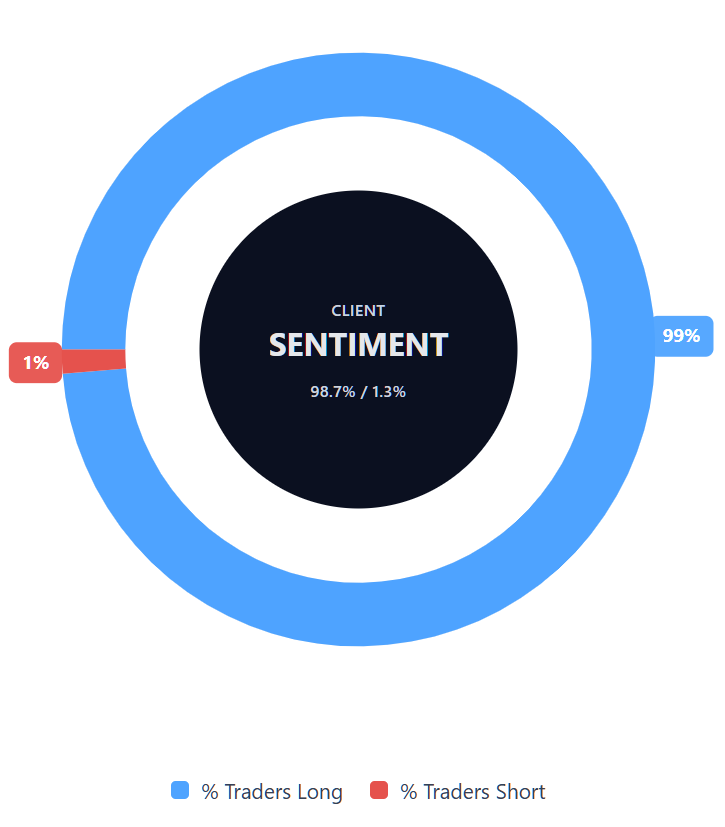
As of 25 March 2026, Capital.com client positioning in Novo Nordisk CFDs stands at 98.7% buyers vs 1.3% sellers, which puts buyers ahead by 97.4 percentage points and places sentiment firmly in heavy-buy, one-sided-towards-longs territory. This snapshot reflects open positions on Capital.com and can change rapidly as market conditions evolve.
Summary – Novo Nordisk 2026
- NVO trades at $36.66 as of 3:37pm UTC on 25 March 2026, down approximately 50.4% year on year and 30.1% year to date.
- TradingView data shows NVO trading below its entire moving-average stack, with the 20/50/100/200-day SMAs ranging between $37.87 and $54.36 above the current price.
- The 14-day RSI sits at 31.60, approaching oversold territory, while the ADX at 36.04 indicates that an established downward trend remains in place.
- Key price drivers include Novo Nordisk's February 2026 guidance cut, disappointing CagriSema Phase 3 weight-loss data, and intensifying GLP-1 competition from Eli Lilly's tirzepatide franchise.
- US MFN drug-pricing pressure and semaglutide patent expiries in several international markets add further near-term headwinds to revenue and margin visibility.
- Potential upside catalysts include a pending FDA decision on CagriSema, a possible oral Wegovy launch, and the ongoing 15 billion DKK share-buyback programme.
- Analyst consensus sits at Hold, with individual 12-month price targets ranging from approximately $31 to $43.29 across brokerages active in March 2026.
Past performance is not a reliable indicator of future results.
FAQ
Who owns the most Novo Nordisk stock?
What is the 5 year Novo Nordisk share price forecast?
Is Novo Nordisk a good stock to buy?
Whether Novo Nordisk is considered a good stock to buy depends on an investor’s objectives, risk tolerance and time horizon. Some market participants may focus on its established diabetes and obesity franchise, manufacturing investment and product pipeline. Others may focus on weaker guidance, pricing pressure, competitive risks and patent-related uncertainty. Because those factors can support both bullish and bearish cases, the stock is usually assessed in the context of valuation, expectations and individual strategy rather than in absolute terms.
Could Novo Nordisk stock go up or down?
Should I invest in Novo Nordisk stock?
Can I trade Novo Nordisk CFDs on Capital.com?
Yes, you can trade Novo Nordisk CFDs on Capital.com. Trading share CFDs lets you speculate on price movements without owning the underlying asset and to take long or short positions. However, contracts for difference (CFDs) are traded on margin, and leverage amplifies both profits and losses. You should ensure you understand how CFD trading works, assess your risk tolerance, and recognise that losses can occur quickly.