
Novo Nordisk stock forecast: Guidance cut and buyback
Novo Nordisk is a Danish pharmaceutical company behind Wegovy and Ozempic; its February 2026 guidance for a 5–13% decline and a DKK 15bn buyback continue to frame NVO coverage. Past performance is not a reliable indicator of future results. Explore third-party NVO price targets and analysis.
Novo Nordisk A/S (NVO) trades at $38.61 in early European trading at 10:48am UTC on 12 March 2026, within an intraday range of $38.34–$38.88. Past performance is not a reliable indicator of future results.
Novo Nordisk's February 2026 earnings report continues to shape sentiment. Management guided for an adjusted sales and operating profit decline of 5–13% at constant exchange rates for the year , citing slowing GLP-1 prescription trends, intensifying competition from Eli Lilly, and pricing pressure tied to the Trump administration's most-favoured-nation pricing agreement (Reuters, 4 February 2026). On 9 March 2026, shares recovered modestly after the company settled its patent infringement case with Hims & Hers, which cleared telehealth distribution for Wegovy and Ozempic (Reuters, 9 March 2026), and launched a share-repurchase programme of up to DKK 15 billion over 12 months (Nasdaq. 4 February 2026). Phase II data released in February 2026 for experimental triple-agonist candidate UBT251, which showed average weight loss of up to 19.7% at 24 weeks versus 2% for placebo, offered a longer-term pipeline signal, though the drug remains in early development (The Globe and Mail, 3 March 2026).
Novo Nordisk stock forecast 2026–2030: Third-party price targets
As of 12 March 2026, third-party Novo Nordisk stock predictions have shifted sharply since the company's February 2026 earnings report, which guided for a 5–13% decline in adjusted 2026 sales at constant exchange rates. The five briefs below, ordered from lowest to highest 12-month target, reflect ratings and targets published between 28 February and 12 March 2026 only.
Morgan Stanley (upgrade to Equal Weight, $40 target)
Morgan Stanley upgrades NVO from Underweight to Equal Weight, setting a 12-month price target of $40, implying approximately 6% upside from the prior close of $37.74. The firm moves off its bearish stance as it describes the risk-reward as more balanced at current levels, with the stock having surrendered the majority of its gains since mid-2024 amid structural pricing headwinds and slowing US prescription trends (Yahoo Finance, 3 March 2026).
Goldman Sachs (Neutral reaffirmed, $41 target)
Goldman Sachs reaffirms a Neutral rating on NVO, cutting its price target to $41 from $63, implying roughly 9.3% upside from the then-prevailing close of $37.50. The bank cites a deteriorating near-term revenue trajectory and mounting GLP-1 pricing pressure, even as NVO's Q4 2025 EPS of $1.01 beat the $0.90 consensus estimate (Benzinga, 2 March 2026).
TD Cowen (downgrade to Hold, $42 target)
TD Cowen downgrades NVO from Buy to Hold, setting a 12-month price target of $42. The announcement prompted shares to fall approximately 2.6% to around $38.73 on mid-day volume of roughly 19.95 million shares. The firm flags intensifying GLP-1 competitive pressure and loss-of-exclusivity concerns as the primary drivers of the rating change, while noting the company's Hims & Hers distribution agreement and ongoing DKK 15 billion share-repurchase programme as partial offsets (MarketBeat, 10 March 2026).
J.P. Morgan (downgrade to Neutral, $45 BMO parallel)
J.P. Morgan downgrades Novo Nordisk to Neutral from Overweight, cutting its June 2027 NVO stock forecast to DKK 250 from DKK 350, based on 13 times 2027 estimated earnings per share at a 15% discount to the European large-cap pharmaceutical sector. The bank also lowers its NVO group sales forecasts by 2–16% for 2026–2030, citing disappointing CagriSema trial results and an anticipated 2027 reduction in Wegovy's US list price (Investing.com, 24 February 2026).
Predictions and third-party forecasts are inherently uncertain, as they cannot fully account for unexpected market developments. Past performance is not a reliable indicator of future results.
NVO stock price: Technical overview
The NVO stock price trades at $38.61 as of 10:48am UTC on 12 March 2026, sitting beneath a steeply declining moving-average structure. The 20/50/100/200-day SMAs run at roughly $42 / $51 / $50 / $56, all generating sell signals and confirming that the intermediate and long-term trends remain downward. The 10-day SMA at $38.30 is the sole moving-average reading in buy territory, reflecting modest stabilisation over the past week after NVO set a one-year low in early March.
Momentum is mixed but cautious. The 14-day RSI sits at 34.62, in lower-neutral territory and not yet at a classically oversold extreme, while the ADX at 36.08 suggests an established trend in force, indicating that the prevailing downtrend carries meaningful conviction rather than representing a directionless range.
To the topside, the classic R1 pivot at $52.06 is the first meaningful reference. A sustained daily close above that level would put R2 near $66.68 in view, though both levels are well above the current price and would require a substantial recovery. On the downside, the classic pivot (P) at $44.69 now acts as overhead resistance rather than support given the price trades below it. Initial support rests at S1 near $30.07, with S2 at $22.70 the next reference if that level gives way. Losing the $38.34 intraday low from today's session would risk a retest of the S1 area (TradingView, 12 March 2026).
This is technical analysis for informational purposes only and does not constitute financial advice or a recommendation to buy or sell any instrument.
Novo Nordisk share price history (2024–2026)
NVO’s stock price traded broadly in the $120–$148 range through mid-2024, touching a two-year high of $148.23 on 25 June 2024 as investor enthusiasm for its GLP-1 obesity franchise, led by Wegovy and Ozempic, drove the stock to record territory.
The picture shifted sharply in the second half of 2024. NVO slipped from those highs into the $110–$120 range through October and November 2024, then suffered a dramatic single-session decline on 20 December 2024, when the stock fell from an open of $103.58 to close at $85.17 after CagriSema trial data disappointed investors. The stock closed 2024 at $86.22.
The selling continued into 2025. NVO drifted lower through the first quarter before finding a brief footing around $82–$88, then staged a partial recovery through mid-year, reaching $82.49 in July 2025 before sliding to $71.69 on 28 July. That recovery then reversed as competitive and pricing pressures reasserted themselves. The stock closed 2025 at $50.90.
The decline accelerated in early 2026. February's earnings report, which guided for a 5–13% fall in adjusted sales, triggered a gap from $59.05 on 2 February to $48.89 on 3 February, and then a further plunge to $39.85 on 23 February. NVO closed at $38.75 on 12 March 2026, approximately 55.1% down year on year and 26.1% down year to date.

Past performance is not a reliable indicator of future results. Share prices are indicative and may differ from live market prices.
Novo Nordisk (NVO): Capital.com analyst view
Novo Nordisk's NVO has endured a prolonged and substantial decline from its mid-2024 peak near $148, with the stock trading around $38.61 as of 12 March 2026, a fall of roughly 74% over that period. The primary pressure points are well-documented: disappointing CagriSema trial data, a guidance cut signalling a 5–13% decline in adjusted 2026 sales, and intensifying competition in the GLP-1 market from Eli Lilly. Some analysts argue these headwinds are now largely reflected in the valuation, pointing to the active share-repurchase programme and early-stage pipeline assets such as UBT251 as potential longer-term stabilisers. Others caution that US drug pricing policy and continued prescription-growth deceleration could sustain downward pressure for longer than the market currently anticipates.
The divergence between broker targets, ranging from $40 to $73.50, illustrates how uncertain the near-term outlook remains, with bulls and bears each citing credible, data-backed arguments.
Capital.com’s client sentiment for Novo Nordisk CFDs
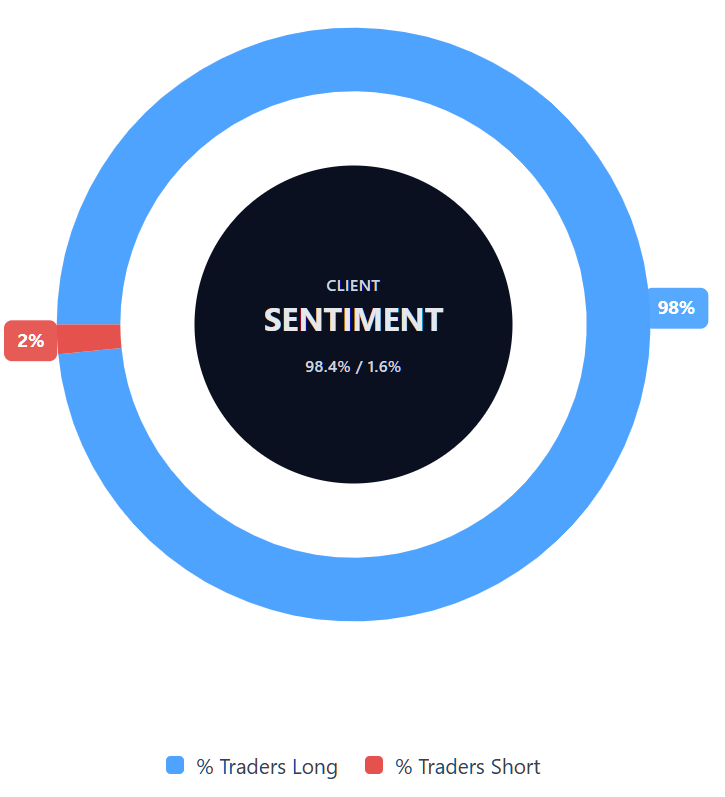
As of 12 March 2026, Capital.com client positioning in Novo Nordisk CFDs shows buyers at 98.4% vs sellers at 1.6%, putting buyers ahead by 96.8 percentage points and placing sentiment firmly in heavy-buy, long-skewed territory. This snapshot reflects open positions on Capital.com and can change rapidly as market conditions evolve.
Summary – Novo Nordisk 2026
- As of 10:48am UTC on 12 March 2026, NVO trades at $38.61, down roughly 74% from its mid-2024 peak near $148 and 55% year on year.
- All major moving averages (20 through 200-day SMA) sit well above price in sell territory. The 14-day RSI at 34.62 reflects a weak but not yet classically oversold reading, with ADX at 36.08 suggesting an established downtrend in force.
- Key drivers include a weak 2026 sales guidance cut of 5–13%, intensifying GLP-1 competition from Eli Lilly, and ongoing US drug pricing policy uncertainty under the Trump administration.
Past performance is not a reliable indicator of future results.
FAQ
Who owns the most Novo Nordisk stock?
What is the 5 year Novo Nordisk share price forecast?
Is Novo Nordisk a good stock to buy?
Could Novo Nordisk stock go up or down?
Should I invest in Novo Nordisk stock?
Can I trade Novo Nordisk (NVO) CFDs on Capital.com?
Yes, you can trade Novo Nordisk CFDs on Capital.com. Trading share CFDs lets you speculate on price movements without owning the underlying asset and to take long or short positions. However, contracts for difference (CFDs) are traded on margin, and leverage amplifies both profits and losses. You should ensure you understand how CFD trading works, assess your risk tolerance, and recognise that losses can occur quickly.