
Microsoft stock forecast: HR restructuring pressures shares
Microsoft is a global technology company whose shares came under pressure after it announced an HR restructuring on 25 March 2026, despite strong fiscal Q2 2026 results. Past performance is not a reliable indicator of future results. Latest third-party MSFT price targets.
Microsoft Corp. (MSFT) is trading at $370.28 as of 4:18pm UTC on 25 March 2026, within a session range of $369.89–$384.45. Past performance is not a reliable indicator of future results.
Sentiment has been weighed by a broad equity market pullback, with the Nasdaq falling 0.8% on 25 March amid rising Brent crude prices above $104 and investor caution around geopolitical developments in the Middle East (Trading Economics, 25 March 2026). Adding company-specific pressure, Microsoft announced a sweeping overhaul of its HR organisation on 25 March 2026, with Chief Diversity Officer Lindsay-Rae McIntyre departing at month-end, continuing a pattern of restructuring that has included multiple rounds of workforce reductions since mid-2025 (Business Insider, 25 March 2026).
Microsoft stock forecast 2026–2030: Third-party price targets
As of 25 March 2026, third-party Microsoft stock predictions reflect broadly constructive sentiment, set against a year-to-date share price decline of approximately 22% from the $483.72 close on 31 December 2025. Targets range from $392 to $675, with the following briefs drawn from ratings and consensus snapshots published within that window.
Jefferies (Buy reiterated, $675 target)
Jefferies reaffirms its Buy rating and $675 price target on MSFT, with analyst Brent Thill describing the stock as inexpensive relative to its long-term AI growth profile. Thill cites the integration of Azure and Microsoft 365 as a structural advantage in capturing enterprise AI spending, noting that MSFT trades near 21x FY2027 earnings, below its 10-year average of 23.5x (Yahoo Finance, 13 March 2026).
RBC Capital Markets (Outperform reiterated, $640 target)
RBC Capital Markets reiterates its Outperform rating on MSFT with a $640 price target. The firm maintains its constructive stance amid the broader equity pullback, pointing to Microsoft’s cloud infrastructure scale and enterprise software positioning as key supports (Yahoo Finance, 21 March 2026).
Bank of America (Buy reinstated, $500 target)
Bank of America reinstates coverage of MSFT with a Buy rating and a $500 price target, the most recently published house view in the window. The firm highlights Azure and Copilot as primary long-term growth drivers while acknowledging elevated capital expenditure as a near-term consideration (Investing.com, 24 March 2026).
MarketBeat (consensus snapshot)
MarketBeat aggregates ratings from 46 analyst firms, arriving at a consensus of Moderate Buy, with 40 Buy ratings, 4 Hold ratings, and 2 Strong Buy ratings. The average 12-month MSFT stock forecast across that panel stands at $591.95, with individual estimates spanning $392 on the low end to $675 on the high end (MarketBeat, 14 March 2026).
Public.com (aggregated consensus)
Public.com reports an aggregate consensus Buy rating from 30 analysts, with an average 12-month price target of $595.27. The platform notes that the broad dispersion of estimates reflects divergent assumptions about AI adoption timing and the pace of cloud revenue acceleration (Public.com, 23 March 2026).
Predictions and third-party forecasts are inherently uncertain, as they cannot fully account for unexpected market developments. Past performance is not a reliable indicator of future results.
MSFT stock price: Technical overview
On the daily chart, the MSFT stock price trades at $370.28 as of 4:18pm UTC on 25 March 2026, sitting below every key moving-average reference tracked by TradingView. The full simple moving average stack of 20-, 50-, 100-, and 200-day SMAs at roughly $396 / $415 / $452 / $480 sits above the current price, with each tenor returning a sell signal, reflecting an extended downtrend from the year-to-date peak. The Hull moving average (9) at $371.02 sits just above the last price, while the Ichimoku base line (9, 26, 52, 26) at $391.40 adds a further overhead reference.
Momentum indicators are broadly weak. The 14-day relative strength index reads 27.36, deep in oversold territory, though TradingView’s summary classifies it as neutral rather than a directional signal in isolation. The average directional index (14) at 27.76 indicates that an established trend is in force, consistent with the sustained directional pressure visible in the moving average stack.
To the upside, the classic pivot point (P) at $401.73 represents the nearest reference above the current price; a daily close through that level could bring R1 at $421.75 into view. Beyond that, the 50-day SMA near $415 and R2 at $450.75 mark the next areas of overhead interest, though the current price remains a considerable distance from both levels.
On pullbacks, the session low of $369.89 and the Hull moving average at $371.02 are the nearest downside references. Classic pivot S1 at $372.72 sits fractionally above the last price, and a move beneath the $369.89 intraday low could bring S2 at $352.70 into focus, with S3 at $303.68 acting as the deeper Fibonacci-derived level on the classic pivot grid (TradingView, 25 March 2026).
This is technical analysis for informational purposes only and does not constitute financial advice or a recommendation to buy or sell any instrument.
Microsoft share price history (2024–2026)
MSFT’s stock price opened March 2024 near $422, having spent much of late 2023 and early 2024 in a steady uptrend fuelled by strong cloud and AI-related revenue growth. The stock climbed to an intraday peak of $468.69 on 9 July 2024 before consolidating through the summer, with a brief dip towards $383 on 5 August 2024 amid a broad market sell-off before recovering into the autumn.
MSFT pushed higher through Q4 2024, touching an intraday high of $494.85 on 10 December 2025, before pulling back to close the year at $483.72 on 31 December 2025. The stock began 2026 under pressure, slipping from $489.51 on 2 January to $481.79 by 27 January, then accelerating lower through February and March as broader tech sentiment deteriorated and capital expenditure concerns weighed on the shares.
MSFT closed at $370.41 on 25 March 2026, approximately 23.4% down year to date, and roughly 12.4% lower year on year compared with the $395.55 close on 25 March 2025.

Past performance is not a reliable indicator of future results. Share prices are indicative and may differ from live market prices.
Microsoft (MSFT): Capital.com analyst view
Microsoft’s share price performance since early 2024 reflects a stock that has navigated competing narratives with varying success. A sustained rally through mid-2024 and into late 2025, underpinned by strong Azure cloud growth, rising Copilot adoption across enterprise customers, and fiscal Q2 2026 revenue of $81.3 billion (up 17% year on year), drove MSFT to intraday highs above $494 in December 2025. However, the stock has since retraced sharply, trading near $370 as of 25 March 2026, as investor focus has shifted from headline growth to the sustainability of profitability amid capital expenditure that increased by about 66% while Azure growth decelerated, compressing gross margins towards 68%, as reported by Seeking Alpha on 20 March 2026.
The case for continued resilience centres on Microsoft’s entrenched enterprise software relationships, Azure’s position as the second-largest cloud platform, and a customer backlog that more than doubled to $625 billion, according to company reporting cited by Yahoo Finance on 11 February 2026. Against that, intensifying competition in AI-driven cloud workloads, regulatory scrutiny across multiple jurisdictions, and concentration risk tied to its OpenAI partnership represent material headwinds that investors are actively weighing, as noted by Forbes on 4 March 2026. The degree to which AI infrastructure investment translates into durable margin expansion, rather than sustained cost pressure, is likely to remain a key variable in how the market prices MSFT in the near term.
Capital.com’s client sentiment for Microsoft CFDs
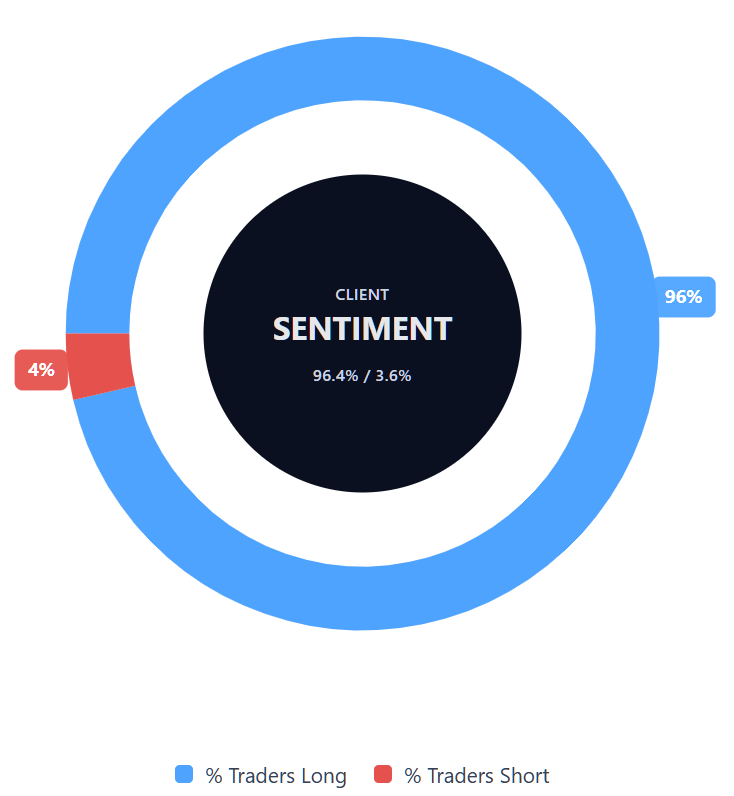
As of 25 March 2026, Capital.com client positioning in Microsoft CFDs stands at 96.4% long and 3.6% short, which puts buyers ahead by 92.8 percentage points and places sentiment firmly in heavily long, one-sided territory. This snapshot reflects open positions on Capital.com and can change rapidly as market conditions evolve.
Summary – Microsoft 2026
- MSFT trades at $370.28 as of 4:18pm UTC on 25 March 2026, down roughly 23% year to date and around 12% lower year on year.
- Technical indicators are broadly bearish: the full 20/50/100/200-day SMA stack sits overhead, the 14-day RSI reads 27.36, and the ADX at 27.76 suggests that an established downtrend is in force.
- Classic pivot resistance sits at $401.73, with R1 at $421.75 the nearest upside reference; session lows near $369.89 and S1 at $372.72 are the immediate downside markers.
- Key risks include rising capital expenditure that is compressing margins, decelerating Azure growth, intensifying AI cloud competition, regulatory scrutiny, and concentration risk tied to the OpenAI partnership.
Past performance is not a reliable indicator of future results.
FAQ
Who owns the most Microsoft stock?
Microsoft’s largest shareholders are typically institutional investors such as Vanguard and BlackRock, based on public filings, while a significant portion is also held by company insiders and other asset managers. Ownership levels can change over time as funds rebalance and insiders buy or sell shares. For traders, concentration in large institutional hands can matter because shifts in fund positioning, passive flows and sentiment around major indices may influence Microsoft’s share price.
What is the 5 year Microsoft share price forecast?
A five-year MSFT stock forecast is inherently uncertain because it depends on variables that can change materially over time, including cloud growth, AI monetisation, competition, regulation, margins and broader market conditions. Long-term third-party forecasts should therefore be treated as scenario-based rather than predictive. In practice, analysts tend to revise their assumptions as new earnings data, spending trends and macroeconomic developments emerge, so longer-range targets can quickly become outdated.
Is Microsoft a good stock to buy?
Whether Microsoft is a good stock to buy depends on an individual’s objectives, risk tolerance, time horizon and view of the company’s prospects. Some market participants may focus on Microsoft’s cloud scale, enterprise positioning and AI exposure, while others may focus on valuation, margin pressure and competitive risks. That means there is no universal answer. Research and analyst commentary can provide context, but they do not remove risk or guarantee any particular outcome.
Could Microsoft stock go up or down?
Microsoft’s share price could move in either direction depending on company-specific developments and wider market conditions. Supportive factors may include stronger-than-expected earnings, Azure growth, progress in AI-related products and improving sentiment across technology stocks. On the other hand, the price could come under pressure if margins tighten, capital expenditure remains elevated, growth slows or risk appetite weakens. Technical levels may help traders identify reference points, but they do not determine future price moves.
Should I invest in Microsoft stock?
Whether you should invest in Microsoft stock is a personal decision rather than a general conclusion that can be applied to every investor or trader. It depends on your financial circumstances, objectives, tolerance for loss and the role the position would play in your broader portfolio or trading plan. Microsoft may appeal to those seeking exposure to large-cap technology, but its share price can still be volatile, and past performance does not guarantee future returns.
Can I trade Microsoft CFDs on Capital.com?
Yes, you can trade Microsoft CFDs on Capital.com. Trading share CFDs lets you speculate on price movements without owning the underlying asset and to take long or short positions. However, contracts for difference (CFDs) are traded on margin, and leverage amplifies both profits and losses. You should ensure you understand how CFD trading works, assess your risk tolerance, and recognise that losses can occur quickly.