
Microsoft stock forecast: Data centre pause before earnings
Microsoft is under investor scrutiny as it slows some early-stage data centre projects ahead of its 29 April 2026 earnings release, with focus on Azure growth and AI-related spending. Explore third-party MSFT price targets. Past performance is not a reliable indicator of future results.
Microsoft Corp. (MSFT) last traded at $378.48 on Capital.com's feed as of 4:15pm UTC on 13 April 2026, within a session range of $367.55–$379.47. Past performance is not a reliable indicator of future results.
Sentiment has been shaped by several converging factors: ongoing investor scrutiny of Microsoft's AI infrastructure spending, after the company confirmed it was slowing or pausing certain early-stage data centre projects amid heavy capital expenditure pressures (CFO Dive, 15 April 2025); a broader tech-sector reset tied to US trade policy uncertainty, with the S&P 500 (US500) also sliding to around 6,777 on 13 April 2026 (Trading Economics, 9 April 2026); and the approaching fiscal Q3 2026 earnings release, confirmed by Microsoft for 29 April 2026, which is drawing attention to whether Azure cloud growth can sustain its recent trajectory amid margin compression (Microsoft Investor Relations, 8 April 2026).
Microsoft stock forecast 2026–2030: Third-party price targets
As of 13 April 2026, third-party Microsoft stock predictions reflect a broadly constructive but increasingly differentiated consensus, as several firms have revised their 12-month targets downward amid Copilot monetisation concerns, elevated capital expenditure, and broader tech-sector pressure, while retaining positive ratings in most cases.
New Street Research (buy, target revised)
New Street Research raised its MSFT stock forecast to $675 from $670, maintaining a 'buy' rating and placing its target at the top of the current analyst range. The upward revision came amid a broader market reset, with the firm pointing to Azure and enterprise AI adoption as the primary long-term value drivers (MarketBeat, 1 April 2026).
UBS Group (buy, target lowered)
UBS Group analyst Karl Keirstead maintained a 'buy' rating on MSFT, trimming the 12-month price target from $600 to $510. The cut reflected caution over near-term margin pressure from heavy AI infrastructure spending, as Azure capacity requirements have grown to support internal model training alongside external demand (GuruFocus, 10 April 2026).
Melius Research (hold, target cut)
Melius Research analyst Ben Reitzes lowered his price target on MSFT from $430 to $400, retaining a 'hold' rating and citing Microsoft's Copilot reorganisation as a sign of structural weakness. The firm flagged scepticism over customers paying incremental fees for Copilot amid corporate hiring freezes, noting that Microsoft may face capacity constraints in meeting Azure demand even if AI adoption improves (Investing.com, 23 March 2026).
BNP Paribas (outperform, target cut)
BNP Paribas analyst Stefan Slowinski maintained an 'outperform' rating on MSFT while cutting the adjusted price target sharply from $659 to $556, a reduction of 15.6%. The downward revision reflected the cumulative drag from trade policy uncertainty and AI capex concerns weighing on near-term earnings visibility, even as the firm retained a positive long-term rating (Benzinga, 10 April 2026).
MarketBeat (consensus overview)
MarketBeat's aggregated consensus as of 1 April 2026 places the average 12-month price target for MSFT at $588.97, drawn from 45 analysts, with a 'Moderate Buy' consensus rating (38 buys, 2 strong buys, 5 holds). The target range runs from $392 at the low end to $675 at the high end, with the wide dispersion reflecting divergent views on Copilot monetisation, AI capital returns, and macro exposure (MarketBeat, 1 April 2026).
Predictions and third-party forecasts are inherently uncertain, as they cannot fully account for unexpected market developments. Past performance is not a reliable indicator of future results.
MSFT stock price: Technical overview
The MSFT stock price last traded at $378.48 on Capital.com's feed as of 4:15pm UTC on 13 April 2026, sitting just above the 20-day simple moving average (SMA) at around $376 but well beneath the longer-term moving average cluster – the 30/50/100/200-day SMAs range from around $386 through around $474 – all of which register sell signals on TradingView's indicator summary.
The short-term moving average picture is mixed: the 10- and 20-day SMAs at around $371 and around $376 both carry buy signals, as does the Hull moving average (9) at around $375 and the volume-weighted moving average (20) at around $375, indicating that the immediate price trend is constructive on a short timeframe. However, the 30-day SMA at around $386 and beyond points to sell signals, reflecting the stock's sharp drawdown over the prior quarter.
Momentum is broadly neutral: the 14-day relative strength index (RSI) reads 47.26, per TradingView, sitting in the mid-range with no clear directional bias, while the average directional index (ADX) at 28.35 suggests that an established trend is present. On the classic pivot framework, the pivot point at $379.83 is the immediate reference, with R1 at $403.39 coming into view on a sustained close above. To the downside, S1 at $346.62 represents the next classic support reference if the pivot fails to hold (TradingView, 13 April 2026).
This is technical analysis for informational purposes only and does not constitute financial advice or a recommendation to buy or sell any instrument.
Microsoft share price history (2024–2026)
MSFT’s stock price traded around $414 in mid-April 2024, broadly range-bound through the summer before climbing steadily into autumn. The stock peaked intraday at $557.66 on 28 October 2025, lifted by strong Azure cloud results and AI spending optimism, then drifted lower as macro concerns increased. MSFT closed 2025 at $483.72.
The picture shifted sharply in 2026. MSFT opened the year near $489 but shed roughly 21% through the first quarter – its steepest quarterly decline since 2008 – as concerns mounted over AI capital expenditure, Copilot monetisation, and the broader US trade policy environment. The stock also registered an intraday low of $341.55 on 7 April 2025 during a brief but severe tech sell-off, before recovering sharply to close near $391.93 two sessions later on 9 April 2025.
Microsoft (MSFT) closed at $378.62 on 13 April 2026, approximately 22.7% down year to date and 8.6% lower year on year, and around 32.1% below its October 2025 peak of $557.66.

Past performance is not a reliable indicator of future results. Share prices are indicative and may differ from live market prices.
Microsoft (MSFT): Capital.com analyst view
Microsoft's share price has faced considerable pressure in 2026, shedding over a fifth of its value in the first quarter amid investor concerns over the pace and returns on AI infrastructure spending, as well as broader headwinds from US trade policy uncertainty. The stock's retreat from its October 2025 peak near $557.66 reflects a reassessment of near-term earnings visibility, particularly around Copilot adoption rates and Azure margin trajectories. That said, the company's forthcoming Q3 2026 earnings release on 29 April provides an opportunity for the underlying fundamentals – cloud revenue growth, enterprise AI uptake, and a $625bn commercial backlog – to be reassessed against current valuations.
The case for a recovery rests on Microsoft's entrenched position across enterprise software, cloud infrastructure, and AI tooling; yet risks remain material. Elevated capital expenditure could continue to compress margins in the near term, while any slowdown in Azure growth or further deterioration in the macro backdrop could sustain downward pressure on the stock. Both scenarios carry meaningful uncertainty.
Capital.com’s client sentiment for Microsoft CFDs
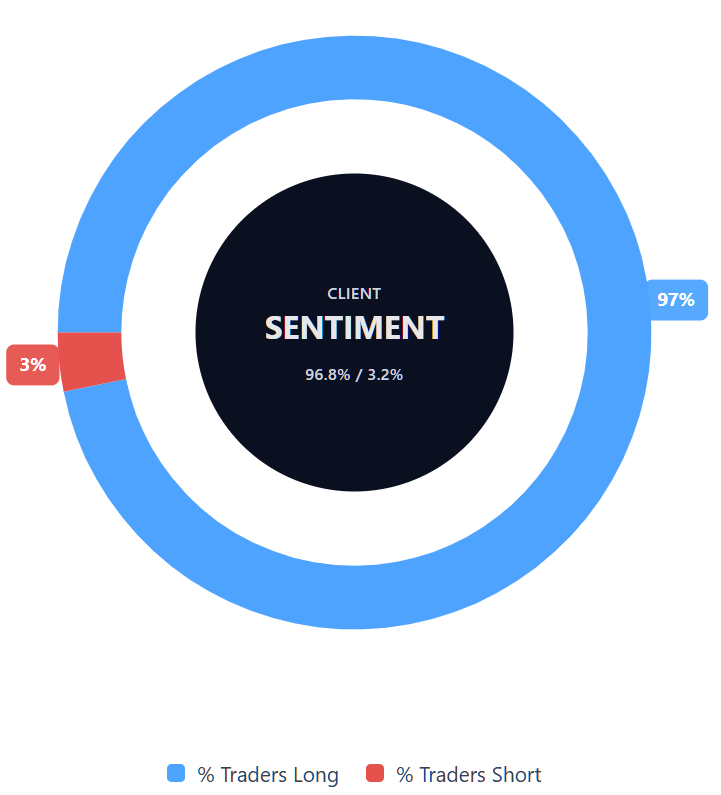
As of 13 April 2026, Capital.com client positioning in Microsoft CFDs shows 96.8% buyers vs 3.2% sellers, putting buyers ahead by 93.6 percentage points and placing sentiment firmly in heavy-buy, one-sided territory. This snapshot reflects open positions on Capital.com and can change rapidly as market conditions evolve.
Summary – Microsoft 2026
- MSFT last traded at $378.48 as of 4:15pm UTC on 13 April 2026, down roughly 22.7% year to date and approximately 32.1% below its October 2025 peak of $557.66.
- Key price drivers include concerns over AI infrastructure capital expenditure, Copilot monetisation uncertainty, and broader US trade policy headwinds weighing on the tech sector.
- Microsoft confirmed its Q3 2026 earnings release for 29 April 2026, with investor focus centred on Azure cloud growth, AI product revenue, and whether margins can withstand elevated spending.
Past performance is not a reliable indicator of future results.
FAQ
Who owns the most Microsoft stock?
What is the 5 year Microsoft share price forecast?
Is Microsoft a good stock to buy?
Could Microsoft stock go up or down?
Should I invest in Microsoft stock?
Can I trade Microsoft CFDs on Capital.com?
Yes, you can trade Microsoft CFDs on Capital.com. Trading share CFDs lets you speculate on price movements without owning the underlying asset and to take long or short positions. However, contracts for difference (CFDs) are traded on margin, and leverage amplifies both profits and losses. You should ensure you understand how CFD trading works, assess your risk tolerance, and recognise that losses can occur quickly.