
Hensoldt stock forecast: Third-party price targets
Hensoldt is a Germany-based defence technology group listed in Frankfurt, providing radar, sensor and electronic systems for military and security applications across Europe and international markets. Explore third-party HAG price targets and technical analysis.
Hensoldt AG (HAG) is trading around €80.32 on Capital.com’s platform as of 10:39am on 18 February 2026 (UTC), moving within an intraday range of €76.72–€81.32. Past performance is not a reliable indicator of future results.
Recent trading follows Hensoldt’s update that adjusted EBITDA for the first nine months of 2025 rose to €211m from €187m a year earlier, alongside continued growth in its order pipeline (Defence Industry Europe, 7 November 2025). The stock is trading against a broader sector backdrop that includes a framework agreement under which Rheinmetall and Hensoldt will cooperate on radar systems for air-defence applications (Investing.com, 12 December 2025). Management has also highlighted partnerships such as the recently announced collaboration with Schwarz Digits on software-defined, data-driven defence capabilities (Defensehere, 17 February 2026).
Hensoldt stock forecast 2026–2030: Third-party price targets
As of 18 February 2026, third-party Hensoldt stock predictions indicate a cluster of 12-month targets in the high double-digit to low triple-digit euro area. These targets reflect differing assumptions about defence spending, order momentum and execution on major programmes. The summaries below outline six recent third-party views on Hensoldt’s valuation and medium-term positioning.
Jefferies (single-stock view)
Jefferies analyst Chloe Lemarié maintains a Hold rating on Hensoldt with a 12-month HAG stock forecast of €90. The broker cites exposure to rising European defence budgets and programme visibility as supportive factors, while flagging valuation sensitivity and the need to deliver on revenue and margin ambitions amid elevated sector expectations (The Globe and Mail, 31 January 2026).
Deutsche Bank (single-stock view)
Deutsche Bank analyst Christophe Menard reiterates a Buy rating on Hensoldt with a 12-month price target of €101. The bank points to anticipated growth in defence orders and ongoing investment in radar and sensor capabilities as potential drivers, while acknowledging execution risks around major projects and uncertainty over the trajectory of European defence spending (Tiger Brokers, 29 January 2026).
Warburg Research (broker study)
Warburg Research raises its Hensoldt price target from €86 to €91 and upgrades the stock from Hold to Buy, following what it described as a recent correction in the share price. Analyst Christian Cohrs said he expects ‘a solid year-end result in both business segments and strong order momentum’ for 2025, and adjusted the target to reflect updated earnings expectations and sector conditions (MarketScreener, 16 February 2026).
Deutsche Ban (broker-action)
Deutsche Bank continues to apply a Buy rating to Hensoldt, with the target price ‘still set at €101’, underscoring the bank’s unchanged 12-month objective. The firm attributes the stance to expectations for sustained demand in defence electronics and Germany’s role in European security, while highlighting that capital-intensive projects and investment needs remain part of the medium-term backdrop (MarketScreener, 29 January 2026).
Fintel (consensus target snapshot)
Fintel’s Hensoldt page shows an average one-year price target of about €92.14, based on a range of broker estimates between roughly €65.65 and €117.60 for the Xetra-listed shares. The service aggregates individual analyst views on earnings and valuation, updating the consensus as new research is published and as order intake, budget trends and sector conditions evolve (Fintel, 18 February 2026).
Predictions and third-party forecasts are inherently uncertain, as they cannot fully account for unexpected market developments. Past performance is not a reliable indicator of future results.
HAG stock price: Technical overview
The HAG stock price is trading near €80.32 as of 10:39am on 18 February 2026 (UTC), sitting just below its short-term moving-average band, with the 20-, 50-, 100- and 200-day simple moving averages (SMAs) clustered around approximately €82, €80, €86 and €89. On this setup, the 20-day SMA remains above the 50-day, while the 200-day exponential moving average (EMA) near €80.89 runs close to the current price and acts as a nearby longer-term reference alongside the 50-day SMA at €80.25.
Momentum readings are mixed. The 14-day relative strength index (RSI) is around 47 and the average directional index (ADX) near 18, suggesting that while a trend may be present, it is not firmly established.
On the topside, traders often monitor the classic R1 pivot near €95 as an initial resistance reference, with R2 around €107 coming into focus only after any sustained daily close above the first resistance zone. On pullbacks, initial support sits near the classic pivot at about €85, with the 100-day SMA around €86 forming a nearby moving-average reference. A clear break below that region would bring the S1 area near €73 into view (TradingView, 18 February 2026).
This technical analysis is provided for informational purposes only and does not constitute financial advice or a recommendation to buy or sell any instrument.
Hensoldt share price history (2024–2026)
HAG’s stock price has seen a marked re-rating over the past two years, moving from the low-€30s in early 2024 to trade in the high-€70s to low-€80s range by February 2026. The stock gathered pace through 2024, climbing from around €33–€35 in February to the low-€40s by April, before fluctuating in the mid-€30s to high-€30s band over the summer. It then accelerated from late September 2024 into early 2025 as defence-related stocks attracted increased investor attention.
Momentum extended into 2025. Hensoldt moved from the mid-€60s in April to trade consistently above €90 by June, and briefly rose above €110 in early October 2025 before easing back. After that spike, the price consolidated within a broad €70–€90 range towards year-end. In January and February 2026, the shares traded mostly between approximately €76 and €93, with a latest close of around €80.59 on 18 February 2026.

Past performance is not a reliable indicator of future results. Share prices are indicative and may differ from live market prices.
Hensoldt (HAG): Capital.com analyst view
Hensoldt’s share price has re-rated significantly since early 2024, reflecting a combination of company-specific developments, evolving expectations for European defence spending and broader shifts in market risk appetite. The move above €110 in October 2025, followed by consolidation below those highs, illustrates how quickly sentiment can adjust when valuations and headlines change.
From both a fundamental and technical perspective, future price movements may remain sensitive to defence budget decisions, contract awards and execution on major programmes. Delays in orders, margin pressure or changes in geopolitical conditions could affect investor expectations. At the same time, renewed sector inflows or improved earnings visibility may influence price action. Broader equity-market trends and changes in interest-rate expectations could also play a role, highlighting that both upside and downside scenarios remain possible.
Capital.com’s client sentiment for Hensoldt CFDs
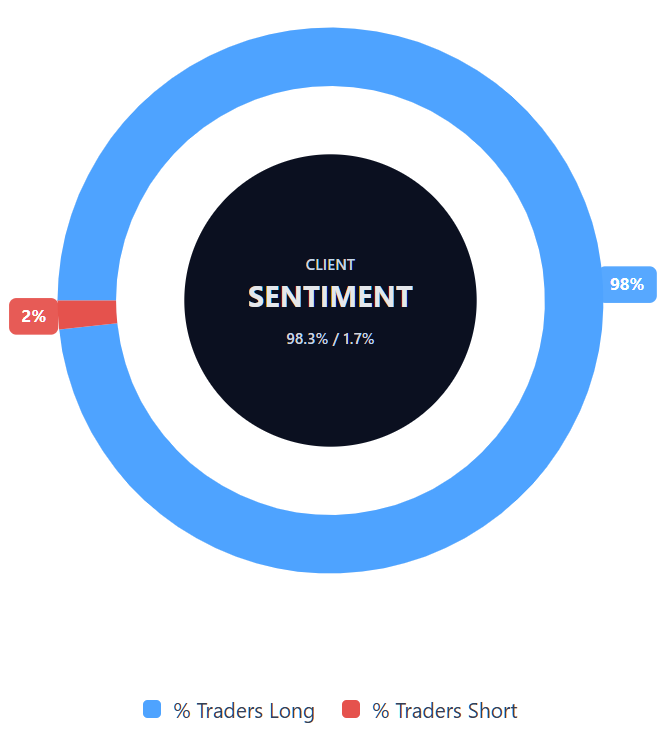
As of 18 February 2026, Capital.com client positioning in Hensoldt CFDs currently stands at 98.3% buyers versus 1.7% sellers. This reflects a pronounced long bias among clients at the time of writing. Sentiment data represents open positions on Capital.com’s platform and can change over time.
Summary – Hensoldt 2026
- Hensoldt shares moved from the low-€30s in early 2024 to trade largely within a higher €60–€100 range through 2025, including a brief move above €110 in October.
- Technical indicators into early 2026 show price fluctuating around key short- and medium-term moving averages, with momentum readings that are neither strongly positive nor negative.
- Hensoldt’s price remains sensitive to defence budgets, project execution and broader equity-market conditions, meaning future moves could depend on both company developments and the wider macroeconomic backdrop.
Past performance is not a reliable indicator of future results.
FAQ
Who owns the most Hensoldt stock?
Hensoldt’s shareholder base includes a mix of institutional investors, strategic stakeholders and free-float shareholders. Large asset managers and investment funds typically hold significant portions of listed German equities, while government-linked or strategic investors may also maintain meaningful stakes, depending on disclosure filings. Ownership levels can shift as institutions rebalance portfolios or as new investors enter the register, so investors should refer to the company’s latest annual report and regulatory disclosures for the most up-to-date information on major shareholders.
What is the five-year Hensoldt share price forecast?
There is no single agreed five-year HAG stock forecast. Most publicly available analyst targets focus on a 12-month horizon and reflect assumptions about defence budgets, order intake, margins and execution. Longer-term projections depend on variables such as geopolitical developments, procurement cycles and broader equity-market conditions. Because these drivers can change materially over time, multi-year projections are inherently uncertain and should be viewed as indicative scenarios rather than fixed outcomes.
Is Hensoldt a good stock to buy?
Whether Hensoldt is considered ‘good’ depends on an investor’s objectives, risk tolerance and time horizon. The company operates in the defence electronics sector, which may benefit from increased security spending, but it also faces project execution risks, budget constraints and valuation sensitivity. Share price volatility in recent years highlights that returns are not guaranteed. Investors typically weigh potential growth drivers against operational and market risks before making any allocation decision.
Could Hensoldt stock go up or down?
Like all listed shares, Hensoldt’s price can move in either direction. Defence spending commitments, contract awards, earnings performance and broader equity-market trends may influence price movements. Technical levels and investor positioning can also affect shorter-term trading dynamics. At the same time, delays in programmes, margin pressure or shifts in geopolitical conditions could weigh on the stock. As a result, both upward and downward price scenarios remain possible at any given time.
Should I invest in Hensoldt stock?
Deciding whether to invest in Hensoldt shares is a personal decision that depends on your financial situation, investment goals and tolerance for risk. Shares and share CFDs can be volatile, particularly in sectors influenced by political and budgetary decisions. This information is provided for educational purposes only and does not constitute investment advice. You may wish to conduct your own research and consider seeking independent financial advice before taking any action.
Can I trade Hensoldt CFDs on Capital.com?
Yes, you can trade Hensoldt CFDs on Capital.com. Trading share CFDs lets you speculate on price movements without owning the underlying asset and to take long or short positions. However, contracts for difference (CFDs) are traded on margin, and leverage amplifies both profits and losses. You should ensure you understand how CFD trading works, assess your risk tolerance, and recognise that losses can occur quickly.