
GameStop stock forecast: Ryan Cohen buys before Q4
GameStop is a US video game retailer whose shares remain in focus ahead of its 24 March 2026 Q4 FY2025 earnings release. Past performance is not a reliable indicator of future results. Explore third-party GME price targets and technical analysis.
GameStop Corporation (GME) is trading at $23.31 as of 4:01pm UTC on 18 March 2026, within an intraday range of $23.20–$23.70. Past performance is not a reliable indicator of future results.
Sentiment around GME continues to be shaped by several concurrent factors: anticipation of the company's Q4 FY2025 earnings release, scheduled for 24 March 2026 (Yahoo Finance, 16 March 2026); ongoing speculation regarding a potential large-scale acquisition by CEO Ryan Cohen; and Ryan Cohen's reported purchase of 500,000 additional shares at an average price of $21.12 (MarketBeat, 22 January 2026). Broader market tone on 18 March 2026 remained cautious ahead of the Federal Reserve's March FOMC rate decision and a wholesale inflation (PPI) report, with Dow Jones futures pointing approximately 0.5% higher at the open (Investing.com, 17 March 2026).
GameStop stock forecast 2026–2030: Third-party price targets
According to the third-party sources referenced below, as of 18 March 2026, GameStop stock predictions show a limited range of estimates and reflect differing views around company-specific and macro factors.
MarketBeat (consensus overview)
MarketBeat aggregates two active ratings for GameStop, producing a consensus ‘Reduce’ rating and a mean 12-month GME stock forecast of $13.50, with both the high and the low estimate also sitting at $13.50. The platform notes that this target implies approximately 42% downside from the 18 March 2026 closing level of $23.28, and that GME's consensus trails the broader consumer discretionary sector average of ‘Hold’ (MarketBeat, 18 March 2026).
Public.com (analyst snapshot)
Public.com reports a Sell consensus for GME, based on one active analyst rating, with a 12-month price target of $13.50. The platform cites GameStop's gross margin improvement to 34.5% and a $1.5 billion convertible note raise as context, while noting ongoing hardware and software revenue headwinds (Public.com, 18 March 2026).
Yahoo Finance / Argus (quantitative model)
Yahoo Finance's quantitative research service raised its model-derived price target for GME to $26. The report is quantitative in nature rather than a traditional fundamental analyst note, and no narrative rationale was publicly disclosed alongside the figure (Yahoo Finance, 11 March 2026).
Predictions and third-party forecasts are inherently uncertain, as they cannot fully account for unexpected market developments. Past performance is not a reliable indicator of future results.
GME stock price: Technical overview
The GME stock price trades at $23.31 as of 4:01pm UTC on 18 March 2026, sitting below all four nearer-term simple moving averages – the 20/50/100/200-day SMAs at approximately $24 / $23 / $23 / $23 – with the 20-day SMA running above the 50-day, though price itself is below the entire cluster, which keeps the short-term trend under pressure. The Hull moving average (9) at $23.18 is shown on TradingView as a buy signal and sits just below current price, offering a modest near-term floor, while the 100-day SMA at $22.61 represents the nearest meaningful long-term shelf to the downside.
Momentum is subdued: the 14-day RSI sits at 45.13, in neutral territory and leaning toward the lower half of the scale, offering no directional conviction either way. The average directional index (14) reads 19.78, below the 25 threshold associated with an established trend, which suggests the current move lacks strong directional force.
To the topside, the classic R1 pivot at $25.71 is the first nearby reference level; a convincing daily close above that level would put the R2 zone near $27.39 in view. The classic pivot point (P) at $24.25 acts as an immediate overhead reference, and price would need to move back above that level on a closing basis before a sustained recovery towards R1 becomes credible.
On pullbacks, initial support rests at the Hull moving average shelf near $23.18, followed by the 100-day SMA at $22.61. Should price lose that MA shelf on a closing basis, the S1 pivot at $22.57 becomes the next reference, and a break there would leave scope for a deeper move towards the S2 zone near $21.11 (TradingView, 18 March 2026).
This is technical analysis for informational purposes only and does not constitute financial advice or a recommendation to buy or sell any instrument.
GameStop share price history (2024–2026)
GME’s stock price opened March 2024 trading around $14, having spent much of late 2023 and early 2024 in the $10–$14 range as the meme-stock frenzy of 2021 remained a distant memory and the business continued to shrink its retail footprint.
That changed sharply in May 2024, when the reappearance of ‘Roaring Kitty’ — the online alias of Keith Gill — on social media triggered a dramatic short squeeze. GME surged from around $17 on 10 May to an intraday high of $80.05 on 14 May, before collapsing just as quickly; by the end of May it had retreated to roughly $23. A second, smaller spike hit in early June, with the stock touching $67.55 on 6 June before fading again towards the $22–$25 band where it spent most of the summer and autumn of 2024.
GME closed 2024 at $31.39, buoyed by renewed retail interest and speculation over CEO Ryan Cohen's strategy, then opened 2025 at $31.50 before sliding back through the year. A fresh meme-driven jump pushed the stock to around $35 in late May 2025, but by year-end GME had settled near $20.50, closing 2025 at $20.50.
GME (GameStop) trades at $23.31 as of 18 March 2026, approximately 14% above its 31 December 2025 close of $20.50, and broadly flat year on year versus the $23.47 close on 18 March 2025.

Past performance is not a reliable indicator of future results. Share prices are indicative and may differ from live market prices.
GameStop (GME): Capital.com analyst view
GameStop's (GME) price action over the past two years reflects the stock's unusual dual identity: a legacy brick-and-mortar retailer with declining revenues, and a meme-driven trading vehicle capable of sharp, sentiment-driven moves. The company's ongoing shift towards collectibles and digital products, combined with CEO Ryan Cohen's strategic ambitions, including reported acquisition interest, gives some market participants a reason to look beyond near-term fundamentals. A relatively lean balance sheet, bolstered by the $1.5 billion convertible note raise in early 2026, may provide runway for corporate action, though it also introduces dilution risk that could weigh on the share price.
At the same time, GME's core business continues to face structural headwinds, with hardware and software revenues declining sharply year on year, and formal analyst coverage remains thin, with the only active broker target sitting well below the current price. Retail sentiment can move GME quickly in either direction, which cuts both ways, creating the potential for rapid gains as well as abrupt reversals. Market participants may wish to weigh the speculative premium embedded in the current price against the underlying business trajectory.
Capital.com’s client sentiment for GameStop CFDs
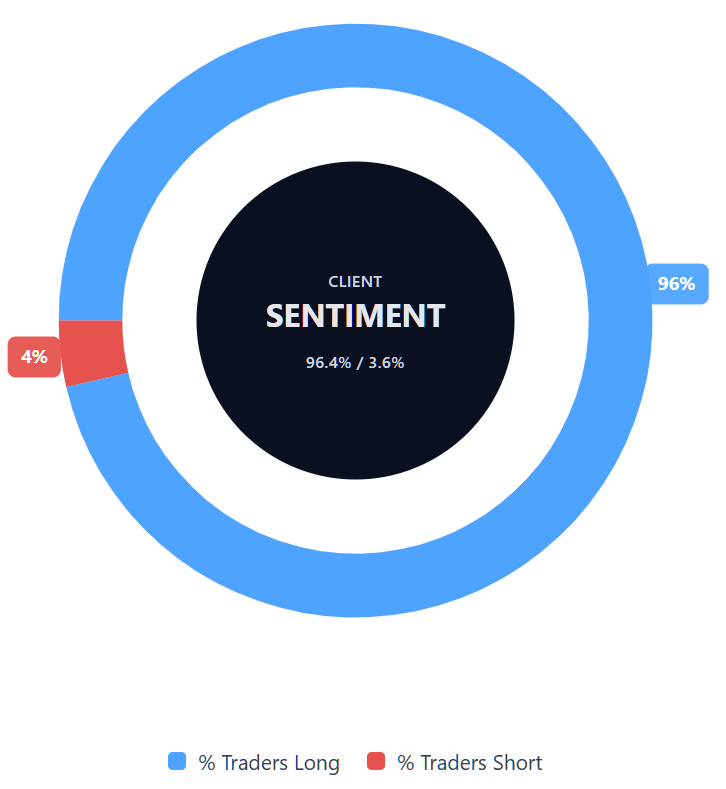
As of 18 March 2026, Capital.com client positioning in GameStop CFDs stands at 96.4% buyers vs 3.6% sellers, which puts buyers ahead by 93 pp and places sentiment firmly in heavy-buy, one-sided-long territory. This snapshot reflects open positions on Capital.com and can change.
Summary – GameStop 2026
- GME trades at $23.31 as of 4:01pm UTC on 18 March 2026, up roughly 14% year to date from its 2025 close of $20.50, though well below the May 2024 meme-spike high of $80.05.
- Technical indicators are mixed to bearish: price sits below most short-term moving averages, the 14-day RSI reads 45.13 in neutral territory, and the average directional index at 19.78 signals no established trend.
- Key price drivers include CEO Ryan Cohen's reported share purchases and acquisition ambitions, GameStop's $1.5 billion convertible note raise, and ongoing structural declines in hardware and software revenues.
- Recent attention centres on Q4 FY2025 earnings due on 24 March 2026, Ryan Cohen's acquisition speculation, and the stock's sensitivity to retail sentiment, all of which could drive sharp moves in either direction.
Past performance is not a reliable indicator of future results.
FAQ
Who owns the most GameStop stock?
What is the 5 year GameStop share price forecast?
Is GameStop a good stock to buy?
Could GameStop stock go up or down?
Should I invest in GameStop stock?
Can I trade GameStop CFDs on Capital.com?
Yes, you can trade GameStop CFDs on Capital.com. Trading share CFDs lets you speculate on price movements without owning the underlying asset and to take long or short positions. However, contracts for difference (CFDs) are traded on margin, and leverage amplifies both profits and losses. You should ensure you understand how CFD trading works, assess your risk tolerance, and recognise that losses can occur quickly.