
Eni stock forecast: Third-party price targets
Eni is an Italian energy company listed on the Borsa Italiana, with activities spanning upstream oil and gas, refining, logistics and energy-transition projects. Explore ENI price action, third-party price targets and technical analysis.
Eni (ENI) is trading around €16.51 on 19 January 2026 at 4:47pm, near the top of its intraday range between €16.34 and €16.52 on Capital.com’s feed. Past performance is not a reliable indicator of future results.
The stock is trading amid sector-wide focus on crude benchmarks, with Brent crude oil around $64 per barrel (Trading Economics, 19 January 2026). This sits alongside a backdrop of Eni’s recent corporate reorganisation, which saw its European and Middle Eastern refineries and depots transferred into a new unit, Eni Industrial Evolution, effective 1 January 2026, as part of a broader industrial transformation strategy (Reuters, 5 January 2026).
Eni stock forecast 2026–2030: Third-party price targets
As of 19 January 2026, third-party Eni stock predictions span a relatively narrow band around the mid-teens in euros for the next 12 months, reflecting differing views on oil prices, capital allocation choices, and European energy policy.
Investing.com (consensus screen)
Consensus data for Eni SpA show an average 12-month target of about €16.57, with individual analyst estimates ranging from €14.50 to €20. The service notes this spread as analysts balance oil and gas price assumptions with Eni’s earnings, dividends and investment plans (Investing.com, 19 January 2026).
TipRanks (Wall Street coverage)
TipRanks reports that 13 Wall Street analysts have issued 12-month targets for Eni, with an average around €16.77, a high forecast of €20 and a low of €14.50. The platform cites a Moderate Buy consensus as analysts weigh cash-flow resilience and decarbonisation initiatives amid sector volatility (TipRanks, 19 January 2026).
Fintel (Xetra listing coverage)
For Eni’s German-listed shares, Fintel reports an average one-year target of about €16.89, with forecasts ranging from roughly €14.65 to €21. The range underscores varying analyst assumptions on refining margins, hydrocarbon prices and the pace of balance-sheet strengthening (Fintel, 19 January 2026).
MarketBeat (brokerage summary)
MarketBeat reports that 13 analysts covering Eni’s NYSE-listed shares hold a consensus 12-month target of about $34.60 and an overall Hold recommendation, with one Sell, nine Hold, two Buy and one Strong Buy ratings recorded. MarketBeat notes that this reflects more measured expectations for upside as brokers reassess Eni’s earnings and capital-return profile amid shifting oil and gas assumptions (MarketBeat, 4 January 2026).
Jefferies (broker action)
Jefferies raised its Eni target from €18 to €19.50 while maintaining a Buy stance on the shares, according to a syndicated summary of the note. The broker cites Eni’s refinery spin-off, portfolio simplification and balance-sheet metrics as factors behind the higher fair-value marker amid ongoing sector volatility (TipRanks, 8 January 2026).
Predictions and third-party forecasts are inherently uncertain, as they cannot fully account for unexpected market developments. Past performance is not a reliable indicator of future results.
ENI stock price: Technical overview
The ENI stock price holds around €16.51 as of 4:47pm UTC on 19 January 2026, trading above a rising cluster of simple moving averages, with the 20-, 50-, 100- and 200-day SMAs grouped near ~16.1 / 16.1 / 15.6 / 14.6. The 14-day RSI sits in the upper-neutral band around 56.5, while the ADX near 16.6 indicates a relatively weak underlying trend despite the price holding above its medium- and long-term averages.
On the topside, the nearest classic resistance pivots are R1 at €16.52 and then R2 at €16.91, with a sustained daily close above the first level required to keep higher levels in view. On pullbacks, the classic pivot at €16.04 marks initial support, with the 100-day SMA around €15.62 forming the next key shelf. A move below this zone could expose the S1 pivot near €15.66 as the next downside area (TradingView, 19 January 2026).
This technical analysis is for informational purposes only and does not constitute financial advice or a recommendation to buy or sell any instrument.
Eni share price history (2024–2026)
ENI’s stock price spent much of 2024 trading in a relatively tight band around the mid-€14s, with the stock closing at about €14.37 on 22 January 2024 after oscillating between roughly €13.50 and €15.50 across the year. Through early 2025, the tone was steadier but still range-bound, with Eni changing hands near €13.50 at the start of January 2025 before grinding higher into the mid-€14s by late March and then slipping back toward €12.60–€13 in late May.
Momentum picked up from mid-2025 as the price climbed from around €13 in early June to the mid-€15s by September, before pushing through €16 in November and holding those levels into year-end. By 19 January 2026, Eni closed at €16.51, leaving it noticeably higher than two years earlier and marking a sustained advance from the lows seen in April and May 2025, when the stock traded in the low-€12 area, into the mid-€16s over roughly eight months.
Past performance is not a reliable indicator of future results. Share prices are indicative and may differ from live market prices.
Eni (ENI): Capital.com analyst view
Eni’s share price has climbed from the low-€13 area in early 2025 to around €16.51 by 19 January 2026, reflecting a period of recovery following earlier consolidation around the mid-€14s in 2024. This performance has unfolded against a backdrop of mixed sector conditions, where lower average oil prices in 2025 weighed on profitability even as the company maintained a solid balance sheet and continued shareholder distributions.
From a fundamentals perspective, recent quarterly results and guidance updates have underlined Eni’s focus on cash generation, dividends and buybacks. At the same time, the creation of Eni Industrial Evolution to house refining and logistics assets highlights its efforts to streamline operations and support its energy-transition strategy. Higher hydrocarbon production, portfolio reshaping and decarbonisation initiatives may be supportive for valuation if execution remains on track, but weaker commodity prices, currency movements, regulatory changes or project-specific risks could work in the opposite direction and add volatility to the share price.
Capital.com’s client sentiment for Eni CFDs
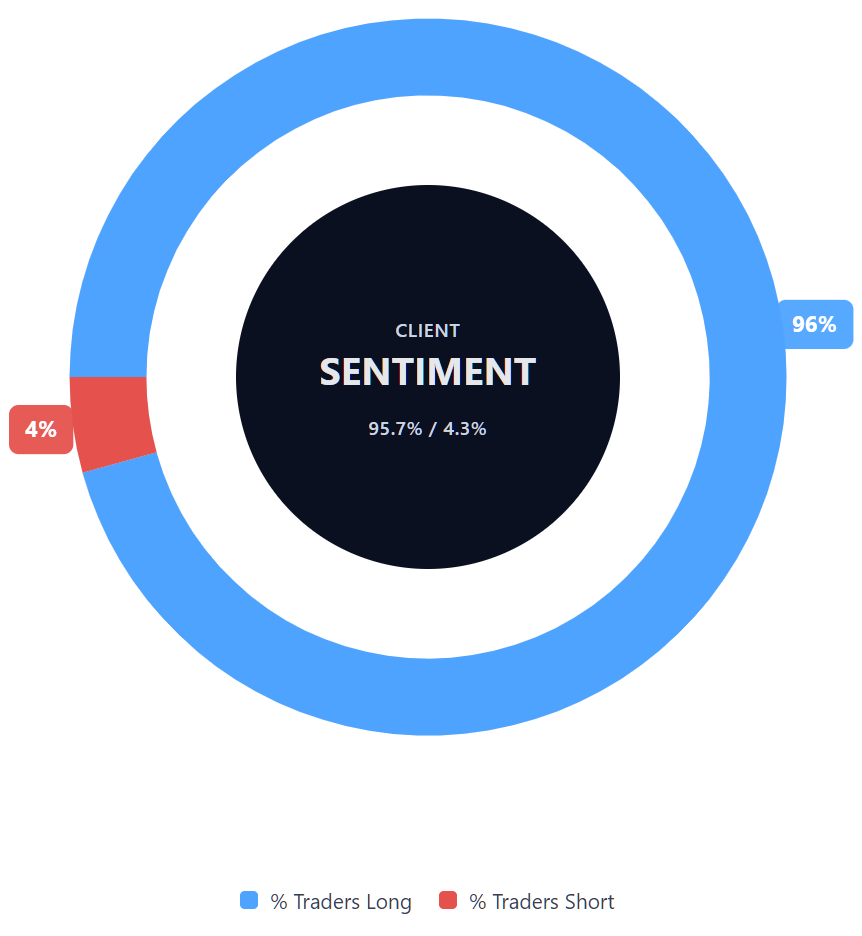
As of 19 January 2026, Capital.com client positioning in Eni CFDs shows 95.7% buyers versus 4.3% sellers, a heavily skewed long setup that puts buyers ahead by about 91.5 percentage points. This reflects open positions on the platform at the time of observation and can change.
Summary – Eni 2026
- Eni is trading around €16.51 as of 4:47pm UTC on 19 January 2026, near the top of its intraday range between €16.34 and €16.52 on Capital.com’s feed.
- Over the past two years, the share price has climbed from the low-€13 area in early 2025 to the mid-€16s, after spending much of 2024 consolidating around €14–€15.
- Technicals show ENI trading above clustered 20-, 50-, 100- and 200-day simple moving averages, with RSI in upper-neutral territory and a relatively weak trend signal on ADX.
- Recent corporate actions include the creation of Eni Industrial Evolution to house refining and logistics assets as part of a broader industrial transformation and energy-transition strategy.
- Analyst 12-month price targets for Eni generally sit in a mid-teens euro band, with recent sources clustering between roughly €14 and €19, or dollar equivalents for US-listed shares.
- Key drivers cited by third-party sources include movements in Brent crude, Eni’s earnings and guidance, capital returns through dividends and buybacks, and the execution of its decarbonisation and portfolio-simplification plans.
Past performance is not a reliable indicator of future results.
FAQ
Who owns the most Eni stock?
Eni has a mixed shareholder structure, with the Italian state remaining its largest single shareholder through the Ministry of Economy and Finance and other public entities. This position gives the government a degree of influence over strategic decisions, while the remainder of Eni’s shares are held by a wide range of institutional investors and private shareholders globally, reflecting its status as a widely traded European energy major.
What is the five-year Eni share price forecast?
There is no single, reliable five-year share price forecast for Eni. Most third-party projections focus on a 12-month horizon, where targets tend to cluster in the mid-teens in euros. Longer-term outcomes are influenced by factors such as oil and gas prices, capital allocation, regulatory changes and the execution of Eni’s energy-transition strategy. Forecasts beyond the short term are inherently uncertain and should be viewed as indicative rather than predictive.
Is Eni a good stock to buy?
Whether Eni is a 'good' stock depends on individual objectives, risk tolerance and prevailing market conditions. Analysts point to factors such as cash generation, dividends and portfolio restructuring as potential supports, while risks include commodity price volatility, regulatory shifts and execution challenges. As with any equity, Eni’s shares can fluctuate, and third-party views differ. This information is for general market insight only and does not constitute investment advice.
Could Eni stock go up or down?
Yes, Eni’s share price can move in either direction. The stock is influenced by changes in oil and gas prices, company earnings, capital returns, geopolitical developments and broader equity market sentiment. Technical factors and short-term positioning can also affect price movements. As a result, periods of volatility are possible, and past price behaviour does not guarantee future performance.
Should I invest in Eni stock?
This article does not provide investment advice or recommendations. Deciding whether to invest in Eni involves considering personal financial circumstances, time horizon and risk appetite, alongside independent research. Shares can rise or fall in value, and external forecasts do not guarantee future outcomes. Some market participants choose to gain exposure through derivatives such as CFDs, which allow speculation on price movements without owning the underlying asset.
Can I trade Eni CFDs on Capital.com?
Yes, you can trade Eni CFDs on Capital.com. Trading share CFDs lets you speculate on price movements without owning the underlying asset and to take long or short positions. However, contracts for difference (CFDs) are traded on margin, and leverage amplifies both profits and losses. You should ensure you understand how CFD trading works, assess your risk tolerance, and recognise that losses can occur quickly.