
ENGIE stock forecast: UK Power Networks deal
ENGIE is a French utility group whose recent share-price performance has been shaped by its planned £10.5bn acquisition of UK Power Networks. Past performance is not a reliable indicator of future results. Explore third-party ENGI price targets and technical analysis.
ENGIE SA (ENGI) is trading at €29.14 in early European trading as of 11:35am UTC on 7 April 2026, within an intraday range of €28.37–€29.16. Past performance is not a reliable indicator of future results.
Sentiment around ENGIE has been shaped by several recent developments. J.P. Morgan upgraded the stock from Neutral to Overweight on 1 April 2026, raising its price target from €24.50 to €31.50 and citing the pending acquisition of UK Power Networks as a structural turning point that could reduce M&A risk and accelerate the group's shift towards a regulated utility model (Investing.com, 1 April 2026). ENGIE announced in February 2026 that it had agreed to acquire UK Power Networks for an equity value of £10.5 billion, with completion expected in mid-2026, subject to regulatory approvals (UK Power Networks, 25 February 2026).
ENGIE stock forecast 2026–2030: Third-party price targets
As of 7 April 2026, third-party ENGIE stock predictions have been revised materially since the group announced the £10.5 billion acquisition of UK Power Networks (UKPN) in late February 2026 and completed a €3 billion rights issue in early March.
MarketBeat (consensus snapshot)
MarketBeat records two Strong Buy, four Buy, and two Hold ratings from eight covering analysts, giving ENGIE a mean consensus rating of Buy. The snapshot notes the stock trading near its 50-day simple moving average, with the broad ratings spread reflecting differing views on integration risk associated with the UKPN transaction (MarketBeat, 21 March 2026).
Investing.com (J.P. Morgan upgrade)
J.P. Morgan upgrades ENGIE from Neutral to Overweight and raises its ENGI stock forecast to €31.50 from €24.50. The bank describes the UKPN acquisition as a structural turning point that repositions the group towards a pure utility model, enabling what it calls 'a clear catalyst for further re-rating over the coming years' as earnings predictability rises and M&A risk diminishes (Investing.com, 1 April 2026).
MarketScreener (consensus aggregate)
MarketScreener aggregates 18 analyst 12-month price targets, arriving at a mean target of €28.83, a high of €34, and a low of €22.20, with an overall consensus rating of Buy. The spread between the high and low estimates reflects divergent assumptions around the RIIO-ED3 regulatory outcome for UKPN and near-term commodity price sensitivity across ENGIE's flexible generation portfolio (MarketScreener, 2 April 2026).
Predictions and third-party forecasts are inherently uncertain, as they cannot fully account for unexpected market developments. Past performance is not a reliable indicator of future results.
ENGI stock price: Technical overview
The ENGIE stock price trades at €29.14 as of 11:35am UTC on 7 April 2026, near the upper end of the €28.37–€29.16 intraday range. The full moving average stack is aligned bullishly across all tenors, according to TradingView data. The 20-, 50-, 100- and 200-day simple moving averages sit at approximately €27, €27, €25 and €22 respectively, with price trading well above all four. The 20-over-50 alignment remains intact, which keeps the near-term trend structure constructive.
Momentum readings are broadly elevated. The 14-day relative strength index (RSI) registers 66.17, sitting in upper-neutral territory and approaching, but not yet entering, overbought territory. The Williams %R at −0.31 reflects proximity to recent highs, while the Hull moving average (9) at €29.12 runs close to the last price, suggesting near-term momentum has not yet faded.
On the upside, the classic R1 pivot at €29.06 has already been tested intraday. A sustained daily close above that level would bring R2 at €30.40 into view. To the downside, the classic pivot point at €27.25 represents initial reference support, with the 100-day simple moving average near €25 forming a deeper shelf. A move back below the pivot could open discussion of S1 near €25.91 (TradingView, 7 April 2026).
This is technical analysis for informational purposes only and does not constitute financial advice or a recommendation to buy or sell any instrument.
ENGIE share price history (2024–2026)
ENGIE’s stock price was trading around €15.60–€16.30 in April 2024, in a tight range that held broadly through the summer and into late 2024. The stock closed 2024 at €15.40 and spent the early weeks of 2025 in a similar range, showing little movement for much of the first quarter.
The picture shifted in 2025. From a base around €15.50 in January, ENGIE rose steadily through the year, closing 2025 at €22.42 – a gain of roughly 45.6% across the calendar year – as sentiment improved around the group's strategic direction and earnings visibility.
That momentum has continued into 2026. ENGI opened the year at €22.995 on 2 January 2026 and rallied to a closing high of €29.16 on 27 February 2026 following the announcement of the £10.5 billion UK Power Networks acquisition and full-year 2025 results. The stock has held broadly above €26 since then.
ENGIE (ENGI) closed at €29.09 on 7 April 2026, approximately 26.5% up year to date and 66.6% up year on year.

Past performance is not a reliable indicator of future results. Share prices are indicative and may differ from live market prices.
ENGIE (ENGI): Capital.com analyst view
ENGIE's (ENGI) price trajectory over the past year reflects a significant re-rating, driven largely by the announced £10.5 billion acquisition of UK Power Networks, which analysts have broadly characterised as a structural shift towards a regulated utility model with more predictable earnings. The group's FY2025 results and raised guidance for 2026–2028 have added further support. For those watching the stock, the move towards regulated infrastructure could reduce commodity price sensitivity over time, though the acquisition also introduces integration risk, execution uncertainty, and the weight of a €3 billion rights issue, which diluted existing shareholders.
Broader macro conditions present a mixed picture. European energy policy tailwinds and elevated power prices have supported the sector, while global trade tensions and a challenging macro backdrop in early April 2026 have created headwinds for risk appetite across European equities more generally. ENGIE's defensive utility characteristics may offer some resilience in a risk-off environment, but the stock's sharp run-up since late 2025 means the valuation may already reflect much of the positive news flow.
Capital.com’s client sentiment for ENGIE CFDs
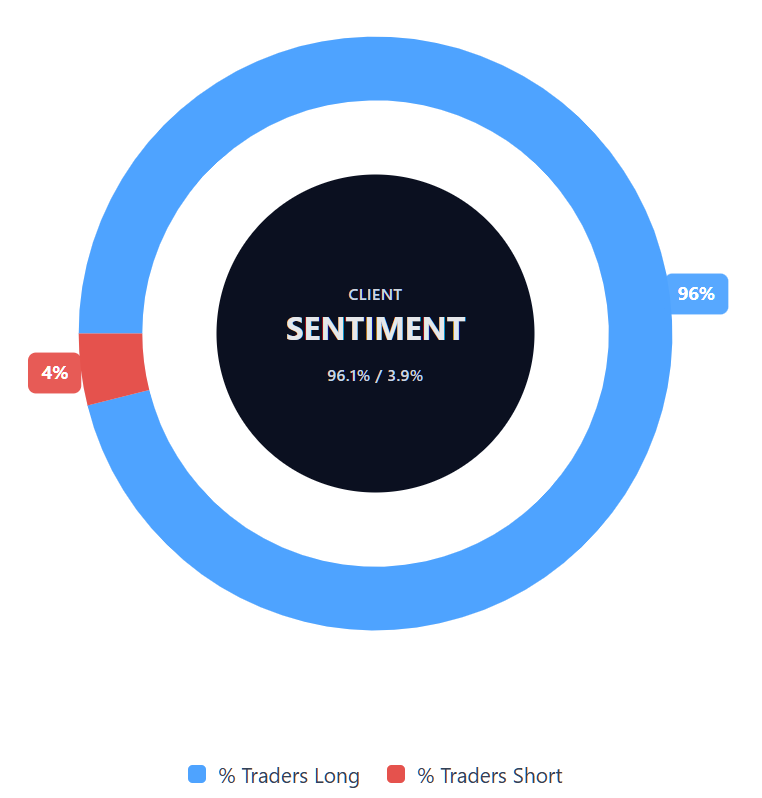
As of 7 April 2026, Capital.com client positioning in ENGIE CFDs shows 96.1% buyers and 3.9% sellers, putting buyers ahead by 92.2 percentage points. That places sentiment firmly in heavy-buy, long-skewed territory. This degree of skew is notably extreme, with sellers representing a very small minority of open positions. This snapshot reflects open positions on Capital.com and can change.
Summary – ENGIE 2026
- As of 11:35am UTC on 7 April 2026, ENGIE (ENGI) was trading at €29.14, up approximately 66.6% year on year and 26.5% year to date.
- The primary driver of the 2026 re-rating is ENGIE's announced £10.5 billion acquisition of UK Power Networks, which could position the group as a more regulated utility with more predictable earnings.
- Risks include acquisition integration uncertainty, the dilutive €3 billion rights issue, broader European equity headwinds from global trade tariffs, and a valuation that may already reflect much of the positive news flow.
- On TradingView, all moving averages from the 20-day through the 200-day are aligned bullishly, with the 14-day RSI at 66.17, in upper-neutral territory and approaching, but not yet reaching, overbought levels.
Past performance is not a reliable indicator of future results.
FAQ
Who owns the most ENGIE stock?
What is the 5-year ENGIE share price forecast?
A five-year ENGI stock forecast is inherently uncertain because it depends on several variables that can change over time, including regulation, energy prices, interest rates, acquisition execution and broader market conditions. In ENGIE’s case, the UK Power Networks deal, commodity exposure and the shift towards more regulated infrastructure are all relevant. Longer-term forecasts should be treated as scenario-based views rather than reliable predictions, especially as analyst targets usually focus on the next 12 months.
Is ENGIE a good stock to buy?
Could ENGIE stock go up or down?
ENGIE stock could move in either direction, depending on how company-specific and market-wide factors develop. On the upside, investors may respond positively to progress on the UK Power Networks acquisition, earnings delivery and a stronger regulated asset profile. On the downside, the share price could come under pressure if integration proves more complex than expected, if regulation disappoints, or if broader risk sentiment weakens across European equities. Price moves are rarely driven by one factor alone.
Should I invest in ENGIE stock?
Can I trade ENGIE CFDs on Capital.com?
Yes, you can trade ENGIE CFDs on Capital.com. Trading share CFDs lets you speculate on price movements without owning the underlying asset and to take long or short positions. However, contracts for difference (CFDs) are traded on margin, and leverage amplifies both profits and losses. You should ensure you understand how CFD trading works, assess your risk tolerance, and recognise that losses can occur quickly.