D-Wave Quantum stock forecast: Third-party price targets
D-Wave Quantum is a US-listed quantum computing company that develops annealing and gate-based systems, generating revenue through cloud-based services, research partnerships and enterprise contracts. Explore third-party QBTS price targets and technical analysis.
D-Wave Quantum, Inc. (QBTS) is trading around $20.35 as of 11:31am on 11 February 2026 (UTC), within an intraday range of approximately $20.01–$21.18 on Capital.com’s CFD feed. Past performance is not a reliable indicator of future results.
The stock is moving amid a series of company developments. D-Wave Quantum plans to relocate its corporate headquarters and a major US research and development facility to the Boca Raton Innovation Campus in Florida, according to recent company and property-owner announcements (Business Wire, 28 January 2026). Trading activity also reflects continued focus on the firm’s dual-platform quantum computing strategy after it completed the acquisition of Quantum Circuits Inc. and reported increased usage of its Advantage2 annealing systems, alongside multi-million-dollar deployment agreements with academic and enterprise partners (Investing.com, 20 January 2026).
D-Wave Quantum stock forecast 2026–2030: Third-party price targets
As of 11 February 2026, third-party D-Wave Quantum stock predictions sit above the Capital.com last price of $20.35 as of 11:31am on 11 February 2026 (UTC). Brokers generally frame their views over a 12-month horizon.
Cantor Fitzgerald (rating reiteration)
Cantor Fitzgerald reiterates an Overweight rating with a 12-month price target of $40, following D-Wave Quantum’s agreement to acquire Quantum Circuits Inc. for a mix of cash and stock. The broker cites the proposed acquisition and the company’s dual-platform strategy as factors supporting its target, while noting that commercial adoption of quantum computing remains at an early stage (Investing.com, 8 January 2026).
Roth MKM (rating reiteration)
Roth MKM analyst Sujeeva De Silva reiterates a Buy rating with a $40 price target, implying upside of about 87% from then-current levels. The analyst highlights commercial adoption trends and new partnership announcements (Insider Monkey, 1 February 2026).
Benchmark (rating and target update)
Benchmark analyst David Williams sets a $35 QBTS stock forecast, alongside a positive rating. The view reflects expectations of further contract wins and product development, while acknowledging share price volatility and execution risk (Quiver Quantitative, 5 February 2026).
Needham & Company (rating reaffirmation)
Needham & Company reaffirms a Buy rating with a $48 12-month price objective. The firm refers to triple-digit revenue growth, an earnings beat and expanding enterprise demand for D-Wave’s services, while stating that the company continues to operate at a net loss (MarketBeat, 29 January 2026).
Predictions and third-party forecasts are inherently uncertain, as they cannot fully account for unexpected market developments. Past performance is not a reliable indicator of future results.
QBTS stock price: Technical overview
The QBTS stock price trades around $20.35 as of 11:31am on 11 February 2026 (UTC), below its short- and medium-term moving-average cluster. The 20-, 50-, 100- and 200-day moving averages group near approximately $24, $26, $28 and $22 respectively. The 14-day relative strength index (RSI) sits near 40, in a lower-neutral range, while the average directional index (ADX) around 25 suggests an established trend without extreme momentum. The 10-day Hull moving average near $19.90 runs slightly below spot and is the only shorter-term indicator pointing to a tentative stabilisation following recent weakness.
On the upside, the nearest classic resistance level appears near R1 at approximately $28.70. A daily close above that area would bring the R2 zone near $36.20 into focus as a subsequent reference level. On the downside, initial support aligns with the classic pivot around $24.70, while the 200-day simple moving average near $21.70 forms a nearby technical level. A sustained close below that zone could expose the S1 area near $17.20 (TradingView, 11 February 2026).
This technical analysis is for informational purposes only and does not constitute financial advice or a recommendation to buy or sell any instrument.
D-Wave Quantum share price history (2024–2026)
QBTS’s stock price has shifted significantly over the past two years, moving from below $3 in late 2024 to substantially higher levels by early 2026. The stock closed at about $2.90 on 25 November 2024 and remained below $3 for much of December. It opened 2025 at $9.61 on 2 January before pulling back toward the mid-$5 range later that month. By March 2025, QBTS had traded between roughly $4.60 and $11.98, illustrating pronounced volatility as the price entered double digits for a more sustained period.
Momentum strengthened through mid-2025. Shares rose from around $6.35 in early April to close June near $14.69, then traded mostly in the mid-teens over the summer. The rally accelerated into autumn, with QBTS climbing from approximately $15.69 at the end of August to an intraday high just above $47 on 16 October 2025. The stock later retreated into the mid-$20s to low-$30s range, closing around $26.36 on 31 December 2025. In early 2026, the price continued to pull back from its October peak, declining from about $31.33 on 6 January to around $20.35 on 11 February 2026. Despite this retracement, the stock remains well above its late-2024 levels.
Past performance is not a reliable indicator of future results.
D-Wave Quantum (QBTS): Capital.com analyst view
D-Wave Quantum’s share price has shown pronounced volatility into February 2026. After reaching a peak above $45 in October 2025, the stock now trades near $20. This pattern reflects the wider debate surrounding early-stage quantum computing companies, where sharp rallies can reverse as market participants reassess revenue visibility, contract sustainability and valuation assumptions.
On one hand, recent announcements include sizeable commercial agreements and an expanded product roadmap, such as a reported $10m two-year quantum computing as a service (QCaaS) agreement with a Fortune 100 client and the proposed acquisition of Quantum Circuits Inc. These developments indicate enterprise engagement and a broader platform strategy. If contract momentum continues and execution aligns with expectations, this could support sentiment.
On the other hand, several risks remain. The company continues to report operating losses, and a $330m shelf registration may create scope for future share issuance. Elevated valuations relative to current earnings and cash flow metrics can also increase sensitivity to earnings misses or slower-than-expected customer adoption. If growth moderates or funding conditions tighten, the share price could remain volatile.
Capital.com’s client sentiment for D-Wave Quantum CFDs
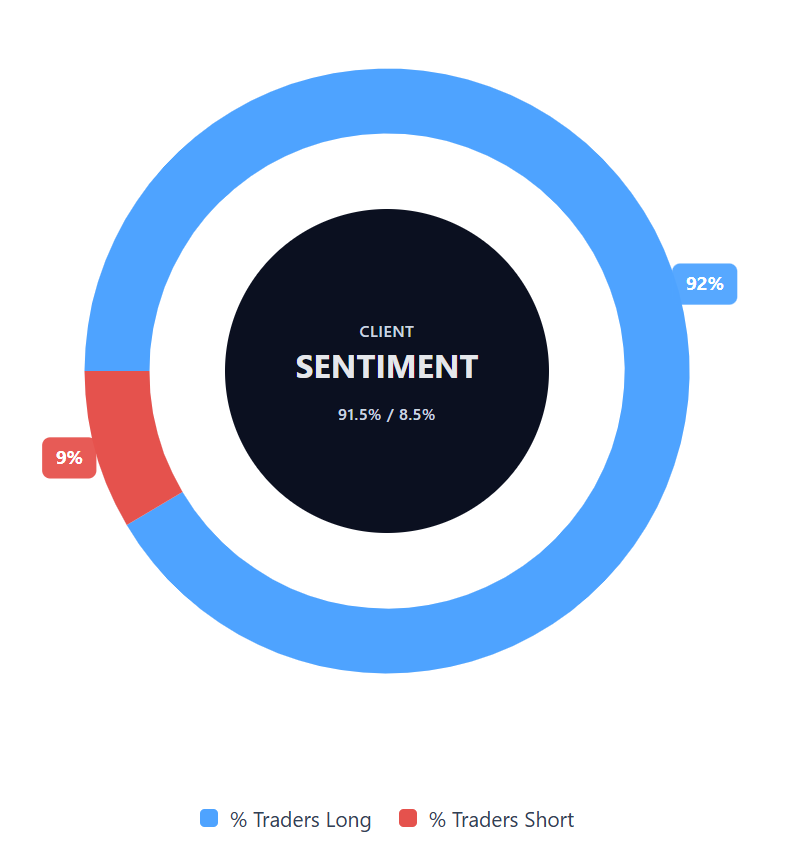
As of 11 February 2026, Capital.com client positioning in D-Wave Quantum CFDs is skewed to the upside, with buyers representing 96% of open positions and sellers 4%. This reflects a strong long bias among clients at the time of writing. Positioning data is dynamic and can change as market conditions evolve.

Summary – D-Wave Quantum 2026
- D-Wave Quantum (QBTS) trades around $20.35 as of 11 February 2026 (UTC), below its October 2025 high above $45 but significantly above late-2024 levels near $3.
- Technical indicators show a mixed picture. The price sits below a 20-, 50-, 100- and 200-day moving-average cluster in the low- to high-$20s, while RSI near 40 and ADX around 25 point to an established but moderating trend.
- Company developments include a planned relocation of its headquarters and R&D operations to Florida, the proposed acquisition of Quantum Circuits Inc., and a reported $10m, two-year QCaaS agreement with a Fortune 100 firm. Analysts’ 12-month price targets published in early 2026 range broadly between $30 and $48, reflecting differing assumptions about revenue growth, execution and the path to profitability.
Past performance is not a reliable indicator of future results.
FAQ
Who owns the most D-Wave Quantum stock?
Public filings show that D-Wave Quantum’s largest shareholders generally comprise a mix of institutional investors, asset managers and early strategic backers. Ownership levels may change over time as funds rebalance portfolios, reduce exposure or as the company issues new shares. Investors can review the latest regulatory filings to identify major holders and assess whether any concentrated stakes could influence voting power or market liquidity.
What is the 5-year D-Wave Quantum share price forecast?
There is currently no established five-year QBTS stock forecast. Most published analyst targets referenced in this article focus on a 12-month timeframe, reflecting the company’s early-stage commercial profile and evolving revenue base. Longer-term forecasts are subject to considerable uncertainty and depend on factors such as technology adoption, competitive pressures, funding conditions and the company’s progress towards profitability.
Is D-Wave Quantum a good stock to buy?
Whether D-Wave Quantum is considered attractive depends on an individual’s objectives, time horizon and tolerance for volatility. The company operates in an emerging sector and has reported revenue growth and new commercial agreements, but it also continues to post operating losses and faces execution and funding risks. Investors and traders typically weigh potential growth against valuation sensitivity and financial sustainability before making any decision. This is not investment advice.
Could D-Wave Quantum stock go up or down?
Like any listed equity, D-Wave Quantum’s share price can move in either direction. It has shown significant volatility over the past two years, rising sharply into October 2025 before retracing into early 2026. Future price movements may reflect earnings releases, contract announcements, capital-raising activity, sector-wide developments and broader market conditions. Volatility can create trading opportunities, but it also increases downside risk.
Should I invest in D-Wave Quantum stock?
Only you can decide whether investing in D-Wave Quantum aligns with your financial circumstances and risk tolerance. The company operates in a developing industry with both growth potential and material uncertainties. This article provides market context and references to third-party analyst views for informational purposes only and does not constitute financial advice. You may wish to conduct your own research or seek independent financial guidance before investing.
Can I trade D-Wave Quantum CFDs on Capital.com?
Yes, you can trade D-Wave Quantum CFDs on Capital.com. Trading share CFDs lets you speculate on price movements without owning the underlying asset and to take long or short positions. However, contracts for difference (CFDs) are traded on margin, and leverage amplifies both profits and losses. You should ensure you understand how CFD trading works, assess your risk tolerance, and recognise that losses can occur quickly.