
BioNTech stock forecast: mRNA patent dispute & Q4 results
BioNTech is a Germany-based biotechnology company developing mRNA vaccines and cancer therapies, currently in focus ahead of its 10 March 2026 results and a US patent case against Moderna. Explore third-party BNTX price targets and technical analysis.
BioNTech SE (BNTX) is trading around $109.75 as of 1:30pm (UTC) on 26 February 2026, within an intraday range of approximately $108.95–$111.94 on Capital.com’s feed. Past performance is not a reliable indicator of future results.
The shares are attracting increased attention after BioNTech confirmed it will report fourth-quarter and full-year 2025 results on 10 March 2026, followed by a conference call and webcast to provide a broader corporate update (BioNTech, 4 November 2025). At the same time, the company has filed a patent infringement lawsuit in a US federal court against Moderna, alleging that Moderna’s Covid-19 vaccine mNEXSPIKE infringes BioNTech’s mRNA vaccine technology covered by at least one US patent (Reuters, 19 February 2026). These developments sit alongside management’s 2026 strategic focus on expanding its late-stage oncology pipeline, including multiple planned Phase 3 trials across major tumour types such as lung and breast cancer (Market Chameleon, 12 January 2026).
BioNTech stock forecast 2026–2030: Third-party price targets
As of 26 February 2026, third-party BioNTech stock predictions emphasise oncology pipeline execution, normalising Covid-19 revenues and broader biotech risk appetite as key variables for the stock.
Fintel (consensus range)
Fintel reports that the average one-year BNTX stock forecast stands at about $140.77 per share, with individual analyst forecasts ranging from roughly $82.93 to $190.05. The platform notes an overall tilt towards Buy-type recommendations and attributes the wide dispersion to differing assumptions around clinical data milestones, regulatory timelines and the durability of Covid-19 vaccine demand (Fintel, 24 February 2026).
Public.com (analyst snapshot)
Public.com states that 11 analysts assign BioNTech an average 12-month price target of around $140.31 per share, alongside a consensus rating of Buy based on a mix of Strong Buy, Buy and Hold recommendations. The platform explains that this aggregate figure reflects varying scenarios for oncology and infectious-disease development programmes, set against valuation swings across the biotech sector (Public.com, 24 February 2026).
MarketBeat (rating summary)
MarketBeat indicates that BioNTech carries a consensus recommendation of ‘Moderate Buy’ from 16 analysts, with a mean 12-month price target of about $140.10 per share derived from the latest ratings in its coverage universe. The outlet states that this stance balances positive views on longer-term cancer immunotherapy prospects against uncertainty around near-term earnings and Covid-19 vaccine revenue trends (MarketBeat, 20 February 2026).
DirectorsTalk (multi-analyst spread)
DirectorsTalk Interviews highlights an average analyst target price of roughly $139.66 per share for BioNTech, with individual targets spanning approximately $102.78 to $175.54. The publication says this dispersion reflects contrasting views on the strength of BioNTech’s clinical pipeline, competitive positioning and funding backdrop as the company advances multiple late-stage oncology candidates (DirectorsTalk Interviews, 23 February 2026).
Predictions and third-party forecasts are inherently uncertain, as they cannot fully account for unexpected market developments. Past performance is not a reliable indicator of future results.
BNTX stock price: Technical overview
The BNTX stock price trades near $109.75 as of 1:30pm (UTC) on 26 February 2026, holding close to its key daily moving-average cluster. The 20/50/100/200-day simple moving averages (SMAs) stand at approximately 110 / 105 / 104 / 104. The 20-day average remains above the 50-day average, while the 14-day relative strength index (RSI) sits near 53, indicating neutral momentum. The average directional index (ADX) around 17 signals a relatively weak trend environment. Shorter-dated exponential moving averages (EMAs) broadly align with these levels, with the 10- to 30-day EMAs holding above their corresponding SMAs, suggesting limited directional conviction while price remains within this range.
On the upside, the nearest classic resistance level stands near R1 at 126.55, with R2 around 139.35 coming into focus only if the price records a sustained daily close above the first pivot zone. On pullbacks, initial support aligns with the classic pivot near 111.20, followed by the 100-day SMA around 103.56 as the first major moving-average reference point. A decisive move below this area could expose S1 near 98.40 under the classic pivot framework (TradingView, 26 February 2026).
Technical analysis is inherently probabilistic and does not guarantee future outcomes. This information is provided for general market commentary and does not constitute financial advice.
BioNTech share price history (2024–2026)
BNTX’s stock price spent much of 2024 trading in a broad $80–$125 range. The price dipped towards $80 in August before recovering into the low $120s by early October and closing the year at $111.79 on 31 December 2024.
During 2025, BNTX remained volatile but trended broadly lower overall. The stock moved above $120 in late January and again in April and June, briefly reaching $127.05 on 3 June. It then declined towards the low $90s into September and finished the year at $95.35 on 31 December 2025.
In 2026 to date, BNTX has edged higher from $97.03 at the 2 January close. The shares reclaimed the $100 level in early January and traded mostly within a $100–$120 range through late January, before moderating. Into February, the price has stabilised in the mid-$100s, with recent sessions centred around $108–$112 and the stock last trading at $109.75 on 26 February 2026.

Past performance is not a reliable indicator of future results. Share prices are indicative and may differ from live market prices.
BioNTech (BNTX): Capital.com analyst view
BioNTech’s share price over the past two years reflects a market recalibrating expectations after the Covid-19 vaccine surge. The stock has fluctuated between the high $70s and levels above $120 as investors weigh near-term revenue trends against longer-term pipeline development. Recent trading around $109–$112 in February 2026 places BNTX near the midpoint of this broader range. Some market participants may interpret this as consolidation following the 2025 pullback, while others may see it as a pause ahead of upcoming earnings and clinical updates.
On the fundamental side, BioNTech has identified 2026 as an important year in its transition towards a multi-product oncology company, with plans for up to 15 Phase 3 oncology trials and several late-stage data readouts. Positive clinical outcomes could strengthen the longer-term investment case. However, management and external commentators also highlight a more cautious outlook for Covid-19 vaccine revenues and no expectation of material oncology product sales in 2026. This dynamic may limit near-term earnings visibility and could increase share-price sensitivity to trial results or guidance updates.
Capital.com’s client sentiment for BioNTech CFDs
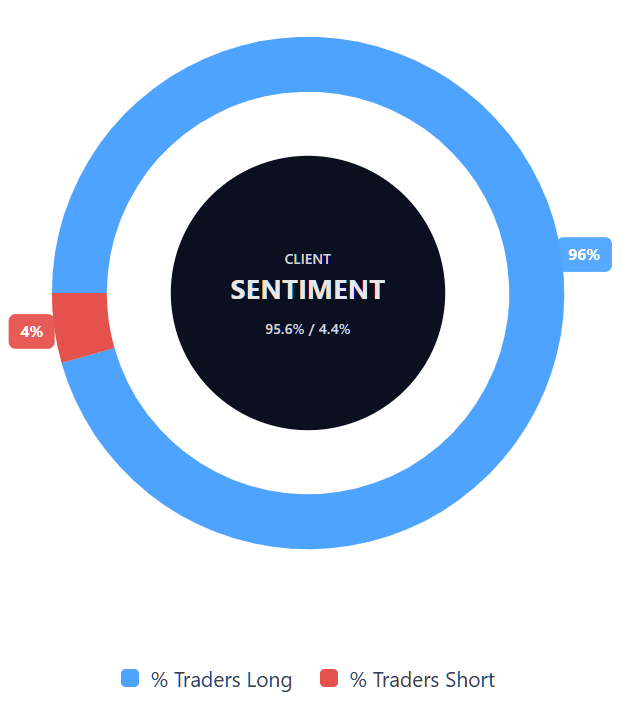
As of 26 February 2026, Capital.com client positioning in BioNTech CFDs shows 95.6% of clients holding long positions versus 4.4% holding short positions, a difference of approximately 91.2 percentage points. Such concentration on one side of the market can indicate strong directional conviction among retail traders, but it can also heighten sensitivity to unexpected price moves. This data reflects open positions on Capital.com at the time stated and can change.
Summary – BioNTech 2026
- As of 1:30pm (UTC) on 26 February 2026, BioNTech (BNTX) trades near $109.75, having moved between the high $70s and above $120 over the past two years.
- Technical indicators show the price holding near its 20/50/100/200-day moving averages, with neutral RSI and low ADX readings pointing to limited trend strength.
- Key variables include BioNTech’s post-Covid strategic shift towards oncology, guidance on vaccine revenues, broader biotech sector sentiment, and forthcoming earnings or clinical data releases.
- Recent newsflow centres on a patent infringement lawsuit against Moderna and the scheduled 10 March 2026 full-year 2025 results announcement.
Past performance is not a reliable indicator of future results.
FAQ
Who owns the most BioNTech stock?
BioNTech’s largest shareholders generally include its co-founders and early backers, alongside institutional investors such as asset managers and investment funds. Ownership changes over time due to share sales, new issuances or portfolio rebalancing. Investors often review regulatory filings, including SEC disclosures, to monitor shifts in major holdings. Concentrated insider ownership can align management’s interests with those of shareholders, but it may also influence voting control and share liquidity.
What is the 5-year BioNTech share price forecast?
There is no single, reliable five-year BNTX stock forecast. Long-term projections depend on factors such as clinical trial outcomes, regulatory approvals, commercial execution in oncology, vaccine revenue trends and broader biotech sector conditions. While some analysts publish 12-month price targets, multi-year forecasts tend to rely on assumptions that may change materially over time. Investors typically treat extended projections with caution given the uncertainty inherent in drug development and market cycles.
Is BioNTech a good stock to buy?
Whether BioNTech is considered a ‘good’ stock depends on an individual’s objectives, risk tolerance and time horizon. The company is transitioning from Covid-19 vaccine-driven revenues towards a broader oncology pipeline, a shift that may create both opportunities and operational risks. Share price performance may react to clinical data releases, earnings updates and sector-wide valuation changes. This information is for general purposes only and does not constitute investment advice.
Could BioNTech stock go up or down?
BioNTech’s share price can move in either direction depending on company-specific and external developments. Clinical trial results, earnings announcements, legal proceedings and shifts in vaccine demand can all affect valuation expectations. Broader market dynamics, including interest rate changes and investor appetite for biotech equities, may also influence price action. As with all listed shares, volatility is possible, and past performance is not a reliable indicator of future results.
Should I invest in BioNTech stock?
Any decision to invest in BioNTech shares should reflect your financial circumstances, experience and tolerance for risk. Biotechnology companies often face binary events, such as trial outcomes or regulatory decisions, which can lead to sharp price movements in either direction. You may wish to conduct independent research or seek professional advice before making an investment decision. Capital.com does not provide personalised investment advice.
Can I trade BioNTech CFDs on Capital.com?
Yes, you can trade BioNTech CFDs on Capital.com. Trading share CFDs lets you speculate on price movements without owning the underlying asset and to take long or short positions. However, contracts for difference (CFDs) are traded on margin, and leverage amplifies both profits and losses. You should ensure you understand how CFD trading works, assess your risk tolerance, and recognise that losses can occur quickly.