
BioNtech stock forecast: Third-party price targets
BioNTech (BNTX) is a biotechnology company developing mRNA-based therapies and vaccines, with a growing oncology pipeline and shares listed on Nasdaq. Explore third-party BNTX price targets and technical analysis.
BioNTech SE (BNTX) is trading around $109.17 in intraday action as of 10:50am on 11 February 2026 (UTC), moving within a session range of $108.30-$112.40, according to Capital.com’s feed. Past performance is not a reliable indicator of future results.
Recent trading follows BioNTech’s 2026 strategic update, in which the company outlined plans to expand its late-stage oncology pipeline and continue investing in mRNA-based cancer and infectious-disease programmes. Management stated that it aims to have around 15 Phase 3 oncology trials under way by year-end (Yahoo Finance, 12 January 2026). Broader sentiment has also responded to coverage of these plans at the J.P. Morgan Healthcare Conference and subsequent analysis of the company’s pipeline-focused strategy (The Globe and Mail, 13 January 2026).
BioNtech stock forecast 2026–2030: Third-party price targets
As of 11 February 2026, third-party BioNtech stock predictions broadly cite oncology pipeline progress and post-pandemic vaccine dynamics as key assumptions in their valuation models. These figures reflect third-party opinions rather than guarantees. Each provider applies its own methodology, time horizon and risk assumptions when setting targets. Forecasts can prove inaccurate, as they cannot account for unforeseen market or company-specific developments.
Goldman Sachs (broker research update)
Goldman Sachs upgrades BioNTech from Neutral to Buy, setting a 12-month price target of $142, up from $115. The bank references the company’s strategic shift towards oncology and expectations for data catalysts in 2026, while reassessing the balance between COVID-19 vaccine revenues and potential new cancer therapies (Investing.com, 16 January 2026).
Fintel (consensus indicator)
Fintel data shows that the average one-year price target for BioNTech stands at around $140.72 per share. The published range extends from $82.93 to $190.05. The platform aggregates the most recent 12-month targets from covering analysts and noted a recommendation mix tilted towards Buy ratings at that time (Fintel, 11 February 2026).
Public.com (retail-focused aggregation)
Public.com aggregates an average 12-month BNTX stock forecast of around $140.31. Individual targets vary above and below that midpoint. The platform attributes these estimates to expectations around execution in late-stage oncology programmes and continued funding from the company’s existing cash reserves, while acknowledging uncertainty around long-term COVID-19 vaccine demand (Public.com, 11 February 2026).
Predictions and third-party forecasts are inherently uncertain, as they cannot fully account for unexpected market developments. Past performance is not a reliable indicator of future results.
BNTX stock price: Technical overview
The BNTX stock price is trading near $109.17 as of 10:50am on 11 February 2026 (UTC). The price is positioned below the Classic pivot at 111 and beneath the first resistance at 127, while a broader resistance zone extends towards 139 on the classic and woodie calculations.
On the daily chart, the simple moving averages cluster around the 20-, 50-, 100- and 200-day levels at approximately 112, 102, 103 and 104 respectively. This places the current price slightly above the medium- and long-term averages, while remaining close to the shorter-term 10-day average near 110. The 14-day relative strength index (RSI) stands near 52, suggesting neutral momentum rather than overbought or oversold conditions.
On the upside, traders often monitor the classic R1 area near 127. A sustained daily close above this level could bring the higher pivot region around 139 into focus as the next technical reference. On the downside, the classic pivot near 111 may act as initial support, followed by the 100- and 200-day moving averages in the low-$100s. A sustained move below that zone would place attention on the S1 area near 98 (TradingView, 11 February 2026).
This technical analysis is provided for informational purposes only and does not constitute financial advice.
BioNtech share price history (2024–2026)
Over the past two years, BNTX’s stock price has experienced several distinct cycles. The stock moved from the low-$90s in early 2024 to a high near $131.88 on 17 September 2024, before retracing. Through late 2024, it largely traded between approximately $85 and $125, ending the year at $111.79 on 31 December 2024. It then closed 2025 at $95.35 after a weaker second half.
In 2026 to date, BNTX has risen from $97.03 on 2 January to an intraday high above $124 in late January, before consolidating in the low-$110 range. The share last traded at $109.17 on 11 February 2026. Compared with $114.80 on 11 February 2025, the stock is modestly lower year on year.

Past performance is not a reliable indicator of future results. Share prices are indicative and may differ from live market prices.
BioNtech (BNTX): Capital.com analyst view
BioNtech reported approximately €17.2bn in cash and investments at the end of 2025 and raised its 2025 revenue outlook to €2.6-2.8bn. This liquidity position may support ongoing research and late-stage trials. At the same time, management has guided for a moderate decline in 2026 COVID-19 vaccine revenues and indicated that it does not expect oncology product sales this year.
From a drivers perspective, BioNTech describes 2026 as a year with multiple planned oncology data readouts and around 15 Phase 3 trials in progress. Positive trial outcomes could influence investor sentiment, while delays, regulatory challenges or weaker-than-expected data may weigh on the share price. The shift from reliance on Comirnaty revenues to a diversified oncology portfolio introduces both opportunity and uncertainty. As a result, headlines relating to clinical results, regulation, competition and broader sector flows may contribute to volatility.
Capital.com’s client sentiment for BioNtech CFDs
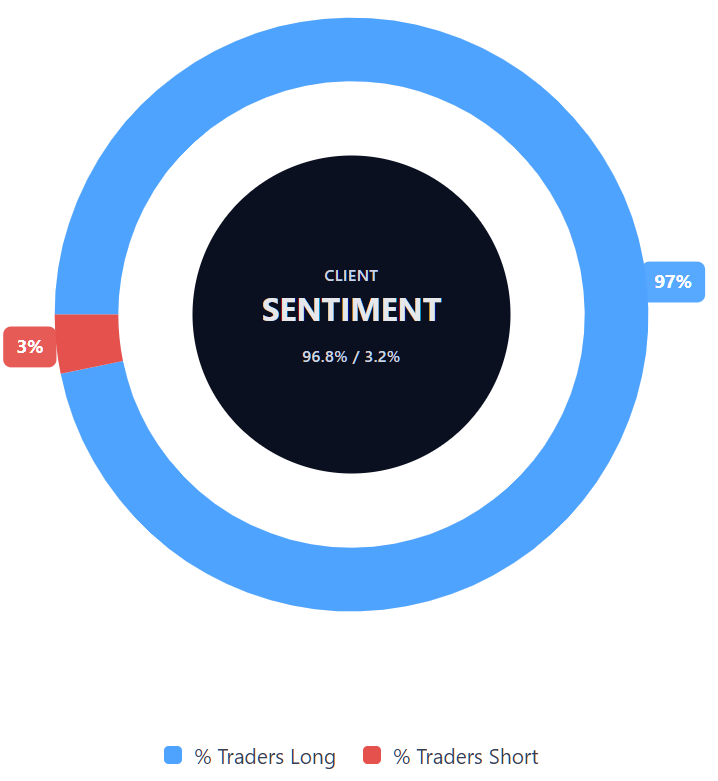
As of 11 February 2026, Capital.com client positioning in BioNTech CFDs remains heavily skewed towards long positions. Buyers account for 96.8% of open positions, compared with 3.2% on the sell side, a difference of around 93.7 percentage points. This snapshot reflects current positioning on the platform only and may change as new trades are opened or closed.
Summary – BioNtech 2026
- BioNTech’s share price has traded within a broad range over the past two years, fluctuating between the high-$70s and low-$130s. It ended 2025 at $95.35 and was last seen at $109.17 on 11 February 2026.
- Technical indicators show the price moving close to key daily averages, with the 20-, 50-, 100- and 200-day SMAs clustered near $112, $102, $103 and $104, and a neutral 14-day RSI around 52.
- Company updates for 2026 highlight an increased focus on oncology, including plans for around 15 Phase 3 trials, supported by a substantial cash position. However, management has also indicated lower COVID-19 vaccine revenues and no oncology product sales in 2026, which may affect expectations.
- BioNTech’s share price may therefore remain sensitive to clinical trial results, regulatory developments, competitive dynamics and broader market conditions.
Past performance is not a reliable indicator of future results.
FAQ
Who owns the most BioNTech stock?
BioNTech was founded by Ugur Sahin and Özlem Türeci, who remain significant shareholders alongside early investor groups. A substantial portion of shares is held by institutional investors, including global asset managers and investment funds. Ownership structures can change over time as funds adjust allocations and insiders buy or sell shares. Investors may review the company’s latest regulatory filings for the most up-to-date breakdown of major shareholders.
What is the 5-year BioNTech share price forecast?
There is no single agreed five-year BNTX stock forecast. Most publicly available analyst targets focus on a 12-month horizon, with projections varying according to assumptions about oncology pipeline progress, vaccine revenues, and broader market conditions. Longer-term forecasts often rely on scenario-based modelling rather than fixed price targets. Such projections are inherently uncertain and can change materially as new clinical data or financial results emerge.
Is BioNTech a good stock to buy?
Whether BioNTech is considered an appropriate investment depends on an individual’s objectives, risk tolerance, and time horizon. The company holds a substantial cash position and continues to advance multiple oncology trials, but it also faces uncertainty around clinical outcomes and declining COVID-19 vaccine revenues. Share prices can be volatile in response to data releases and regulatory developments. This information is for educational purposes only and does not constitute investment advice.
Could BioNTech stock go up or down?
BioNTech’s share price may move in either direction. Price movements can follow clinical trial updates, earnings releases, regulatory decisions, or changes in broader market conditions. Technical factors, such as moves above resistance or below support levels, can also influence short-term price action. As with all equities, sector trends and macroeconomic developments may contribute to volatility. Past performance does not guarantee future results.
Should I invest in BioNTech stock?
The decision to invest in BioNTech shares should reflect your financial circumstances, investment goals, and understanding of the risks involved. Equity investments, including stock CFDs, can result in gains or losses, and biotechnology companies in particular may experience sharp price movements around data releases. You may consider seeking independent financial advice before making any decision. This content does not provide a recommendation to buy or sell.
Can I trade BioNTech CFDs on Capital.com?
Yes, you can trade BioNtech CFDs on Capital.com. Trading share CFDs lets you speculate on price movements without owning the underlying asset and to take long or short positions. However, contracts for difference (CFDs) are traded on margin, and leverage amplifies both profits and losses. You should ensure you understand how CFD trading works, assess your risk tolerance, and recognise that losses can occur quickly.