
Bayer stock forecast: Roundup settlement, Durnell ruling
Bayer is a German life sciences group whose shares remain influenced by 2026 guidance, Roundup settlement costs and the pending US Supreme Court decision on glyphosate litigation.Explore third-party BAYN price targets and technical analysis.
Bayer AG (BAYN) is trading at €38 in afternoon European trading at 2:29pm UTC on 25 March 2026, within an intraday range of €36.85–€38.55. Past performance is not a reliable indicator of future results.
Sentiment on BAYN continues to be shaped by three converging factors. First, Bayer's full-year 2026 guidance, issued on 4 March 2026, projected adjusted EBITDA of €9.6–€10.1 billion – broadly flat year on year – alongside negative free cash flow (Reuters, 4 March 2026), as the company absorbs costs related to its $7.25 billion Roundup class-action settlement, which received preliminary court approval in Missouri (Bayer, 4 March 2026). Second, the US Supreme Court is expected to rule by June 2026 on the Durnell glyphosate case, a decision Bayer has framed as central to containing its residual litigation liability (Bayer, 16 January 2026). Third, the broader DAX remains under pressure, trading around 22,961 on 25 March 2026, weighed by elevated Bund yields approaching 3% and geopolitically driven energy costs (Daily Forex, 20 March 2026).
Bayer stock forecast 2026–2030: Third-party price targets
As of 25 March 2026, third-party Bayer stock predictions reflect a wide dispersion of views, shaped primarily by the status of glyphosate litigation, the trajectory of the pharmaceuticals division, and Bayer's negative free cash flow guidance for the year.
Barclays (post-results note, Buy)
Barclays reiterates a Buy rating on Bayer with a BAYN stock forecast of €48, reduced from €50 following the full-year 2025 results. Analyst Charles Pitman-King notes that 2026 EBITDA guidance implies an approximately 2–3% currency-related downgrade to consensus, while presenting 2026 as a potential trough year for pharmaceuticals sales ahead of a projected return to mid-single-digit growth from 2027 (MarketScreener, 9 March 2026).
Deutsche Bank (post-results note, Neutral)
Deutsche Bank retains a Neutral rating on BAYN with a price target of €23, the most cautious among tracked brokers. Analyst Falko Friedrichs maintains this view amid negative free cash flow guidance for 2026 and unresolved uncertainty around the US Supreme Court's pending decision in the Durnell glyphosate case (MarketScreener, 5 March 2026).
Goldman Sachs (initiation, Buy)
Goldman Sachs initiates coverage on BAYN with a Buy rating and a price target of €54, citing the preliminary Roundup settlement approval and the pharmaceutical pipeline as twin re-rating catalysts. The bank says that litigation containment, combined with a projected recovery in crop science volumes, underpins its constructive thesis (The Globe and Mail, 17 March 2026).
MarketScreener (broker consensus, Outperform)
MarketScreener's aggregated view across 20 analysts sets the average 12-month price target at €45.29, within a range of approximately €23 to €60, and assigns a mean consensus rating of Outperform. The wide spread between the low and high estimates reflects divergent assumptions on glyphosate cash outflow timing, currency effects, and the pace of recovery in the pharmaceuticals division (MarketScreener, 25 March 2026).
Predictions and third-party forecasts are inherently uncertain, as they cannot fully account for unexpected market developments. Past performance is not a reliable indicator of future results.
BAYN stock price: Technical overview
The BAYN stock price trades at €38 in afternoon European trading at 2:29pm UTC on 25 March 2026, sitting below its short- and medium-term moving-average cluster – the 20- and 50-day SMAs at roughly €39.01 and €42.53 – while holding above the 100- and 200-day SMAs at €37.64 and €32.58 respectively, according to TradingView data. The price is therefore caught between two competing signals: the cluster of shorter-term averages overhead may act as resistance, while the longer-term averages below may offer a structural floor. The Hull moving average (9) at €37.69 sits just beneath the last price, adding a marginal near-term supportive reference from the same dataset.
Momentum indicators from TradingView's oscillator suite present a mixed picture. The 14-day relative strength index reads 40.23, placing it in neutral territory with a mild downside lean – neither oversold nor showing strong selling pressure. The average directional index (14) registers 26.83, indicating an established rather than directionless trend, which adds some weight to the current move lower from the short-term MA cluster.
On the topside, the classic pivot point (P) at €44.35 represents the first reference above the current price; a daily close back through this level could put the R1 level near €47.45 in view. The R2 pivot at €52.88 would become the next area of interest only on a sustained move above R1.
To the downside, the 100-day SMA at €37.64 and the S1 classic pivot at €38.91 form the nearest support band; a close below the 100-day SMA shelf would bring the S2 level near €35.81 into the picture as the next reference lower (TradingView, 25 March 2026).
This is technical analysis for informational purposes only and does not constitute financial advice or a recommendation to buy or sell any instrument.
Bayer share price history (2024–2026)
BAYN’s stock price opened around €27.35 in late March 2024, and over the following months the stock moved broadly sideways between roughly €25 and €30 through to the end of 2024, closing the year at €19.40 on 30 December 2024 – weighed down by persistent litigation uncertainty around glyphosate and a difficult operating environment for the crop science division.
2025 told a more dramatic story. BAYN started the year at €19.45 and slid to a two-year trough of €19.80 on 7 April 2025, before staging a meaningful recovery through the spring and summer. The stock climbed steadily through the second half of the year, reaching €30.50 by 1 October 2025, then pulled back before finishing 2025 at €37.05 on 30 December – a gain of roughly 90.5% for the full calendar year.
The rally extended into early 2026. BAYN touched a two-year high of €49.50 on 17 February 2026, buoyed by the preliminary court approval of Bayer's $7.25 billion Roundup class-action settlement and improving sentiment around the pharmaceuticals pipeline. The stock has since retraced, closing at €38.20 on 25 March 2026 – approximately 22.8% below that February peak, but still around 0.4% up year to date and roughly 61.5% higher year on year.

Past performance is not a reliable indicator of future results. Share prices are indicative and may differ from live market prices.
Bayer (BAYN): Capital.com analyst view
Bayer's price performance over the past 12 months reflects a stock caught between two competing narratives. The roughly 90% gain recorded across 2025 and the subsequent rally to a two-year high of €49.50 in February 2026 show that investor sentiment can shift quickly when litigation risk begins to recede – the preliminary approval of the $7.25 billion Roundup settlement was widely seen as a step towards closing a long-running overhang. However, the subsequent pullback of nearly 23% from that peak to current levels near €38.20 also shows how quickly that sentiment can reverse. Opt-outs from the settlement and the pending US Supreme Court ruling on the Durnell glyphosate case mean material uncertainty persists.
On the operational side, Bayer's stable 2026 EBITDA guidance and projected return to pharmaceutical growth from 2027 provide a constructive medium-term backdrop. At the same time, negative free cash flow guidance for the current year and currency headwinds represent genuine near-term drags that could limit upside, particularly if macro conditions tighten or the litigation timeline extends further than markets currently anticipate.
Capital.com’s client sentiment for Bayer CFDs
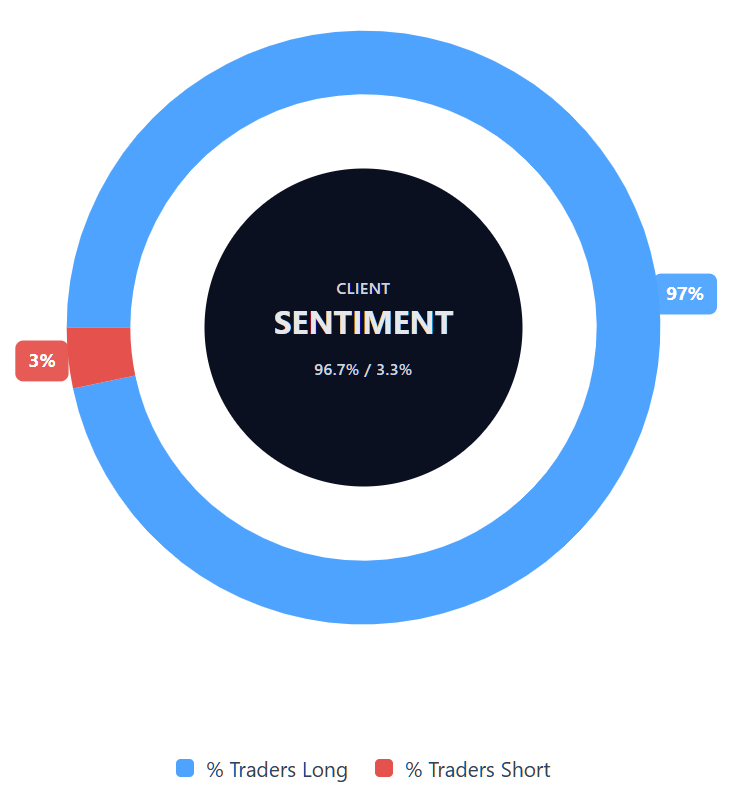
As of 25 March 2026, Capital.com client positioning in Bayer CFDs is skewed towards longs: 96.7% buyers versus 3.3% sellers, putting buyers ahead by 93.4 percentage points and placing sentiment firmly in one-sided territory. This snapshot reflects open positions on Capital.com and can change.
Summary – Bayer 2026
- Bayer (BAYN) trades at €38 as of 2:29pm UTC on 25 March 2026, within an intraday range of €36.85–€38.55.
- TradingView's oscillator suite reads broadly neutral, with the 14-day relative strength index at 40.23 and the average directional index at 26.83, suggesting an established but not accelerating trend.
- Short- and medium-term moving averages (20- and 50-day SMAs near €39.01 and €42.53) sit above the last price, acting as overhead resistance, while the 100- and 200-day SMAs below provide longer-term structural support.
- The primary price driver remains glyphosate litigation; the $7.25 billion Roundup settlement received preliminary court approval on 4 March 2026, though the pending US Supreme Court Durnell ruling introduces ongoing uncertainty.
- Bayer's full-year 2026 guidance projects stable adjusted EBITDA of €9.6–€10.1 billion alongside negative free cash flow, adding near-term pressure to the investment case.
Past performance is not a reliable indicator of future results.
FAQ
Who owns the most Bayer stock?
What is the 5 year Bayer share price forecast?
A five-year BAYN stock forecast is inherently uncertain because it depends on factors that are difficult to project with confidence, including glyphosate litigation outcomes, pharmaceutical pipeline delivery, crop science demand, currency moves and broader market conditions. While some analysts publish 12-month targets, longer-term forecasts are usually scenario-based rather than precise predictions. For that reason, any five-year view should be treated as a possibility, not a certainty or a reliable indicator of future performance.
Is Bayer a good stock to buy?
Whether Bayer is considered a good stock to buy depends on an investor’s objectives, risk tolerance and time horizon. The company offers potential upside if litigation pressure eases and pharmaceutical growth improves, but it also faces ongoing legal uncertainty, negative free cash flow guidance and macroeconomic headwinds. As a result, opinions remain mixed. Rather than offering a simple yes or no answer, it is more accurate to view Bayer as a stock with both possible opportunities and material risks.
Could Bayer stock go up or down?
Bayer’s share price could move in either direction, depending on how key developments unfold. A reduction in litigation uncertainty, stronger pharmaceuticals performance or improving cash flow could support the stock. On the other hand, adverse legal outcomes, weaker operating performance or tougher market conditions could weigh on it. Recent trading and analyst forecasts show that expectations remain divided, which underlines that Bayer’s next move is uncertain rather than one-sided.
Should I invest in Bayer stock?
Can I trade Bayer CFDs on Capital.com?
Yes, you can trade Bayer CFDs on Capital.com. Trading share CFDs lets you speculate on price movements without owning the underlying asset and to take long or short positions. However, contracts for difference (CFDs) are traded on margin, and leverage amplifies both profits and losses. You should ensure you understand how CFD trading works, assess your risk tolerance, and recognise that losses can occur quickly.