
AMD stock forecast: AI tariff carve-outs
Advanced Micro Devices (AMD) is a US semiconductor company whose 2026 share-price performance has been influenced by AI demand, US tariff exemptions for key chip imports, and stronger sales across the chip sector. Explore third-party Advanced Micro Devices price targets and technical analysis.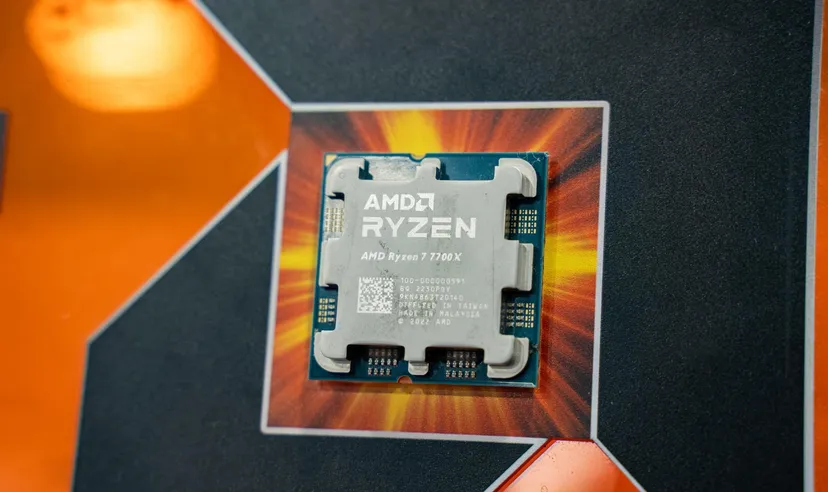
Advanced Micro Devices Inc (AMD) is trading at $242.65 on the Capital.com feed as of 11:08am UTC on 13 April 2026, within a session range of $235.27 – $248.55. Past performance is not a reliable indicator of future results.
Momentum in the stock has been supported by several converging factors. First, the Trump administration's January 2026 executive order imposed a 25% tariff on select AI chips, including AMD's MI325X, but explicitly carved out imports destined for US data centres, domestic R&D, and public-sector applications, limiting the direct commercial impact on AMD's core hyperscaler business (Reuters, 15 January 2026). Second, AMD shares rallied approximately 4% on 8 April 2026 amid broader tech sector optimism tied to a US-Iran ceasefire, which eased risk-off pressure across the Nasdaq, while semiconductor weekly sales also rose year on year through the week ending 3 April 2026 (TradingView, 8 April 2026). Third, TSMC reported a record 45% year-on-year sales increase for March 2026 on 11 April 2026, reinforcing the AI infrastructure demand that underpins AMD's data centre GPU and EPYC CPU revenue lines (Amiko Consulting, 11 April 2026).
AMD stock forecast 2026–2030: Third-party price targets
As of 13 April 2026, third-party AMD stock predictions span a wide range, shaped by the trajectory of AI GPU adoption, EPYC server CPU market-share gains, and near-term execution risk around the MI-series product ramp.
Citigroup (neutral rating, trimmed target)
Citigroup trimmed its 12-month price target on AMD from $260 to $248, while maintaining a neutral rating. The bank also placed AMD on a 30-day positive catalyst watch ahead of the 30 April earnings date, citing accelerating agentic AI chip demand as a near-term support, even as it lowered its longer-term target amid ongoing execution and valuation risk (MarketBeat, 6 April 2026).
Wolfe Research (outperform reiteration)
Wolfe Research reiterated an Outperform rating and a $300 12-month price target on AMD, a position the firm maintained through the period ending 13 April 2026. Analyst Chris Caso based the view on AMD's multi-year AI GPU agreements and improving EPYC server CPU visibility, noting that agentic AI demand is pulling forward CPU orders and supporting above-consensus revenue estimates for the second half of 2026 (Investing.com, 16 March 2026).
Wells Fargo (overweight reiteration)
Wells Fargo maintained an Overweight rating with a $345 AMD stock forecast. Analyst Aaron Rakers continues to flag AMD as the firm's top AI pick for 2026, citing the MI-series data-centre GPU ramp and expanding hyperscaler customer base as the primary supports for an above-consensus long-term revenue trajectory (MarketBeat, 8 April 2026).
MarketBeat (broker consensus aggregation)
MarketBeat aggregated 40 analyst ratings on AMD, reporting a Moderate Buy consensus with an average 12-month price target of $290.19. The breakdown included 30 Buy ratings, 9 Hold ratings, and 1 Strong Buy, with individual targets ranging from $220 to $365, reflecting divergent views on AMD's AI GPU execution risk and the pace of hyperscaler capital expenditure growth (MarketBeat, 7 April 2026).
Public.com (consensus snapshot)
Public.com's AMD forecast page reports a Wall Street average 12-month price target of $264.82 based on its panel of covering analysts. The aggregate figure sits below the MarketBeat mean of $290.19, reflecting differences in the analyst sample and recency weighting, with both aggregators pointing to a broadly constructive long-term view on AMD's AI and data-centre exposure (Public.com, 9 April 2026).
Predictions and third-party forecasts are inherently uncertain, as they cannot fully account for unexpected market developments. Past performance is not a reliable indicator of future results.
Advanced Micro Devices stock price: Technical overview
The AMD stock price is trading at $242.65 as of 11:08am UTC on 13 April 2026, holding well above its key moving-average cluster, with the 20/50/100/200-day simple moving averages sitting at roughly $210 / $209 / $215 / $199. The 20-over-50 alignment remains intact across both the simple and exponential families, which indicates that the near-term trend is still upward.
Momentum is stretched: the 14-day relative strength index reads 70.14, placing it at the lower boundary of overbought territory, while the moving average convergence/divergence level of 7.51 registers a buy signal, consistent with continued positive short-term price momentum, according to TradingView data. The average directional index at 17.36 sits between the weak-trend and established-trend thresholds, suggesting the current directional move lacks strong conviction.
On the topside, the classic R1 pivot at $220.43 has already been cleared, with R2 at $237.44 also trading below the current price. The next reference on the classic pivot framework is R3 near $270.55, with the $257.25 Woodie R2 level as an intermediate area before that (TradingView).
On pullbacks, the classic pivot at $204.33 offers initial reference support, followed by the 100-day simple moving average shelf near $215. A slip back beneath the 20-day simple moving average near $210 would place the $199 – $200 area, where the 200-day simple moving average sits, as the next downside reference (TradingView, 13 April 2026).
This is technical analysis for informational purposes only and does not constitute financial advice or a recommendation to buy or sell any instrument.
AMD share price history (2024–2026)
AMD’s stock price opened April 2024 around $164, riding the wave of AI GPU enthusiasm that had dominated sentiment across the semiconductor sector through late 2023 and into early 2024.
That optimism faded through the second half of 2024. AMD slid from a mid-July 2024 peak close of around $183 down towards $120 by the end of December 2024, as investors rotated out of the broader AI trade amid concerns over execution on the MI-series GPU ramp and margin pressure. The stock closed 2024 at $120.59.
2025 brought further turbulence. AMD dipped below $100 in early May 2025, closing as low as $96.25 on 1 May, under pressure from sweeping US tariff announcements and broader tech sector selling. A recovery gathered pace through the summer, with AMD reclaiming the $160 range by September, before a sharp rally in October lifted the stock briefly above $260 on 29 October 2025. A reversal followed, pulling AMD back towards the $200 area by February 2026.
AMD closed at $242.65 on 13 April 2026, which is approximately 101.2% up year on year from the 14 April 2025 close of $93.34, and approximately 13.3% up year to date from the 31 December 2025 close of $214.24.

Past performance is not a reliable indicator of future results. Share prices are indicative and may differ from live market prices.
AMD (Advanced Micro Devices): Capital.com analyst view
AMD's price trajectory over the past two years reflects the contested nature of its AI market position. The stock recovered sharply from lows near $76 in April 2025 to close above $242 by mid-April 2026, supported by expanding EPYC server CPU market share, the anticipated MI-series GPU ramp, and high-profile supply agreements with Meta and OpenAI. AMD's full-year 2025 revenue grew 35% year on year to $34.6bn, offering a tangible foundation for the bullish case. However, the same period also exposed meaningful vulnerabilities: a sharp February 2026 sell-off followed a guidance miss that revealed a steep drop in China data-centre revenue, from a $390m windfall in late 2025 to approximately $100m in 2026 as US export controls tightened, alongside a product transition gap before the high-volume Helios/MI455X platform launch.
Looking across the factors in play, the case for continued price support rests on second-half 2026 catalysts, including MI450 deployments, the OpenAI supply ramp, and an expected EPYC upgrade cycle, while the bear case centres on Nvidia's entrenched competitive position in high-end AI workloads, ongoing tariff and export-control exposure, and the limited margin for execution error as Wall Street consensus already reflects aggressive revenue growth.
Capital.com’s client sentiment for AMD CFDs
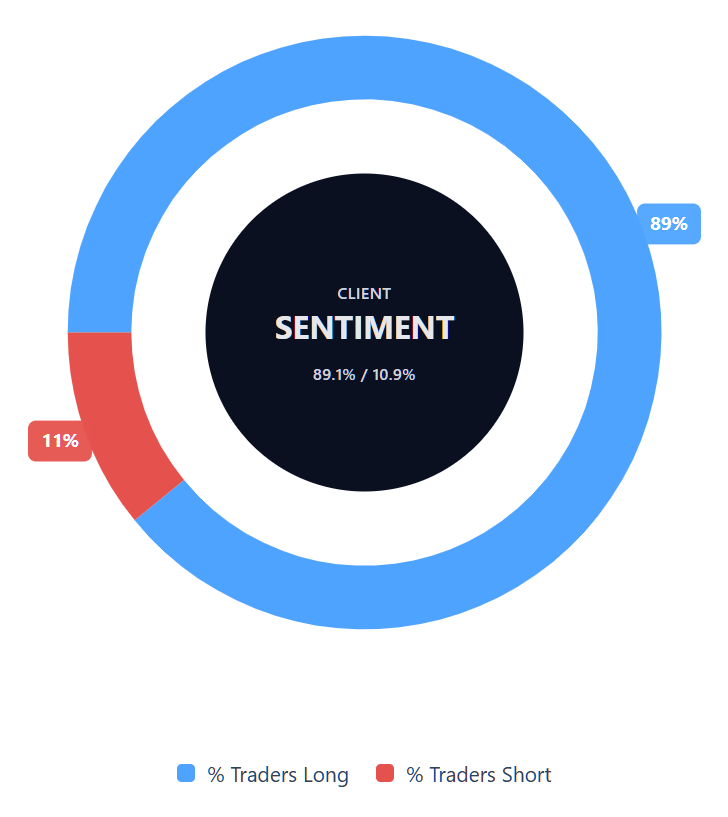
As of 13 April 2026, Capital.com client positioning in AMD CFDs shows 89.1% buyers and 10.9% sellers, which puts buyers ahead by 78.2 percentage points and places sentiment firmly in favour of long positions. This snapshot reflects open positions on Capital.com and can change rapidly as market conditions evolve.
Summary – AMD 2026
- AMD is trading at $242.65 as of 11:08am UTC on 13 April 2026, around 101% up year on year and approximately 13% up year to date from $214.24 at end-2025.
- Key risks include intensifying competition from Nvidia, US export controls limiting China data-centre revenue, and AMD's limited margin for execution error against consensus revenue forecasts.
- A 25% tariff on select AI chip imports imposed in January 2026 carries mixed implications, damping some revenue lines while carve-outs for US data-centre deployments limit the direct impact on AMD's core hyperscaler business.
Past performance is not a reliable indicator of future results.
FAQ
Who owns the most AMD stock?
What is the 5 year AMD share price forecast?
Is AMD a good stock to buy?
Whether AMD is a good stock to buy depends on an individual’s objectives, risk tolerance, time horizon and view of the semiconductor sector. The company has exposure to areas that many analysts watch closely, including AI infrastructure and server processors, but it also faces competitive, regulatory and execution risks. For that reason, the article presents third-party forecasts and market context for information only, rather than suggesting that AMD is suitable for any particular investor or trader.
Could AMD stock go up or down?
Should I invest in AMD stock?
Can I trade AMD CFDs on Capital.com?
Yes, you can trade AMD CFDs on Capital.com. Trading share CFDs lets you speculate on price movements without owning the underlying asset and to take long or short positions. However, contracts for difference (CFDs) are traded on margin, and leverage amplifies both profits and losses. You should ensure you understand how CFD trading works, assess your risk tolerance, and recognise that losses can occur quickly.