
AMD stock forecast: Meta AI deal
Advanced Micro Devices (AMD) is a US semiconductor company whose shares remain in focus after an expanded AI infrastructure agreement with Meta. Past performance is not a reliable indicator of future results. Explore third-party Advanced Micro Devices price targets and technical analysis.
Advanced Micro Devices Inc (AMD) is trading at $203.95 as of 1:22pm UTC on 2 April 2026, within an intraday range of $202.68–$213.41. Past performance is not a reliable indicator of future results.
Sentiment around Advanced Micro Devices has been supported by the company’s expanded 6-gigawatt, multi-year AI infrastructure agreement with Meta Platforms (AMD, 24 February 2026). Broader tech sentiment is under pressure on 2 April 2026, with Nasdaq 100 futures down 1.6% ahead of the session amid continued macro uncertainty (Investopedia, 2 April 2026).
AMD stock forecast 2026–2030: Third-party price targets
As of 2 April 2026, third-party AMD stock predictions span a wide range, shaped by competing views on the company's AI GPU ramp, data-centre demand trajectory, and execution risk ahead of Q1 2026 earnings, scheduled for 30 April 2026. The following targets summarise coverage captured between 24 March and 2 April 2026.
RBC Capital (Sector Perform reiteration)
RBC Capital reiterates a Hold rating on Advanced Micro Devices with a $230 12-month AMD stock forecast. The firm acknowledges that MI450 and Helio demand remain robust and that OpenAI and Meta volume in the second half of 2026 is expected to increase, while maintaining a neutral stance amid valuation considerations relative to sector peers (Finbold, 15 March 2026).
Wolfe Research (Outperform reiteration)
Wolfe Research reiterates an Outperform rating on AMD with a $300 12-month price target. Analyst Chris Caso notes that while AMD expressed incremental caution on the client and gaming segments due to higher memory pricing, server momentum continues to improve, with the AI accelerator roadmap and EPYC server CPU trajectory remaining the primary anchors for this constructive view (Investing.com, 16 March 2026).
Aletheia Capital (Buy reiteration)
Aletheia Capital reiterates a Buy rating on AMD with a $330 12-month price target. The firm cites AMD's expanding role from a second-source GPU supplier to a comprehensive AI compute provider, projecting data-centre revenue to grow roughly 4.5-fold from $17 billion in 2025 to $58 billion in 2027, with server CPU revenue expected to compound at 45% annually through 2028 (Investing.com, 30 March 2026).
Wells Fargo (Overweight, Q2 tactical addition)
Wells Fargo analyst Aaron Rakers adds AMD to the firm's Q2 Tactical Ideas List with an Overweight rating and a $345 12-month price target. Rakers cites a positive setup into Q1 results, pointing to continued indicators of strong EPYC server CPU demand, expected gigawatt-scale AI GPU announcements, and AMD's July Accelerating AI event as a further potential catalyst window (24/7 Wall St., 1 April 2026).
MarketBeat (broker consensus aggregation)
MarketBeat aggregates 40 analyst ratings on AMD and reports a Moderate Buy consensus with an average 12-month price target of $290.53, as of 1 April 2026. The breakdown covers 29 Buy ratings, 10 Hold ratings, and one Strong Buy, with individual targets ranging from $220 to $365, reflecting divergent views on AMD's AI GPU execution risk and the pace of data-centre spending growth (MarketBeat, 1 April 2026).
Predictions and third-party forecasts are inherently uncertain, as they cannot fully account for unexpected market developments. Past performance is not a reliable indicator of future results.
Advanced Micro Devices stock price: Technical overview
The AMD stock price trades at $203.95 as of 1:22pm UTC on 2 April 2026, sitting just below a cluster of short-term moving averages. The 20/50/100/200-day SMAs stand at approximately $202 / $212 / $216 / $196, with the price currently sandwiched between the 20-day SMA below and the 50-day SMA above, a mixed alignment that reflects a lack of clear directional bias across the MA family, according to TradingView data.
The 14-day RSI reads 53.62, placing momentum in neutral territory with no directional lean. The average directional index (14) registers 11.62, below the 15 threshold associated with a defined trend, suggesting the current move lacks strong trending conviction, according to TradingView's oscillator panel.
On the topside, the classic R1 pivot at $220.43 is the nearest reference above the last price; a daily close above that level would put the R2 pivot at $237.44 in view. The classic pivot point at $204.33 sits fractionally above the last price, acting as an immediate area of reference. On pullbacks, the 200-day SMA near $196 represents the nearest long-term MA shelf, with the S1 classic pivot at $187.32 providing the next structured reference below (TradingView, 2 April 2026).
This is technical analysis for informational purposes only and does not constitute financial advice or a recommendation to buy or sell any instrument.
AMD share price history (2024–2026)
AMD’s stock price opened April 2024 near $181, trading broadly sideways through the summer before slipping towards $133 in early August 2024 amid a broader tech sell-off. The stock recovered into year-end, closing 2024 at $120.59 before regaining footing and ending 2025 at $214.24 – a gain of approximately 77.4% across the calendar year.
The defining moment of the past two years came in early April 2025, when AMD hit a low of $84.29 on 7 April 2025 as sweeping US tariff announcements rattled semiconductor names. The stock rebounded sharply over the following months, reclaiming the $200 level by late November 2025 and reaching $259.55 on 23 January 2026 – its highest point in the data window – as AI infrastructure spending and AMD's expanded Meta partnership supported sentiment.
A pullback followed through February and March 2026, with the stock dipping to a near-term low close of $192.98 on 13 March 2026 before stabilising. AMD closed at $203.95 on 2 April 2026, approximately 8.9% down year to date but 110.0% higher than one year ago.

Past performance is not a reliable indicator of future results. Share prices are indicative and may differ from live market prices.
AMD (Advanced Micro Devices): Capital.com analyst view
AMD's price action over the past year reflects the competing forces shaping the broader semiconductor sector. The stock's recovery from its April 2025 lows near $84 to a peak of $259.55 in January 2026 illustrates the scale of optimism around AI-driven data-centre demand and AMD's expanding GPU and server CPU pipeline. That said, the subsequent pullback towards $193 in mid-March 2026 serves as a reminder that elevated valuations can amplify downside moves when macro conditions shift or execution concerns emerge, as seen during the February 2026 sell-off following earnings.
Looking ahead to Q1 2026 results, scheduled for 30 April 2026, the setup appears mixed. Bulls point to AMD's multi-gigawatt MI450 AI accelerator pipeline and growing EPYC server CPU share as structural tailwinds. Bears, however, note that the stock trades at a meaningful premium to historical averages, that US export restrictions on advanced chips to China remain an ongoing headwind, and that the average directional index signals a weak trend at current levels. Both views carry merit, and outcomes will likely depend on management's guidance tone as much as on the headline numbers.
Capital.com’s client sentiment for AMD CFDs
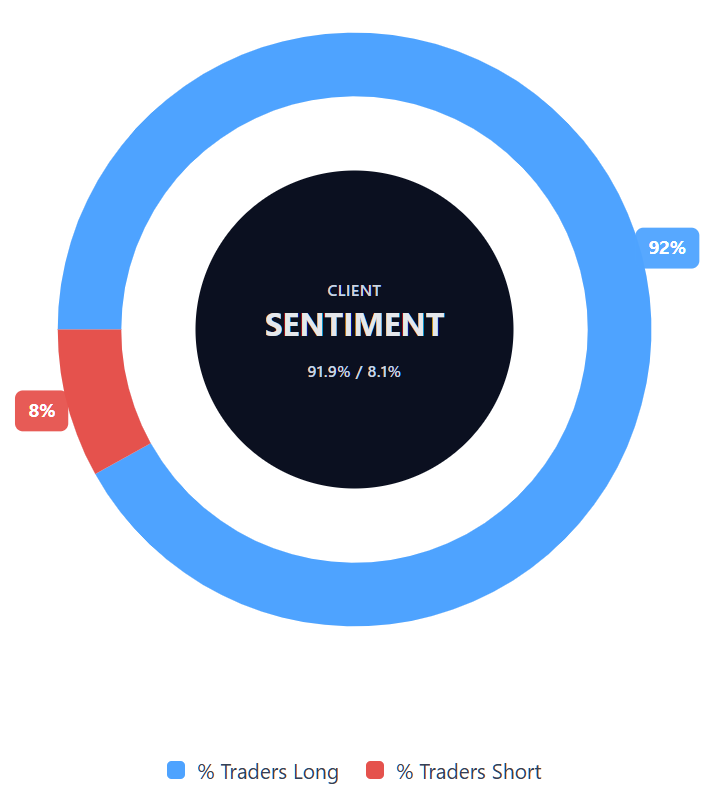
As of 2 April 2026, Capital.com client positioning in AMD CFDs shows 91.9% buyers and 8.1% sellers, putting buyers ahead by 83.8 percentage points and placing sentiment firmly in heavy-buy, one-sided-long territory. This snapshot reflects open positions on Capital.com at the time of writing and can change rapidly as market conditions evolve.
Summary – AMD 2026
- AMD trades at $203.95 as of 1:22pm UTC on 2 April 2026, down approximately 8.9% year to date but up around 110% year on year.
- TradingView technical indicators show AMD trading below its 50- and 100-day SMAs, with RSI neutral at 53.62 and a weak ADX of 11.62, suggesting no established directional trend.
- Key price drivers include AMD's AI GPU and EPYC server CPU pipeline, ongoing US export restrictions on advanced chips to China, and broader Nasdaq sentiment, which remains under pressure on 2 April 2026.
Past performance is not a reliable indicator of future results.
FAQ
Who owns the most AMD stock?
The largest AMD shareholders are typically institutional investors such as asset managers, index fund providers and other investment firms, rather than individual investors. Ownership levels can change over time as funds rebalance portfolios, institutions adjust exposure, or company insiders buy or sell shares. In practice, this means AMD’s shareholder base is broad and can shift with market conditions, benchmark changes and sentiment towards the semiconductor sector.
What is the 5 year AMD share price forecast?
There is no single verified five-year AMD stock forecast. Longer-term projections tend to vary widely because they depend on factors that are difficult to measure with precision, including AI-related demand, competition in GPUs and server CPUs, macroeconomic conditions, valuation levels and export restrictions. For that reason, long-range forecasts should be treated as one possible scenario rather than a reliable outcome, especially in a fast-moving sector such as semiconductors.
Is AMD a good stock to buy?
Whether AMD is a good stock to buy depends on your objectives, risk tolerance, time horizon and view of the semiconductor sector. Some market participants focus on its exposure to AI infrastructure, data-centre growth and server demand, while others focus on valuation risk, competition and regulatory headwinds. That balance means the stock may appeal to some investors and not others. This is why it is important to do your own research rather than rely on a single view.
Could AMD stock go up or down?
AMD stock could move in either direction, depending on earnings results, guidance, AI-related revenue trends, broader Nasdaq sentiment and developments in US export controls on advanced chips. Technical indicators in the article point to a market without a strong established trend, which can leave price action sensitive to new information. In practice, that means both upside and downside scenarios remain possible, particularly around major updates such as quarterly results or forward guidance.
Should I invest in AMD stock?
Only you can decide whether AMD fits your portfolio, and that decision should reflect your financial goals, risk tolerance and investment horizon. AMD offers exposure to themes such as AI and data-centre growth, but it also carries risks linked to valuation, competition and sector volatility. If you are considering an investment, it may help to compare the potential opportunities and risks carefully and review whether the position would suit your broader strategy.
Can I trade AMD CFDs on Capital.com?
Yes, you can trade AMD CFDs on Capital.com. Trading share CFDs lets you speculate on price movements without owning the underlying asset and to take long or short positions. However, contracts for difference (CFDs) are traded on margin, and leverage amplifies both profits and losses. You should ensure you understand how CFD trading works, assess your risk tolerance, and recognise that losses can occur quickly.