
Pfizer stock forecast: Third-party price targets
Pfizer is a large US-listed pharmaceutical company, with its share price influenced by earnings guidance, product sales trends, pipeline progress and broader conditions across the global healthcare sector. Explore PFE’s recent price action, third-party price targets and technical analysis.
Pfizer, Inc (PFE) is trading around $25.52 as of 11:07am on 15 January 2026 (UTC), within an intraday range of $25.05–$25.64 and broadly in line with levels seen earlier in the week. Past performance is not a reliable indicator of future results.
Price action comes amid continued focus on Pfizer’s guidance update, after the company projected 2026 adjusted earnings per share of between $2.80 and $3.00 and outlined weaker COVID-related revenue contributions (Reuters, 16 December 2025), alongside previously reported third-quarter 2025 revenue of about $16.7bn and an operational decline linked to lower Paxlovid and Comirnaty sales (BioSpace, 5 November 2025). Broader sector and index moves also frame trading conditions, with recent sessions seeing mixed performance across US equities and healthcare benchmarks as investors reassess large-cap pharma earnings trajectories and valuation metrics (MarketScreener, 13 January 2026).
Pfizer stock forecast 2026–2030: Third-party price targets
As of 15 January 2026, third-party Pfizer stock predictions are clustered in the high-$20s, with recent updates reflecting reassessments of earnings power following the company’s revised guidance and the ongoing reset in COVID-related revenues..
Stock Analysis (consensus snapshot)
Stock Analysis reports a 12-month PFE stock forecast of about $27.18, implying modest upside relative to recent trading levels and characterising the stock’s analyst stance as broadly 'Hold.' The service notes that this consolidated target sits against a 52-week trading range of roughly $20.92–$27.69, as markets balance earnings guidance and lower volatility characteristics against the defensive profile of large-cap pharmaceutical stocks (Stock Analysis, 8 January 2026).
MarketBeat (street average and dispersion)
A MarketBeat update cites a consensus PFE stock forecast of approximately $27.88, alongside an aggregated analyst recommendation in the 'Hold' range. The piece highlights a mix of views, with some brokers emphasising oncology and obesity-drug optionality, while others point to ongoing COVID revenue erosion and loss-of-exclusivity pressures as factors supporting more measured targets (MarketBeat, 14 January 2026).
BMO Capital Markets (broker target)
An analyst note relayed by Investing.com states that BMO Capital Markets reiterated an Outperform rating and a $30.00 price target on Pfizer. BMO cites Pfizer’s conservative 2026 revenue and earnings guidance, highlighting pressure from a forecast decline in COVID products partly offset by cost-saving initiatives and contributions from newer pipeline assets (Investing.com, 17 December 2025).
UBS (individual broker target)
A widely cited broker summary notes that UBS set a $25.00 price target for Pfizer, with a natural rating. Commentary around the move underscores uncertainty over the pace of earnings recovery as COVID revenues fade, even as management continues to pursue portfolio reshaping and operational efficiency measures (Investing.com, 7 January 2026).
Predictions and third-party forecasts are inherently uncertain, as they cannot fully account for unexpected market developments. Past performance is not a reliable indicator of future results.
PFE stock price: Technical overview
The PFE stock price is around $25.52 as of 11:07am on 15 January 2026 (UTC), holding close to a tight cluster of moving averages, with the 20-, 50-, 100- and 200-day SMAs near 25.2, 25.3, 25.0 and 24.5 respectively. The 14-day RSI around 55.4 sits in the upper-neutral band, while an ADX near 17 signals a relatively weak underlying trend rather than a strong directional move.
On the topside, the nearest classic resistance is the R1 pivot at about 26.1, and a sustained daily close above that level would bring the R2 band near 27.3 into view as the next upside reference. On pullbacks, the classic pivot around 25.5 aligns with the current price zone as initial support, while the 200-day SMA near 24.5 forms a deeper shelf. A sustained move below this longer-term average would expose the S1 region around 24.3 (TradingView, 15 January 2026).
This technical analysis is for informational purposes only and does not constitute financial advice or a recommendation to buy or sell any instrument.
Pfizer share price history (2024–2026)
PFE’s stock price has traded in a relatively tight band over the past two years, moving from around $26.59 at the start of 2025 to $25.52 on 15 January 2026. Over 2024, the stock mostly held in the high-$20s to low-$30s, with several moves above $30 in mid-2024 before easing back into the upper-$20s by year-end.
Through 2025, PFE gradually slipped from the $26–$27 area in January towards lows just under $24 in early August, before recovering into the mid-$20s. The price then rose from roughly $23.80 at the end of September to finish the year close to $25.00. As of 15 January 2026, Pfizer trades modestly below its mid-2024 highs but above the troughs seen in mid-2025, consistent with a consolidation phase rather than a sustained trend over the full two-year window.

Past performance is not a reliable indicator of future results. Share prices are indicative and may differ from live market prices.
Pfizer (PFE): Capital.com analyst view
Pfizer’s share price has spent much of the past two years oscillating between the mid-$20s and low-$30s, with 2025 marked by a drift from the $26–$27 area early in the year towards sub-$24 levels in mid-summer before recovering into the mid-$20s into January 2026. This pattern points to a period of consolidation rather than a clear directional trend, as shorter-term moves have played out within a broad range shaped by company-specific developments and changing expectations for post-pandemic earnings.
Several factors could influence the stock from here, including Pfizer’s revenue mix following lower COVID-related sales, ongoing cost-reduction efforts, and the performance of its late-stage pipeline and recent acquisitions. More effective-than-expected execution in these areas could support the shares, while setbacks in product launches, pricing, or integration may weigh on sentiment. Broader market conditions also matter: a supportive backdrop for defensive healthcare names or lower bond yields can be constructive for large-cap pharma, while rotation towards higher-growth sectors or further earnings downgrades across the industry could act as headwinds for valuation.
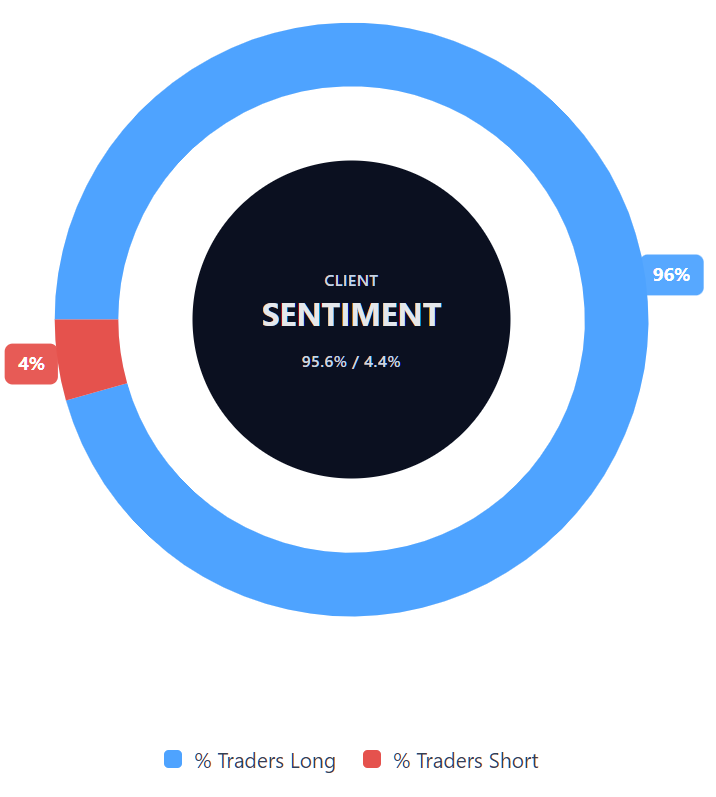
Capital.com’s client sentiment for Pfizer CFDs
As of 15 January 2026, Capital.com client positioning in Pfizer CFDs shows 95.6% buyers versus 4.4% sellers, a heavy-buy stance that puts buyers ahead by roughly 91.3 percentage points. This one-sided tilt towards long positions highlights concentrated positioning rather than a balanced distribution of views. This snapshot reflects open positions on Capital.com and can change.
Summary – Pfizer stock price
- Pfizer’s share price moved within roughly the low-$20s to high-$20s range during 2025, after starting the year just above $26.
- The stock dipped below $24 in mid-2025 before recovering to close near $25.00 by the end of December.
- Price action reflected shifting expectations around Pfizer’s post-pandemic revenue mix, cost-cutting measures and pipeline execution.
- Technical signals into early 2026 show the price holding near clustered moving averages around the mid-$25 area, which is consistent with a consolidating market structure.
Past performance is not a reliable indicator of future results.
FAQ
Who owns the most Pfizer stock?
Pfizer’s largest shareholders are institutional investors, including major asset managers and pension funds. Firms such as Vanguard Group, BlackRock and State Street typically rank among the top holders, reflecting Pfizer’s long-standing inclusion in global equity indices and healthcare-focused portfolios. Ownership levels can change over time as funds rebalance or adjust exposure, while individual retail investors generally account for a smaller share of outstanding stock than institutions.
What is the 5-year Pfizer share price forecast?
There is no single agreed five-year share price forecast for Pfizer, as longer-term projections vary widely and depend on assumptions around earnings, pipeline delivery, acquisitions and broader market conditions. Most publicly available forecasts focus on shorter horizons, such as 12 months to two years. Longer-term views are often framed around scenarios rather than specific price targets, reflecting the uncertainty involved over extended timeframes.
Is Pfizer a good stock to buy?
Whether Pfizer is considered a 'good' stock depends on an individual’s objectives, time horizon and risk tolerance. Analysts typically assess factors such as revenue diversification following COVID-related products, cost controls, and the strength of the drug pipeline. However, analyst opinions differ, and a 'buy' or 'hold' rating reflects a third-party view at a given point in time rather than a prediction of future performance. This information is not investment advice.
Could Pfizer stock go up or down?
Pfizer’s share price can move both up and down, influenced by company-specific developments and wider market conditions. Key drivers may include earnings updates, guidance changes, clinical trial results, regulatory decisions and shifts in healthcare sector sentiment. Broader factors such as interest rates, equity market trends and overall risk appetite can also affect price movements. As with any listed equity, price volatility means outcomes are uncertain.
Should I invest in Pfizer stock?
Deciding whether to invest in Pfizer stock is a personal decision that depends on individual financial circumstances, goals and risk appetite. While analysts publish forecasts and assessments, these are third-party opinions and may change over time. Shares can fall as well as rise, and losses are possible. This content is provided for informational purposes only and does not constitute financial advice or a recommendation.
Can I trade Pfizer CFDs on Capital.com?
Yes, you can trade Pfizer CFDs on Capital.com. Trading share CFDs lets you speculate on price movements without owning the underlying asset and to take long or short positions. However, contracts for difference (CFDs) are traded on margin, and leverage amplifies both profits and losses. You should ensure you understand how CFD trading works, assess your risk tolerance, and recognise that losses can occur quickly.