
EUR/TRY forecast: Third-party price targets
Euro / Turkish lira (EUR/TRY) was quoted at 49.68 as of 11:58 on 4 December 2025 (UTC) on Capital.com’s feed, trading near the upper end of its intraday range between 49.21 and 49.70. Past performance is not a reliable indicator of future results.
As of 4 December 2025, EUR/TRY moves against a backdrop of gradual disinflation in Türkiye. Official data shows annual consumer price inflation easing to around 31–32% in November, its lowest level in several years (RTÉ, 3 December 2025). Meanwhile, the Central Bank of the Republic of Türkiye cut its policy rate to 39.5% in October and has signalled further adjustments as it works towards its medium-term inflation goals (Trading Economics, 4 December 2025).
Past performance is not a reliable indicator of future results.
EUR/TRY forecast 2025–2030: Analyst price target view
Publicly available EUR/TRY predictions released between October and December 2025 show a wide range of possible paths into late 2025 and 2026. These outlooks often differ because they rely on varying assumptions about Turkish inflation, domestic policy and the euro’s performance more broadly.
Traders Union (long-term projection)
Traders Union projects EUR/TRY near 50.4 by January 2026, with monthly averages rising to 57.4 by June. Longer-term projections extend towards 63.7 by the end of 2029. The report highlights the pair’s volatility and the uncertainty surrounding Türkiye’s monetary policy and inflation trajectory (Traders Union, 4 December 2025).
PandaForecast (quantitative model range)
PandaForecast lists a weighted-average target of roughly 50 for end-2025, using historical data and statistical modelling. Its model incorporates assumptions about ongoing macro uncertainty in both Türkiye and the euro area, alongside anticipated volatility (PandaForecast, 4 December 2025).
Longforecast.com (monthly path)
Longforecast.com expects EUR/TRY to end 2025 at around 50.45 and projects a 49.78–52.17 range for January 2026., while its Euro to turkish lira forecast 2030 places the pair near 95.8 at the start of January. These figures come from a mechanical model that uses historical volatility and trend patterns, rather than discretionary market views (Long Forecast, 4 December 2025).
Wallet Investor (algorithmic forecast)
Wallet Investor’s long-term model indicates an upward profile from spot levels near 49.5 in December 2025, with targets gradually increasing into 2026 and beyond (as of 12 October 2025). The service notes that its projections rely on pattern-recognition algorithms and assumptions that prevailing macro trends remain broadly intact (Wallet Investor, 4 December 2025).
Forecasts are inherently uncertain, and past performance isn’t a reliable indicator of future results.
Euro–Turkish lira: Technical overview
EUR/TRY last traded at 49.68 as of 11:58 (UTC) on 4 December 2025, remaining above a rising cluster of moving averages. The 20/50/100/200-day SMAs sit around 49.11, 48.84, 48.32 and 45.92, respectively. Short-term momentum stays constructive, with a 20-over-50 alignment in place. The 10-day SMA at 49.25, the Hull MA at 49.56 and the 20-day VWMA at 49.08 all track close to current prices.
The 14-day RSI near 72.8 indicates stretched conditions, while the ADX around 26 reflects an established trend. Indicators such as MACD and 10-day Momentum skew to the buy side, illustrating the strength of the recent move rather than signalling any specific future direction.
On the topside, Classic R1 sits around 49.66, with R2 near 50.05 if daily closes hold above this area. On pullbacks, initial support aligns with the Classic Pivot around 48.97, while the 100-day SMA near 48.32 is the next notable technical level. A sustained break below this zone could open the way towards S1 around 48.58. The broader structure remains supported by the 200-day SMA at 45.92, which sits well below spot (TradingView, 4 December 2025).
This technical analysis is for information only and isn’t financial advice or a recommendation.
EUR/TRY history
EUR/TRY has climbed steadily since late 2023. It closed at roughly 31.38 on 8 December 2023, traded around 32–33 into early 2024 and moved into the mid-30s by mid-year, closing near 35.40 at the end of June 2024.
The pair continued its advance through late 2024 and early 2025. By 18 March 2025, it traded around 40.31, pushing into the mid-40s by early June. EUR/TRY closed at 45.00 on 4 June 2025 and later moved into the 48–49 area through August–October. It reached 49.70 on 4 December 2025, marking a substantial two-year appreciation of the euro against the lira.

Past performance is not a reliable indicator of future results. Share prices are indicative and may differ from live market prices.
Capital.com analyst view
EUR/TRY has risen from the low-30s at the end of 2023 to just under 50 in early December 2025, indicating a prolonged period of lira weakness relative to the euro. This trend may appeal to traders who follow longer-running price moves, but it also brings the risk of sharp reversals if market sentiment shifts or policy expectations change.
Key drivers include Türkiye’s inflation outlook, domestic interest-rate policy and broader risk appetite. These factors can either support the pair or weigh on it, depending on how investors assess the balance of risks. Euro-area data surprises, moves in global yields and changes in positioning can also influence volatility and contribute to periods of trend extension or consolidation.
Capital.com’s client sentiment for EUR/TRY CFDs
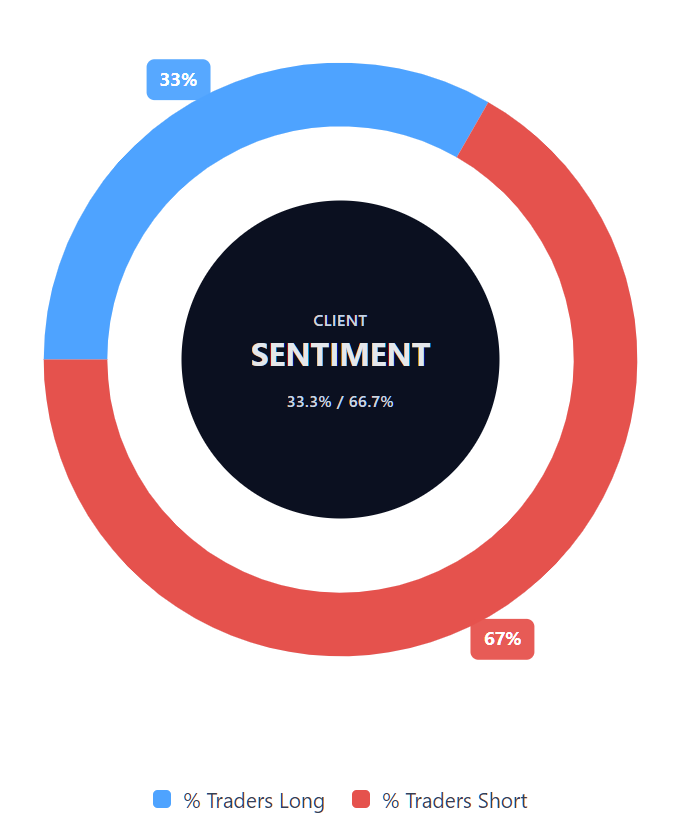
As of 4 December 2025, client sentiment on Capital.com shows 33.3% buyers and 66.7% sellers in EUR/TRY CFDs. This indicates a majority-sell stance, though not at extreme levels. Sentiment reflects open positions at a specific point in time and can shift quickly as traders respond to news, data releases and market volatility.
Summary – EUR/TRY 2025
- EUR/TRY traded around 49.68 on 4 December 2025, close to its intraday high and near its highest levels of the year.
- The pair has risen from the low-30s in late 2023 to the high-40s in 2025, showing a sustained period of euro appreciation against the lira.
- Technical signals in late 2025 place EUR/TRY above a rising 20/50/100/200-day moving-average cluster, while momentum indicators show stretched conditions.
- Third-party forecasts for late 2025 generally fall in the high-40s to low-50s range, though assumptions and methodologies vary widely.
- Capital.com’s client sentiment is majority-sell at around 66.7%, but remains fluid as markets move.
- As with any leveraged forex CFD, EUR/TRY trading carries both potential opportunities and significant risks, particularly around volatility, policy changes and global risk appetite. Past performance isn’t a reliable guide to future results.
Past performance is not a reliable indicator of future results.
FAQ
What is the EUR TRY forecast?
Publicly available EUR/TRY forecasts released between October and December 2025 present a wide range of possible outcomes. This variation reflects different assumptions about Türkiye’s inflation path, domestic policy decisions and broader macroeconomic conditions. Many projections fall in the high-40s to low-50s area for late 2025, but there’s no single agreed view, and each provider uses its own methodology. As with any forecast, these estimates can’t factor in every future development, and past performance isn’t a reliable indicator of future results.
Why has EUR/TRY been dropping or rising?
Movements in EUR/TRY tend to reflect changing expectations around Türkiye’s inflation outlook, policy rates and macroeconomic stability, alongside shifts in euro-area data and global risk appetite. Recent price action has been shaped by signs of disinflation, adjustments to interest-rate policy and market positioning. Broader influences – such as geopolitical events, global yield changes and liquidity conditions – can also drive volatility. As these factors evolve, the pair may rise or fall without implying a predictable or sustained trend.
Could EUR/TRY go up or down?
EUR/TRY can move in either direction depending on how markets respond to new information. Inflation data, policy decisions, economic releases from the euro area and global market sentiment can all influence the pair. Forecasts and technical indicators capture conditions at a particular point in time and don’t guarantee future outcomes. Unexpected events may shift sentiment quickly, contributing to periods of both appreciation and depreciation.
What should traders consider when trading EUR/TRY CFDs on Capital.com?
Trading EUR/TRY forex CFDs lets you speculate on rising or falling prices, without having to own the underlying currencies. Volatility, liquidity, funding costs and market conditions can all affect trade performance. It’s important to understand how CFDs work, consider using risk-management tools such as stop-losses, and be aware that past performance isn’t a reliable guide to future results. Contracts for difference (CFDs) are traded on margin – leverage amplifies both your profits and your losses.*
*Standard stop-loss orders are not guaranteed. Guaranteed stop-loss orders incur a fee if activated.