
Apple stock split: when could AAPL shares split again?
Apple has a long record of stock splits, reflecting its growth and market evolution. This guide explains how stock splits work, reviews Apple’s previous splits, and summarises what’s currently known about any possible future action.
As of 10 November 2025, Apple (AAPL) hasn’t announced any new stock split, despite continued speculation among analysts about the possibility of one in 2025 or 2026. Could the iPhone maker follow other tech firms with another split? Here’s what’s known so far.
Apple’s performance
As of 10 November 2025, Apple’s performance has been supported by steady earnings and strong brand equity. In 2025, AAPL reached an intraday high of $285.05 on 30 October, with a closing price of $272.75 on 10 November. Earlier in the year, the shares dipped to an intraday low of $168.15 on 9 April before rebounding in the autumn.
Despite this recovery, market observers remain focused on whether Apple could introduce another split if prices stay near record levels.

Past performance is not a reliable indicator of future results. Share prices are indicative and may differ from live market prices.
What is a stock split?
A stock split increases a company’s number of shares in circulation, reducing the price per share while maintaining the same total market value. Current shareholders receive additional shares in proportion to their existing holdings, so their overall ownership doesn’t change.
For example, in a 4-for-1 split, an investor holding one share at $100 would hold four shares worth $25 each after the split. The company’s total value remains unchanged.
Stock splits are often introduced to make shares appear more affordable and improve liquidity. However, with the growth of fractional share trading and derivative instruments such as contracts for difference (CFDs), the practical need for splits has reduced.
Past performance is not a reliable indicator of future results.
Apple stock split history
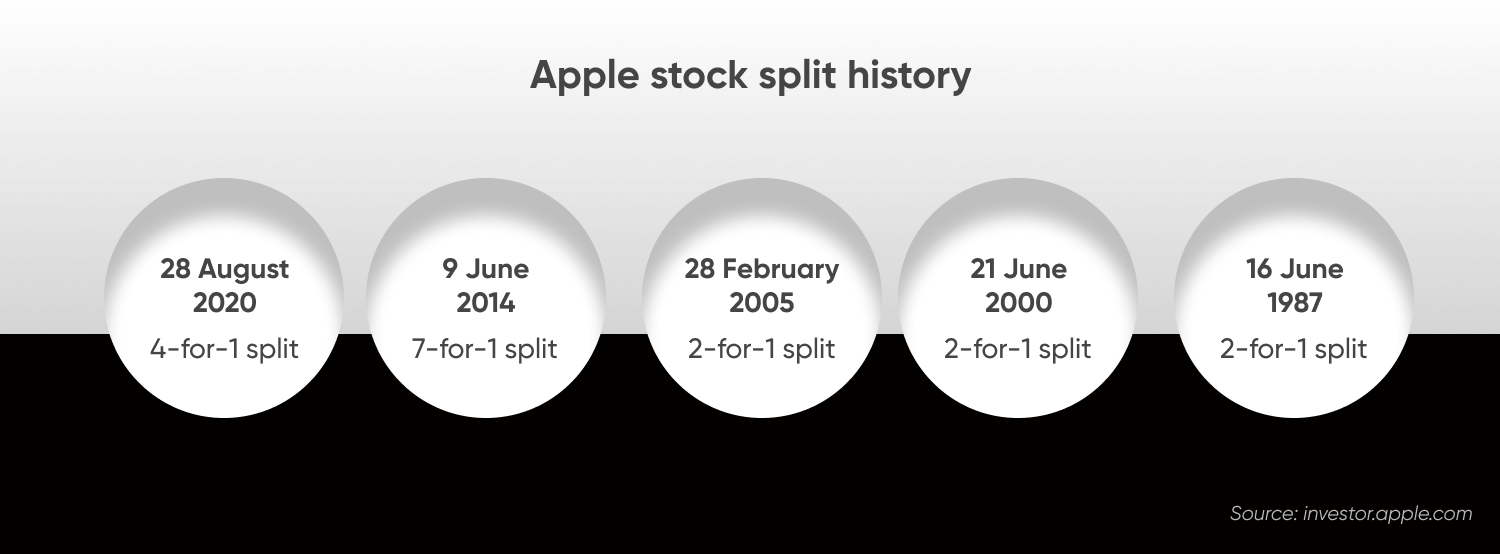
Apple has split its stock five times since going public, most recently on 31 August 2020 (4-for-1). Since then, AAPL shares have risen by around 47% to recent highs, reflecting long-term brand strength rather than the split itself. However, past performance is not a reliable indicator of future results.
Previous Apple stock split dates include:
| Date | Split ratio |
|---|---|
| 15 June 1987 | 2-for-1 |
| 21 June 2000 | 2-for-1 |
| 28 February 2005 | 2-for-1 |
| 9 June 2014 | 7-for-1 |
| 31 August 2020 | 4-for-1 |
Will Apple split its stock again?
Apple’s management hasn’t confirmed any plans for another stock split – no official schedule has been released. Apple’s financial decisions tend to be shaped by long-term strategy and investor sentiment, rather than other firms’ actions. The company often aligns major structural changes with key events such as new software or hardware releases.
What effect does a stock split have?
A stock split doesn’t alter a company’s fundamentals, financial performance, or valuation. It doesn’t raise new capital or guarantee future growth. Historically, some stocks have seen short-term increases in trading activity after a split due to heightened retail interest, but these effects are typically short-lived.
In Apple’s case, post-split performance has varied. A split is largely a symbolic move, often reflecting a company’s strong performance rather than driving it.
Past performance is not a reliable indicator of future results.
Forward-looking commentary
As of 10 November 2025, there is no confirmed timeline for another Apple stock split. Market discussion continues around whether Apple might use a split to signal confidence during a period of heightened volatility across the tech sector.
Some analysts view potential future splits as a strategic communication tool, helping Apple maintain visibility and reinforce its premium market position, though no decision has been made.
Create an account Open a demo account