
Volkswagen forecast 2025-2030: Third-party price target
Volkswagen’s supervisory board approved Future Plan 2030 on 3 September, including further job cuts and measures that could cost about €16bn. Explore third-party VOW price targets and technical analysis. Past performance is not a reliable indicator of future results.
Volkswagen AG (VOW) traded at €80.03 at 1:54pm UTC on 16 September 2026, within the session’s €78.47–€81.51 range. Past performance is not a reliable indicator of future results.
The shares remained in focus after Volkswagen’s supervisory board approved its 'Future Plan 2030' on 3 September. The programme includes adjustments to about 50,000 positions worldwide, including management roles, based on existing plans, as the group cited excess capacity in Europe, competition from China and trade-policy pressures (Volkswagen, 3 September 2026). Reuters reported on 10 September that Volkswagen had estimated the cost of job cuts and potential plant closures at about €16 billion. Four German plants, in Emden, Zwickau, Hanover and Neckarsulm, were being assessed for alternative uses as their current vehicle production allocations end over the coming decade (Reuters, 10 September 2026).
Third-party Volkswagen outlook: Future Plan 2030
As of 16 September 2026, third-party Volkswagen stock predictions vary widely, from €80 to €120.
Goldman Sachs (Neutral)
Goldman Sachs maintains a Neutral rating, with analyst Christian Frenes lowering the price target to €88 from €89 on 25 August 2026 (MarketScreener, 25 August 2026).
UBS (Neutral)
UBS maintains a Neutral rating and an €80 price target, unchanged after the restructuring agreement on 4 September 2026 (MarketScreener, 4 September 2026).
Oddo BHF (Neutral)
Oddo BHF raised its price target to €90 from €80 while maintaining a Neutral rating following approval of the transformation plan on 7 September 2026 (MarketScreener, 7 September 2026).
Bernstein (Market-Perform)
Bernstein maintains a Market-Perform rating and a €100 price target following the turnaround agreement on 7 September 2026 (MarketScreener, 7 September 2026).
Jefferies (Buy)
Jefferies reiterates a Buy rating and a €120 price target following an industry conference on 10 September 2026 (MarketScreener, 10 September 2026).
Predictions and third-party forecasts are inherently uncertain, as they cannot fully account for unexpected market developments. Past performance is not a reliable indicator of future results.
VOW stock price: technical overview
The VOW stock price trades at €80.03, above its 20- and 50-day simple moving averages (SMAs) at about €78 and €76. The 100-day SMA sits near €81, while the 200-day SMA and exponential moving average (EMA) are near €90 and €86, respectively.
The 14-day relative strength index (RSI) is 55, while stochastic %K stands at 71. The average directional index (ADX) at 18 points to limited trend strength. MACD remains positive at 1.38, while the awesome oscillator is at 3.9.
The classic R1 pivot sits at €80.70, with the 100-day SMA at €81.37 and R2 at €82.85 above it. Below the current price, the classic pivot stands at €76.70, followed by the 50-day SMA at €76.45, S1 at €74.55 and S2 near €70.50 (TradingView, 16 September 2026).
Technical indicators can give mixed signals and do not predict future price movements. This analysis is for informational purposes only and does not constitute financial advice or a recommendation to buy or sell any instrument.

Past performance is not a reliable indicator of future results. Share prices are indicative and may differ from live market prices.
Volkswagen (VOW): Capital.com analyst view
Volkswagen’s outlook centres on whether its restructuring plan can lower costs without putting too much pressure on earnings, cash flow or production.
The Future Plan 2030 includes about 50,000 further workforce reductions alongside 50,000 already being implemented, as well as a review of four German manufacturing sites. Lower structural costs and firmer vehicle pricing could support margins and, in turn, the share price. Higher restructuring costs, weaker execution or production disruption could have the opposite effect.
Demand in China and Europe, electric-vehicle competition, foreign-exchange movements and trade policy could shape the picture further. Stronger demand or higher delivery volumes could support revenue, while softer sales, discounting, tariffs or higher supply-chain costs could weigh on it.
Capital.com’s client sentiment for Volkswagen CFDs
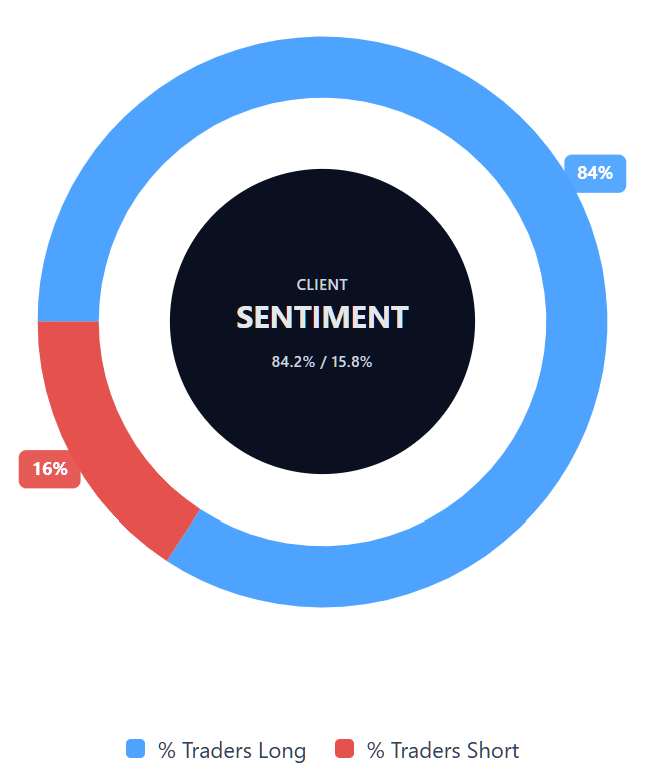
As of 16 September 2026, Capital.com client positioning in Volkswagen CFDs shows 84.2% buyers versus 15.8% sellers, a difference of 68.4 percentage points.
This snapshot reflects open positions on Capital.com at the time recorded. Positioning can change and does not indicate how Volkswagen’s share price will move.
Summary – Volkswagen 2026
- As of 1:54pm UTC on 16 September 2026, Volkswagen (VOW) traded at €80.03, within its intraday range of €78.47–€81.51.
- According to TradingView data, technical readings placed VOW above its 20- and 50-day simple moving averages, while RSI at 54.79 indicated neutral momentum and ADX at 18.24 signalled a limited directional trend.
- Price drivers include European and Chinese vehicle demand, pricing, electric-vehicle competition, tariffs, foreign-exchange movements and the balance between restructuring savings, charges and cash-flow effects.
- Volkswagen’s 3 September Future Plan 2030 approval included about 50,000 workforce adjustments, while Reuters reported roughly €16 billion of estimated restructuring and potential plant-closure costs.
Past performance is not a reliable indicator of future results.
FAQ
Who owns the most Volkswagen stock?
Porsche Automobil Holding SE is Volkswagen’s largest shareholder. As of 31 December 2025, it held 31.9% of Volkswagen AG’s subscribed capital and 53.3% of the voting rights attached to ordinary shares. The State of Lower Saxony held 20% of ordinary-share voting rights, while Qatar Holding held 17%. Volkswagen’s ownership structure matters because ordinary and preference shares carry different voting rights, so ownership and voting control are not the same thing.
What is the five-year Volkswagen share price forecast?
The article does not provide a five-year VOW stock forecast, and long-range targets carry considerable uncertainty. The analyst estimates covered here focus on a 12-month horizon, ranging from €80 to €120, with an average near €105 during the period reviewed. Over five years, Volkswagen’s share price could be shaped by restructuring progress, vehicle demand, pricing, electric-vehicle competition, tariffs, costs and wider economic conditions. Forecasts can change as these factors develop.
Is Volkswagen a good stock to buy?
Whether Volkswagen is a good stock to buy depends on an individual’s objectives, risk tolerance and view of the company, so this article does not make a buy or sell recommendation. Volkswagen’s restructuring could support margins if it lowers costs without disrupting production, while higher restructuring charges, weaker demand or competitive pressure could weigh on performance. Analyst targets also vary widely, from €80 to €120, showing that third-party views differ and may change over time.
Could Volkswagen stock go up or down?
Volkswagen shares could move in either direction as investors assess the group’s restructuring alongside conditions in the wider car market. Lower costs, firmer vehicle pricing or stronger demand could support earnings and the share price. On the other hand, higher restructuring costs, weaker sales, discounting, tariffs, adverse currency moves or stronger competition could put pressure on both. Technical indicators may provide useful reference points, but they cannot reliably predict future price movements.
Should I invest in Volkswagen stock?
This article does not say whether you should invest in Volkswagen. That decision depends on factors such as your financial goals, time horizon and tolerance for risk. Volkswagen’s planned cost reductions may improve profitability if implementation goes to plan, but restructuring costs, demand weakness, tariffs and competitive pressure could affect results in the opposite direction. Analyst forecasts and technical indicators can add context, but neither provides certainty about future returns or whether the shares suit an individual investor.
Can I trade Volkswagen CFDs on Capital.com?
Yes, you can trade Volkswagen CFDs on Capital.com. Trading share CFDs lets you speculate on price movements without owning the underlying asset and to take long or short positions. However, contracts for difference (CFDs) are traded on margin, and leverage amplifies both profits and losses. You should ensure you understand how CFD trading works, assess your risk tolerance, and recognise that losses can occur quickly.