
Taylor Wimpey share price: half-year earnings and margins
Taylor Wimpey is a UK housebuilder that reported higher revenue but lower underlying operating profit in its half-year results on 31 July 2026, alongside reduced guidance. Explore third-party TW. price targets and technical analysis. Past performance is not a reliable indicator of future results.
Taylor Wimpey plc. (TW.) is trading near £0.84 in early London trading on Monday, 10 August 2026 (9.18am UTC), within an intraday range of £0.83–£0.85. Past performance is not a reliable indicator of future results.
Recent price movements follow the company's half-year results announcement on 31 July 2026, when the company reported lower profit and margins (Investing.com, 31 July 2026).
Those results showed group revenue rising 1.7% to £1.68 billion, while underlying operating profit fell to £129.7 million from £161 million a year earlier, and gross margin declined 200 basis points to 15.1% amid build cost inflation and softer underlying pricing (Taylor Wimpey, 31 July 2026). Taylor Wimpey also reduced its shareholder distribution policy from 7.5% to 4% of net asset value and lowered its full-year UK guidance to a range of 10,600–10,800 homes, citing affordability constraints across the wider UK housing market (Reuters, 31 July 2026). A share buyback programme covering up to 10% of issued share capital, sanctioned at the company's Annual General Meeting, commenced on 31 July 2026 (MarketScreener, 4 August 2026).
Third-party TW. outlook: results and guidance
As of 10 August 2026, third-party Taylor Wimpey share price predictions show a broad range of potential 12-month values for Taylor Wimpey (TW.) These are forward-looking estimates, not observations of its past share-price performance.
Deutsche Bank (individual broker target)
Deutsche Bank set an 82p (£0.82) target and retained a hold rating, as captured on 4 August 2026. This represents the broker's estimate of a potential 12-month share price (MarketBeat, 4 August 2026).
Investing.com (analyst consensus)
Investing.com reports a 12-month average target of 87.40p (£0.874) as of 7 August 2026, with estimates ranging from 60p (£0.60) to 130p (£1.30) across 20 analysts. The figure aggregates analysts' estimates over the stated 12-month period (Investing.com, 7 August 2026).
MarketScreener (analyst consensus)
MarketScreener records an average target of 89p (£0.89) as of 1 August 2026, with a 60p (£0.60) low and a 130p (£1.30). These figures form the provider's consolidated forward target range (MarketScreener, 1 August 2026).
MarketBeat (analyst consensus)
MarketBeat places the average 12-month target at 99.40p (£0.994) as of 9 August 2026, based on 10 analysts, with targets ranging from 70p (£0.70) to 120p (£1.20) and a hold consensus rating. This provides another forward-looking measure of analysts' expectations (MarketBeat, 9 August 2026).
TradingView (analyst consensus)
TradingView shows a one-year target of 84.94p (£0.8494) as of 7 August 2026, while the 18 analysts in its dataset provide estimates ranging from 60p (£0.60) to 110p (£1.10). The figure reflects TradingView's aggregated analyst forecast data (TradingView, 7 August 2026).
Predictions and third-party forecasts are inherently uncertain, as they cannot fully account for unexpected market developments. Past performance is not a reliable indicator of future results.
Taylor Wimpey: latest earnings
Taylor Wimpey's most recent financial disclosure is its half-year results for the six months to 28 June 2026, published on 31 July 2026 and confirmed on the company's investor relations page as of 10 August 2026 (Taylor Wimpey, 10 August 2026). Group revenue reached £1.68bn, up 1.7% from the prior-year period, while adjusted operating margin narrowed to 7.7% from 9.7%, which the company attributed to weaker pricing and build cost inflation (Reuters, 31 July 2026). Adjusted operating profit, including joint ventures, fell 19.4% to £129.7 million, while pre-tax profit improved to £116.8 million from a £92.1 million loss a year earlier, when results had been affected by a cladding-related provision (This Is Money, 31 July 2026).
Taylor Wimpey also cut its full-year 2026 UK home guidance to a range of 10,600–10,800 homes, down from a prior range of 10,600–11,000, describing the revised figure as the lower half of its earlier forecast (Investing.com, 31 July 2026). The company revised its shareholder distribution policy to 4% of net asset value, down from 7.5% previously, citing ongoing market and cost headwinds (Yahoo Finance, 31 July 2026). Its share buyback programme, covering up to £41.9 million and conducted under the general authority approved at the company's Annual General Meeting on 28 April 2026, began the same day (Investing.com, 31 July 2026).
TW. share price: technical overview
As of 9.18am UTC on 10 August 2026, the TW. share price trades near 83.7p (£0.837), according to TradingView data, above its 20-, 50- and 100-day simple moving averages (SMAs) at roughly 82.2p (£0.822), 80.1p (£0.801) and 81.7p (£0.817), respectively. The 20-day SMA also remains above the 50-day SMA.
The 200-day SMA sits higher at approximately 93.5p (£0.935), leaving the share price below its longer-term average even though it is above the shorter-term measures. The 100-day exponential moving average (EMA) is around 84.4p (£0.844), compared with the 100-day SMA near 81.7p (£0.817). Because EMAs place more weight on recent prices than SMAs, the two indicators can respond differently to recent market moves. Neither measure predicts future direction on its own.
TradingView data shows the 14-day relative strength index (RSI) around 55.7 and the 14-day average directional index (ADX) near 16.3. The RSI sits around the middle of its commonly used range, while the ADX reading suggests limited trend strength. These indicators are descriptive rather than predictive.
On the upside, TradingView's classic pivots place R2 near 88.7p (£0.887) and R3 near 97.8p (£0.978) as higher reference levels. On the downside, the classic pivot near 79.7p (£0.797) and the 100-day SMA near 81.7p (£0.817) provide lower technical reference point (TradingView, 10 August 2026).
This is technical analysis for informational purposes only and does not constitute financial advice or a recommendation to buy or sell any instrument.
Taylor Wimpey share price history (2024–2026)
TW.’s share price has trended lower overall over the past two years after reaching the highest level in the dataset, £1.696, on 20 September 2024. It has not returned to that level since.
The stock closed 2024 at £1.227, then continued to decline through 2025 to finish the year at £1.081, against a backdrop of pressure on UK housebuilder margins and persistent mortgage-affordability constraints.
The decline extended into 2026. TW. touched a two-year low of £0.743 on 11 June 2026 before partially recovering.
More recently, the shares fell following the company's half-year results on 31 July 2026, which included a cut to full-year guidance and a reduced shareholder distribution policy, and closed at £0.794 that day. By 10 August, the price had recovered to £0.838, leaving it around 21.8% lower year to date and roughly 16.9% below its level a year earlier.

Past performance is not a reliable indicator of future results. Share prices are indicative and may differ from live market prices.
Taylor Wimpey (TW.): Capital.com analyst view
Taylor Wimpey's price action over the past two years has occurred against a backdrop of affordability constraints, elevated mortgage rates and rising build costs, all of which can affect selling prices and margins for UK housebuilders.
The company's ongoing share buyback, land-bank flexibility, future guidance, shareholder distributions, UK mortgage affordability and government housing policy may all influence market expectations. Some of these factors could prove supportive under certain conditions, while others could place further pressure on performance. Their eventual effect will depend on how the underlying housing market and company-specific fundamentals develop.
No single factor determines future price direction, and third-party forecasts can change as new information becomes available.
Capital.com’s client sentiment for Taylor Wimpey CFDs
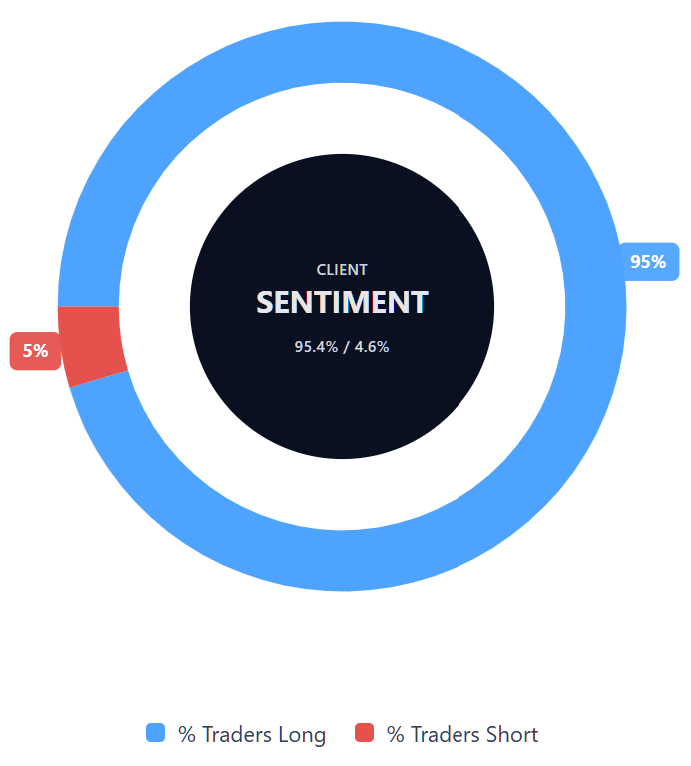
As of 10 August 2026, Capital.com client positioning in Taylor Wimpey CFDs stands at 95.4% buyers and 4.6% sellers, a difference of 90.8 percentage points. The figures represent a snapshot of open positions on Capital.com and may change over time.
Summary – Taylor Wimpey 2026
- As of 9.18am UTC on 10 August 2026, Taylor Wimpey (TW.) traded near £0.84, below 2024 highs above £1.60 but above its June 2026 low near £0.74.
- TradingView data places the price above its 20-, 50- and 100-day SMAs but below its 200-day SMA, while RSI(14) is near 55.7 and ADX remains below 20.
- Factors that may influence the share price include UK housing affordability, mortgage-rate sensitivity, build-cost inflation and margin pressure, alongside the company's ongoing share buyback programme.
- Recent developments include the 31 July 2026 half-year results, reduced guidance, a lowered shareholder distribution policy and a wide range of third-party analyst price targets.
Past performance is not a reliable indicator of future results.
FAQ
Who owns the most Taylor Wimpey shares?
The article does not identify Taylor Wimpey’s largest individual or institutional shareholder, as its focus is on recent price performance, earnings, analyst forecasts and technical indicators. Shareholding data can also change as investors adjust their positions. For the latest ownership information, readers should refer to Taylor Wimpey’s regulatory filings, annual reports or other official shareholder disclosures rather than relying on historical ownership figures.
What is the five-year Taylor Wimpey share price forecast?
The article does not provide a five-year Taylor Wimpey share price forecast. The third-party estimates cited focus mainly on a 12-month horizon, with analyst targets ranging from 60p–130p and central estimates between 82p–99.40p. Longer-term forecasts involve greater uncertainty because factors such as housing demand, mortgage affordability, build costs, company strategy and economic conditions can change substantially over several years.
Is Taylor Wimpey a good stock to buy?
Whether Taylor Wimpey is suitable to buy depends on an individual’s objectives, financial circumstances and risk tolerance, and the article does not make a recommendation. It highlights both company-specific and wider factors that may affect the shares, including mortgage affordability, build costs, guidance, shareholder distributions and the share buyback. Analyst price targets also vary considerably, showing that different providers reach different conclusions about Taylor Wimpey’s potential future valuation.
Could Taylor Wimpey shares go up or down?
Yes. Taylor Wimpey shares can move in either direction as new information changes market expectations. Factors discussed in the article include UK housing affordability, mortgage rates, build costs, margins, guidance, shareholder distributions and government housing policy. Technical indicators and analyst targets provide reference points rather than certain outcomes. The cited analyst forecasts span 60p–130p, illustrating the range of views around the company’s possible future share price.
Should I invest in Taylor Wimpey shares?
The article does not advise whether you should invest in Taylor Wimpey shares. Instead, it presents factual information that may help readers understand some of the factors surrounding the stock, including recent earnings, historical price movements, analyst forecasts and technical indicators. Any decision to invest would need to reflect your own objectives, circumstances and tolerance for risk. Past performance and third-party forecasts do not provide certainty about future returns.
Can I trade Taylor Wimpey CFDs on Capital.com?
Yes, you can trade Taylor Wimpey CFDs on Capital.com. Trading share CFDs lets you speculate on price movements without owning the underlying asset and to take long or short positions. However, contracts for difference (CFDs) are traded on margin, and leverage amplifies both profits and losses. You should ensure you understand how CFD trading works, assess your risk tolerance, and recognise that losses can occur quickly.