
UniCredit stock forecast: Third-party price targets
UniCredit is a major European banking group, with its shares reflecting developments in earnings, capital policy, interest rates and broader conditions across the Italian and European banking sector. Explore UCG’s recent price action, third-party price targets and technical analysis.
Price action comes amid renewed focus on UniCredit’s strategic stance on mergers and acquisitions, after the bank reiterated in a 15 January 2026 statement that ongoing M&A evaluations, including rumours around Banca Monte dei Paschi di Siena (MPS), are speculative and do not imply any specific transaction outcome (MarketScreener, 15 January 2026). The stock is also trading against a backdrop of Italian equity indices that recently showed modest gains, with the FTSE MIB rising around 0.4–0.5% in mid-January, alongside sector headlines highlighting reported talks and denials around a possible MPS stake involving UniCredit and Delfin, MPS’s main investor (Trading Economics, 16 January 2026).
UniCredit stock forecast 2026–2030: Third-party price targets
As of 16 January 2026, third-party UniCredit stock predictions show a range of 12-month views clustered in the mid-€60s to low-€80s per share, based on differing assumptions around European bank profitability, capital returns and interest-rate paths. The following summaries highlight selected third-party targets and their stated drivers; these represent indicative projections rather than guarantees, and methodologies vary between providers.
GROWTH Investing (consensus snapshot)
GROWTH Investing reports that its compiled analyst set points to an average UniCredit 12-month price target of about €72.60, with individual estimates ranging from roughly €57.00 at the low end to €85.70 at the high end, based on contributions from 18 analysts. The site notes this profile against a steady rise in aggregated targets over the past five quarters, as analysts factor in higher-than-previously-assumed earnings and capital distribution capacity (GROWTH Investing, 15 January 2026).
Simply Wall St (analyst update)
Simply Wall St flags a UniCredit price-target increase to around €65.13, describing this as a 7.2% uplift versus its prior marker following better-than-expected results and refreshed analyst models. The service explains that forecast revisions reflect upgraded profit expectations and capital-return assumptions, while also emphasising that consensus remains sensitive to changes in European macroeconomic and interest-rate conditions (Simply Wall St, 16 January 2026).
Morgan Stanley (broker research)
Morgan Stanley raised its UniCredit target price to €82.60 from €76.00 in a note, according to a brief carried by MarketScreener, maintaining a positive assessment of the stock’s risk-reward profile. The brokerage points to stronger earnings power and capital-return potential as supporting factors, while also acknowledging execution and macroeconomic risks across its European banking coverage (MarketScreener, 5 January 2026).
Equita SIM (broker research)
Equita SIM lifted its UCG stock forecast to €83.00 from €71.50, signalling a revised valuation assessment following recent performance and guidance. The broker frames this adjustment alongside expectations for shareholder distributions and resilient profitability, while noting that sector dynamics and regulatory decisions remain potential swing factors (MarketScreener, 14 January 2026).
Predictions and third-party forecasts are inherently uncertain, as they cannot fully account for unexpected market developments. Past performance is not a reliable indicator of future results.
UCG stock price: Technical overview
The UCG stock price is around €72.31 as of 10.48am UTC on 16 January 2026, holding above a rising cluster of moving averages, with the 20-, 50-, 100- and 200-day SMAs around €71, €67, €66 and €61 respectively. The 14-day RSI at about 70.5 sits in relatively stretched territory, while the ADX near 39 signals an established trend, consistent with a market that has developed sustained upside momentum rather than a range-bound profile.
On the topside, the first level in focus is the classic R1 pivot around €73.50, with R2 near €76 only becoming relevant following a sustained daily close above the initial resistance area. On pullbacks, the classic pivot near €68.63 marks initial support, with the 100-day SMA around €65.81 forming the next notable moving-average shelf. A clear break below that zone could expose the S1 area near €66.04 (TradingView, 16 January 2026).
This technical analysis is for informational purposes only and does not constitute financial advice or a recommendation to buy or sell any instrument.
UniCredit share price history (2024–2026)
UniCredit’s share price has climbed sharply over the past two years, rising from around €26.61 at the start of 2024 (18 January) to €41.99 by mid-January 2025, before extending gains to €72.47 by 16 January 2026. During 2024, the stock advanced in relatively steady phases, moving from the mid-€20s in January into the high-€30s by December, before accelerating through the €40s and €50s in early 2025 and continuing higher into the €60s and low-€70s towards late 2025 and early 2026.
Within this broader move, UniCredit experienced a series of pullbacks and consolidation phases that interrupted rather than reversed the prevailing trend. After dipping briefly towards €32.58 in mid-June 2024, the share price recovered into the high-€30s by late November, before breaking higher again in 2025. UCG share prices above €50 from late April and above €60 from mid-July followed, with the stock holding mostly in the mid- to high-€60s by December 2025, setting the stage for the early-2026 move into the low-€70s area.
Past performance is not a reliable indicator of future results. Share prices are indicative and may differ from live market prices.
UniCredit (UCG): Capital.com analyst view
The UCG stock price has delivered a strong two-year performance, rising from the mid-€20s in early 2024 to trade in the low-€70s by mid-January 2026. The advance has been punctuated by regular consolidations and pullbacks rather than a straight-line rally. This trajectory reflects a period of improving bank profitability and elevated investor risk appetite, while also implying that current levels may be more sensitive to changes in earnings delivery, capital-return expectations or the broader macro backdrop.
From a driver perspective, factors such as interest-rate expectations, European banking-sector sentiment and UniCredit’s own strategic actions can influence the share price in either direction. Higher-for-longer rates, for example, may support net interest income while also weighing on credit quality. Similarly, confidence around capital distributions can underpin valuations but may amplify downside if regulators or management adopt a more cautious stance. Sector news or deal speculation can support short-term interest, yet may also introduce execution and integration risks that the market reassesses over time.
Capital.com’s client sentiment for UniCredit CFDs
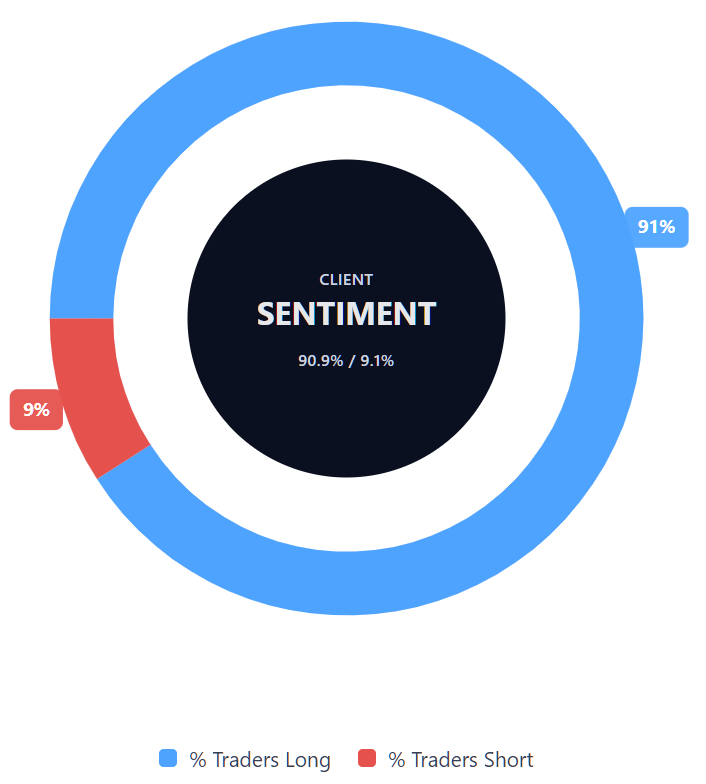
As of 16 January 2026, Capital.com client positioning in UniCredit CFDs shows 90.9% buyers versus 9.1% sellers, creating a pronounced skew towards long positions, with buyers ahead by roughly 81.8 percentage points. This places sentiment firmly in heavy-buy territory, indicating positioning is currently more one-sided than balanced. This snapshot reflects open positions on Capital.com and can change over time.
Summary – UniCredit stock price
- UniCredit’s share price advanced strongly through 2025, rising from around €38.33 in early January to approximately €71.09 by the final trading day of the year.
- The move included several consolidation phases, including a mid-year range in the mid-€50s before a push into the €60s and a period of trading mostly between €64 and €71 during the fourth quarter.
- Technical conditions into late 2025 showed the price trading above key long-term moving averages, with the 100-day and 200-day SMAs near €65.81 and €61.40 respectively, supporting the persistence of the broader upward trend rather than signalling short-term direction.
- By mid-January 2026, UniCredit was trading around €72.31, leaving it well above its early-2025 levels and extending the two-year advance from the mid-€20s seen at the start of 2024.
Past performance is not a reliable indicator of future results.
FAQ
Who owns the most UniCredit stock?
UniCredit has a widely distributed shareholder base, with ownership spread across institutional investors, asset managers and other financial institutions, alongside retail shareholders. No single shareholder holds a controlling majority. Stakes can change over time as funds rebalance portfolios or adjust exposure to the European banking sector. For the most up-to-date breakdown of major shareholders, traders typically refer to regulatory filings, company disclosures and third-party ownership databases rather than relying on static figures.
What is the five-year UniCredit share price forecast?
There is no single, definitive five-year UCG stock forecast. Longer-term projections vary widely between analysts and data providers, reflecting differing assumptions around interest rates, economic growth, regulation and bank profitability. Most published forecasts focus on shorter horizons, such as 12 months, and even these can change frequently. As a result, longer-term views are generally treated as illustrative scenarios rather than dependable predictions of future price levels.
Is UniCredit a good stock to buy?
Whether UniCredit is considered a good stock depends on an individual’s objectives, risk tolerance and market outlook. Some observers point to factors such as earnings performance and capital returns, while risks include economic slowdowns, regulatory changes and sector-specific pressures. Importantly, commentary and analyst targets reflect opinions rather than certainties. This information is provided for general market context only and should not be interpreted as financial advice or a recommendation to buy or sell UniCredit shares.
Could UniCredit stock go up or down?
UniCredit’s share price can move both up and down, influenced by factors such as earnings results, interest-rate expectations, broader equity-market conditions and bank-specific developments. Short-term movements may also reflect sentiment, positioning and sector headlines, while longer-term trends often depend on financial performance and the wider economic environment. Like all equities, UniCredit shares are subject to market volatility, and price movements cannot be predicted with certainty.
Should I invest in UniCredit stock?
Deciding whether to invest in UniCredit stock is a personal decision that depends on individual circumstances, financial goals and risk appetite. Shares in banks can offer exposure to economic cycles but also carry risks linked to regulation, credit conditions and market sentiment. This article provides general information and market context only. It does not take into account personal circumstances and does not constitute investment advice or a recommendation.
Can I trade UniCredit CFDs on Capital.com?
Yes, you can trade UniCredit CFDs on Capital.com. Trading share CFDs lets you speculate on price movements without owning the underlying asset and to take long or short positions. However, contracts for difference (CFDs) are traded on margin, and leverage amplifies both profits and losses. You should ensure you understand how CFD trading works, assess your risk tolerance, and recognise that losses can occur quickly.