
Saab stock forecast: Third-party price targets
Saab AB is a Sweden-based defence and aerospace company listed in Stockholm, with its class B shares closely followed in the context of order intake, programme delivery and wider defence-sector developments. Explore SAAB’s recent price action, third-party price targets and technical analysis.
Saab (SAAB_B) is trading around 691.5 Swedish Krona (SEK) during intraday trade on 15 January 2026, within a session range of 679.7 SEK–698.6 SEK as of 1:29pm UTC. Past performance is not a reliable indicator of future results.
Price action is developing amid a series of defence-related headlines for Saab, including a 1.5bn SEK order from Sweden’s Defence Materiel Administration for the Trackfire Remote Weapon Station, booked in the fourth quarter of 2025 (Saab, 9 January 2026), and the 14 January 2026 launch of Poland’s second signals intelligence vessel, ORP Henryk Zygalski, under the Delfin programme (Saab, 14 January 2026). These contracts add to an already elevated order backlog, after Saab disclosed roughly 138bn SEK of 2025 order intake, with analysts noting that investor focus in 2026 has shifted towards the company’s capacity to execute and deliver long-cycle programmes such as Gripen fighters and A26 submarines (Inderes, 29 December 2025).
Saab stock forecast 2026–2030: Third-party price targets
As of 15 January 2026, third-party Saab stock predictions indicate a wide dispersion of 12-month views into 2026, reflecting differing assumptions around defence spending, programme execution and valuation multiples. These targets are typically framed as 12-month fair-value estimates, rather than specific year-end prices, and can change as new orders, results and guidance are released.
Kepler Cheuvreux (broker research)
Kepler Cheuvreux raised its SAAB_B stock forecast to 420.00 SEK, while maintaining a Reduce rating, framing the figure as a 12-month price objective. The broker cited strong order intake and a potentially high book-to-bill ratio for 2025, while flagging margin pressure, higher central costs and elevated valuation multiples as of that date (Investing.com, 6 January 2026).
Fintel (Stockholm-listing consensus) (data aggregator)
Fintel’s snapshot of SAAB_B stock forecasts shows an average one-year target of 483.56 SEK, within a published range of 272.70 SEK–745.50 SEK. The platform explains that these figures aggregate multiple broker valuations and are updated periodically as analysts revise assumptions around order intake, margins and capital allocation (Fintel, 15 January 2026).
MarketWatch (ADR analyst estimates) (financial media / data)
MarketWatch’s analyst estimates page for Saab’s ADR (SAABY) shows an average target price of $498.33 based on 13 contributing ratings. The outlet notes that these 12-month targets sit alongside earnings and revenue projections and are sensitive to changes in US dollar assumptions, order visibility and sector risk premia (MarketWatch, 14 January 2026).
Predictions and third-party forecasts are inherently uncertain, as they cannot fully account for unexpected market developments. Past performance is not a reliable indicator of future results.
SAAB stock price: Technical overview
The SAAB stock price is trading around 691.5 SEK as of 1:29pm UTC on 15 January 2026, holding well above a rising cluster of daily moving averages, with the 20-, 50-, 100- and 200-day SMAs grouped near 575 / 530 / 529 / 500 SEK. The equivalent EMAs track close to these levels, while shorter-term 10-day averages around 643–648 SEK, and the Hull moving average near 719.8 SEK, highlight an accelerated upswing relative to the longer-term base.
On momentum, the 14-day RSI near 81.0 signals a stretched zone, while the ADX around 36.8 points to an established trend backdrop. MACD and momentum indicators remain supportive, although shorter-term oscillators show some overbought counter-signals. On the topside, the nearest classic pivot resistance lies at R1 near 567.7 SEK, with R2 around 597.7 SEK coming into view on any sustained daily close above the first level. On pullbacks, initial support aligns with the classic pivot near 512.9 SEK, followed by the 100-day SMA around 528.9 SEK, and then S1 near 482.8 SEK as a deeper downside reference (TradingView, 15 January 2026).
This technical analysis is provided for informational purposes only and does not constitute financial advice or a recommendation to buy or sell any instrument.
Saab share price history (2024–2026)
Saab’s class B share price has undergone a marked re-rating over the past two years, moving from the low-200s SEK in late 2024 to levels above 900 SEK at points in April 2025, before pulling back and then accelerating again. The price experienced a step-change in early 2025, rising from around 233.3 SEK on 15 January 2025 to approximately 693.0 SEK by 15 January 2026, with notable volatility along the way. This included a surge towards 985.6 SEK in April 2025, followed by a consolidation phase through mid-2025 in the mid-200s SEK range.

Past performance is not a reliable indicator of future results. Share prices are indicative and may differ from live market prices.
Saab (class B shares): Capital.com analyst view
The SAAB stock price has re-rated sharply over the past two years, transitioning from the low-200s SEK area in early 2025 to the high-600s by mid-January 2026, with alternating phases of rapid repricing and consolidation. This trajectory reflects changing expectations around European defence spending, Saab’s order pipeline and delivery capacity, while also illustrating how sentiment and valuation perceptions can shift quickly when macro or company-specific assumptions evolve.
On the supportive side, sustained geopolitical tensions, NATO-related modernisation and recent contract announcements have supported interest in defence names such as Saab, while the stock’s strong trend may appeal to momentum-focused participants. On the other hand, project execution risks, defence budget cycles, and the potential for policy shifts or spending reallocation could weigh on future pricing if expectations are not met. Short-term technical readings showing stretched momentum can also work both ways, sometimes coinciding with trend continuation, but at other times preceding sharp corrections, highlighting that recent performance does not guarantee future outcomes.
Capital.com’s client sentiment for Saab CFDs
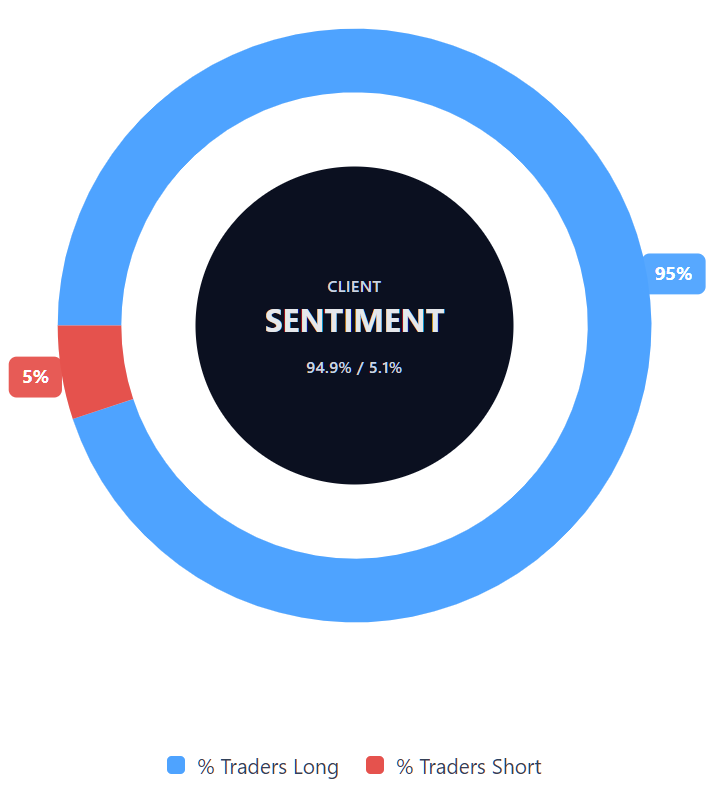
As of 15 January 2026, Capital.com client positioning in Saab CFDs is currently heavily skewed towards long positions, with 94.9% buyers versus 5.1% sellers, leaving buyers ahead by approximately 89.9 percentage points. This reflects a strong directional bias in open positions on the platform, although the distribution can shift quickly as positions are opened or closed.
Summary – Saab stock price
- Saab (SAAB_B) rose from around 233.3 SEK in mid-January 2025 to the low-500s SEK by year-end, representing a substantial re-rating over the course of the year.
- The share price recorded particularly sharp moves during April–May 2025, and again into the second half of the year, with phases of strong gains followed by consolidation.
- Technical conditions into late 2025 showed price holding above rising medium- and long-term moving averages, consistent with a firm upward trend structure.
- Defence-sector developments and order flow, including long-cycle programmes across air, naval and sensor segments, helped keep Saab in focus for market participants throughout 2025.
Past performance is not a reliable indicator of future results.
FAQ
Who owns the most Saab stock?
Saab AB has a concentrated ownership structure, with the Wallenberg family, through Investor AB, holding the largest share of voting rights. While their capital ownership is lower than their voting control, this structure allows for long-term influence over the company’s strategic direction. In addition to cornerstone shareholders, Saab’s class B shares are widely held by institutional investors and traded by retail participants on the Stockholm exchange, contributing to ongoing market liquidity.
What is the five-year Saab share price forecast?
There is no single, reliable five-year share price forecast for Saab, as long-term projections vary widely depending on assumptions around defence spending, programme delivery, margins and broader geopolitical conditions. Most published analyst targets focus on 12-month horizons, rather than multi-year outcomes. Over longer periods, Saab’s share price has historically moved through cycles of re-rating and consolidation, highlighting the uncertainty involved in extended forecasts.
Is Saab a good stock to buy?
Whether Saab is considered a 'good' stock depends on an individual’s objectives, time horizon and risk tolerance. Supportive factors often cited include its sizeable order backlog and exposure to defence programmes, while risks may include execution challenges, valuation sensitivity and reliance on government budgets. As with any listed company, Saab’s shares can experience volatility, and this information is provided for educational purposes only and does not constitute investment advice or a recommendation.
Could Saab stock go up or down?
Saab’s share price can move in either direction, influenced by factors such as contract announcements, earnings results, defence policy decisions and broader market sentiment. Developments related to order intake or delivery progress may influence pricing, while delays, margin pressure or changes in defence spending priorities could have the opposite effect. Short-term price movements may also reflect technical factors or shifts in trader positioning, rather than fundamental changes alone.
Should I invest in Saab stock?
Deciding whether to invest in Saab stock requires careful consideration of personal financial circumstances, objectives and risk appetite. Shares in defence companies can be affected by political decisions, long project timelines and changing market expectations. This article provides factual, educational information only and does not constitute financial advice. Anyone considering an investment may wish to conduct their own research and, where appropriate, seek independent professional guidance.
Can I trade Saab CFDs on Capital.com?
Yes, you can trade Saab CFDs on Capital.com. Trading share CFDs lets you speculate on price movements without owning the underlying asset and to take long or short positions. However, contracts for difference (CFDs) are traded on margin, and leverage amplifies both profits and losses. You should ensure you understand how CFD trading works, assess your risk tolerance, and recognise that losses can occur quickly.